YOU CAN SEE EVERYTHING Review: A Dizzying, Revolutionary Doc That Challenges The Integrity Of The Form

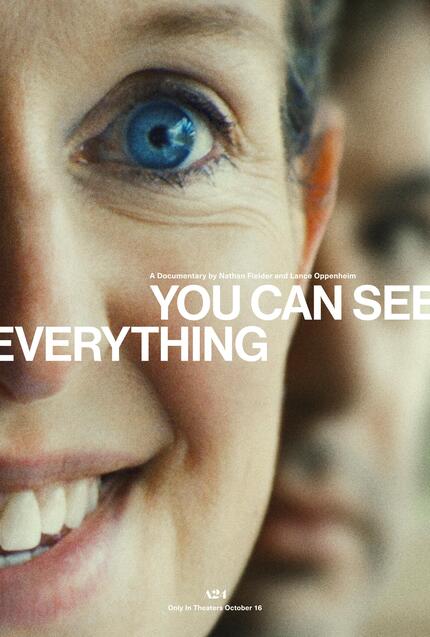
One of the first related searches that Google offers up when you type in the title of anarchist/documentarian/comedian Nathan Fielder’s latest project is, “Is You Can See Everything a real documentary?”. That is a question that will roll around in my head for the foreseeable future as I attempt to wrangle my understanding of this mind-bending experiment into any kind of neat little box. It’s a fool’s errand, and I suppose I am that fool.
Thirty-four days before convicted fraudster Elizabeth Holmes was set to begin a 123-month long sentence in federal prison, she and her husband Billy Evans invited Fielder into their lives to document the real person behind the monster Holmes insists was created by the media coverage around her trial and conviction. One can only imagine that the couple had relatively little understanding about the totality of Fielder’s work, because if they had, they might have understood that this was never going to a puff piece, no matter how delicate and guileless Holmes presented herself to be.
The resulting document of Holmes and Evans’s lives with their two young children is stunner. A dizzying, confounding, aggravating, enlightening, obfuscating, and downright explosive circus of what appears to be intensely naïve optimism crossed with a level of avaricious cynicism that is truly dazzling to behold. And even that assumes that you believe everything you see.
Fielder employs the same level of attention to detail and willingness to go to any length to achieve his goals that he first brought to the public in his genre-defying unscripted comedy series Nathan For You and has since honed to a fine point in The Rehearsal. Fans of either of those series know that Fielder is not one to cut corners or shy away from what he sees as the deeper truths of any situation, and he brings that tenacity to Holmes’s story while still attempting to engage with her and Evans on a human, empathetic level.
That is, until he feels that they may be trying to take advantage of him. Then, it’s on.
At a hair’s breadth short of three hours, You Can See Everything delves deep into the psyche and dynamics of this ambitious couple. Holmes continually insists that she has nothing to hide while Evans seems to spend every waking moment attempting to guide Fielder’s narrative in such a combative fashion that it quickly becomes clear that this is not what he thinks he signed up for.
As Holmes’s surrender date draws closer, Fielder tries with all his might to get to the root of who she is and what she believes. When that truth seems elusive, everyone in the doc starts to question what they are really doing, and when Nathan Fielder feels like he’s not getting the whole truth, you better believe he’ll do anything – no matter how outlandish – to find it.
You Can See Everything can be understood in a thousand different ways by a thousand different viewers. Is it a battle of wits between a dogged investigator and a cocky charlatan? Is it a game of chicken between two teams of master manipulators? Is anything we see on screen even real at all, Fielder veterans will know that it’s not that simple to see the difference between the truth and a carefully constructed façade, but has he met his match in Liz Holmes and Billy Evans?
Before our press screening, my audience was treated to a brief message from Fielder and his co-director, Lance Oppenheim (Primetime), entreating us to be judicious in the way we describe the film. We were asked to preserve some of the film’s surprises to allow the audience to enjoy the discovery the same way we were allowed to, and it was absolutely the right call. If there’s anything that one can be certain of with Fielder, it’s that you never know what’s coming for you in the next five minutes, and the final hour of You Can See Everything is an absolute showstopper that somehow manages to top even the incredible first two acts of this monumental cinematic artifact.
The stories uncovered in You Can See Everything put the audience perpetually off-balance. Just when you think you’ve got it figured out, five minutes later, a new revelation makes us question everything we’ve seen and heard up to that moment. Even as the film builds to its absurdist crescendo, the question of what is real and what is manufactured leaves just enough doubt in our minds to wonder if we ever got the real story. With Fielder at the helm, it feels like this is the closest we’ll ever get to a genuine truth, and it is ugly, confusing, optimistic, disturbing, and wildly entertaining.