
Chicago 2026 Interview: THE SPIRAL Writer/Director Paolo Strippoli on the Nobility of Horror and Cinema's Need for Excess

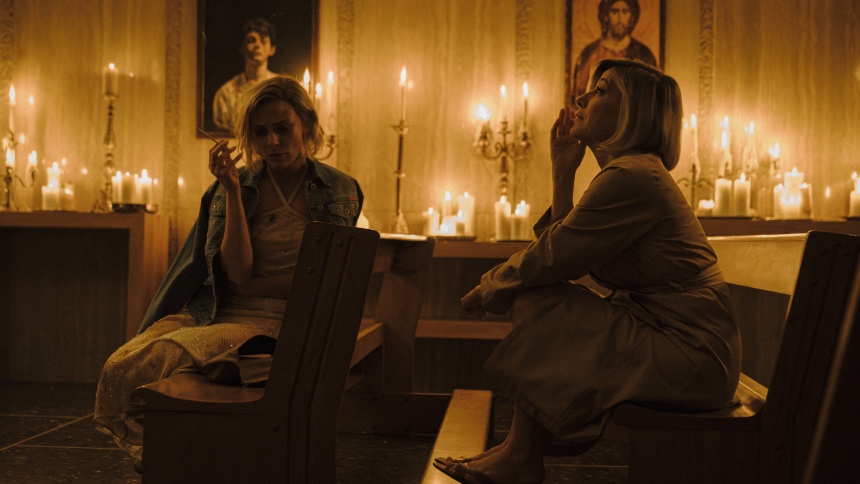
In his review of Paolo Strippoli's new film The Spiral, Martin Tsai writes about how the film presents a "recognizable family drama" that is ruptured by "horror [that] feel[s] like a violation of the film's carefully cultivated normality."
In fact, at one point Martin uses the same word Strippoli used in a conversation I had with him at the 62nd Chicago International Film Festival: "incursion." It's a remarkable instance of a filmmaker's stated intention landing perfectly.
And it's not the only instance of it in The Spiral that Strippoli and I discussed. From Saw and zombie film references to casting the perfect person to balance complex tone, Strippoli highlighted several choices that went into communicating exactly what he wanted to an audience. We also talked about the craft of image creation, making a distinctly Italian film, and using the horror genre to say something about the contemporary world.
You can read our conversation, which has been edited for length and clarity, below.
ScreenAnarchy: So as a huge SAW fan when I first saw the bully character wearing the Billy [the puppet] shirt I was a little upset. I thought "oh no! Are we using SAW to characterize a villainous person?" But then towards the end, which I of course won't spoil, I thought, "maybe this is a loving shout out to SAW."
Paolo Strippoli: It is. Because I really love the Saw franchise. And, of course, it has spirals. [chuckles] It's a loving homage to Saw. Also that scene is set in 2005 [a year after the first Saw's release] and I wanted this pop culture reference on the shirt.
Did you ever think about setting it in a different period? Or was it always going to be 2026 is the present and we're going to start in the 90s? Because the 2006 Italian World Cup victory plays a large part in the movie. Was it always going to be the present and you went "great, I can write the World Cup into it"? Was the World Cup victory part of the decision to set it specifically in this period?
No, the decision came from the fact that I wanted [protagonist] Alice to be my age. I wanted the point of view character to be my age and to go through the same pop culture references as I did growing up.
So we have in '99, these incredible white parties with the Bari bourgeoisie. I wanted this film to feel Italian and I wanted that exact setting at the beginning of the movie. I decided to set it in Bari in '99 because it was a moment of incredible economic, industrial growth. And there was the rise of this new bourgeoisie. They were new money, people who built themselves brick by brick. And they didn't want to see what they'd built fall down. And for me, that moment, that setting was incredibly fertile for this story.
You've already sort of answered another question I was going to ask you. Which is that in English, we have the idiom "keeping up with the Joneses," to describe the competition between neighbors - needing to have a nicer car and all of that. And of course that exists in many cultures, but it seems that there's a very specifically Italian form of it.
I wanted it to feel specifically Italian, because of course it's a Faustian bargain movie. It's a "be careful what you wish for" movie. And we don't have that many movies in Italy with this kind of story. I didn't want it to feel like an American or European movie. I wanted it to feel Italian. And so the setting helped me to be as specific as possible. In spite of the story, which, of course, reminds us of older cinema references.
Right, who knows how many Faust movies there are.
A lot! And I really love them and I think it is an incredible device to tell contemporary stories and to explore the obsessions of contemporary society.
Globally there's this increasing respect for horror and what it can do, can you talk about using genre elements to tell all kinds of stories?
I think horror is the most noble genre in the world and I think it gives you an incredible chance to say something about the contemporary world through an entertainment device and through the fantastic filter.
There is an ongoing conversation in Italy about whether this film is a horror film or a drama or a psychological thriller. And I'm very bored by that because I think we live in a moment in which there is fluidity, and in movie genres also. And I think it's a beautiful thing because when a director starts to write a story, he doesn't think, or shouldn't think about what genre it is, because the story commands, the story guides you.
I started shooting this film as a psychological thriller, but I knew I wanted to have pure horror incursions. I wanted to create an elegant style and I wanted to break it constantly with campy and trashy incursions of the horror genre. Very violently because this film is about not being able to accept life as it comes. And life happens, without ever asking for permission, in very violent ways. And that's the genre tropes in this movie for me. Life incursions breaking the elegance, the good taste of this family.
I wanted moments of bad taste in a good taste style structure. I always felt this film should be excessive. In my previous films, even though they were more horror based, I always tried to find a measure. But seeing how the world is right now - I look at the media, I look on my phone - and we live in excessive times. And cinema should be more excessive than the reality. My only way to be honest is to be at least as excessive at the times we live in, as crazy at the times we live in.
On the point of excess, for me the most memorable image in the movie is after the World Cup victory and [Jasmine Trinca's character] Anna is driving through these crowds and this man in full Italian flag body point jumps on top of a car and then there's fireworks.
I think that man represents the violence of the joy of that moment. I cannot help but think that if you want to find a genre for life, it's not a drama, it's not a comedy, it's a tragedy. And tragedy is made by the contrast at the same time of happiness and pain. And I remember that day, during the World Cup win I was a kid and everyone was so happy. There was joy and an euphoric feeling in the air, and a sense of community that I never felt before or after that moment.
But the reality of life at the end of the day is that that day, that night while everyone was partying, someone was suffering. We are here in this beautiful film festival, and someone around us is grieving, or feeling pain, or in a horrible situation. So I wanted to subvert that moment. I wanted to shoot that moment from the perspective of a woman who was going through one of the worst moments of her life inside that car, with all the joy and euphoria outside the car.
And the only way I could think of shooting it was like a zombie movie. I tried to make a zombie scene. Because if you think of all these painted people, they laugh and cry for joy and scream and sing. But when you are in that moment in the place of Anna and you just want to go through, you cannot go through because they are like zombies, and they are ugly because they laugh too much and they are all painted but it's not precise colors on their faces because they mix with the sweat. And for me it was just like a zombie movie, there was the final boss in that scene, and it's the painted man.
It's a really striking image. Do you storyboard? Was that image always in the script?
It was in the script, but not exactly as I shot it. So then I found a way of shooting it by storyboarding it. I don't like to storyboard but when I have crowds or complex VFX or prosthetics, I need to storyboard because if you have to shoot fast, the crew has to know what you are doing and what you want. We didn't have a huge crowd and we had to maximize the effect of these people so, I didn't storyboard it for the sake of the beauty of the scene, but only for logistic reasons.
Do you not like the storyboard so that you have more options and can be more flexible while shooting?
I tend to fall in love with images and when you storyboard something you think "okay, this is a great image," you just don't think that there could be a better option. And I think when you are on set and you have people in front of you and the location and production design and all that stuff. I think that's the moment you should decide. Of course, you cannot do that every time because time is money in the movie industry. But I think that's the exact moment you should make decisions.
And if you have an idea - and you always have to go on set with an idea - you have to be ready to change it. And storyboarding sometimes makes it more difficult to change your idea. Sometimes the best things come when you change your mind and you have to be ready to change your mind. That's the duty of the director, changing your mind.
Speaking of your actors, Jasmine Trinca and Valeria Bruni Tedeschi are both incredible in this movie. And then you also have the three ages for both Alice and Tobia. Can you talk about the casting process?
Well, Jasmine Trinca as well as Romana Maggiora Vergano, Alice's actress, and Valeria Bruni Tedeschi as The Stranger, and Adriano Giannini as Walter. I chose them without casting because they are pretty famous actors in Italy. I wrote the script thinking of Jasmine Trinca and Adriano Giannini. I [initially] had another actress in mind for Alice, but I got fixated with Romana so I chose her.
Valeria Bruni Tedeschi, I love her. She is one of my favorite actresses. I especially love her in French movies. She's a French actress, she was born in Italy but she moved to France when she was 7 and she works mostly in France. I was thinking of other actresses at the beginning because I wanted the scenes with the Stranger to be bleaker in a way. But then, I don't know what happened to me, but I started to have nightmares about those scenes because the things she says are so cruel. And every time I had to go through those scenes I felt "fuck, I don't like to work on [these scenes]." And I said, "okay, this is a problem, because every villain that I like in movies is always, yes very dangerous, but also sexy, and funny, and sensual in a way."
So I changed my mind. I thought about Valeria Bruni Tedeschi and I wrote the character for her, knowing that she could say the things I wanted the Stranger to say, with the same amount of cruelty, but in a lighter way - with elegance, which is very dangerous, but also funny. I wanted that character to be funny. I wanted people to wait for her, not to say, "fuck, I don't want to see her again. She's too cruel." She has to be cruel, but I wanted people to laugh at the cruelty. And I really loved during the Toronto Film Festival, people were laughing all the time during the Stranger scenes. And after the screening, two kids came to me and said, "Paolo, we were laughing during the Stranger scenes, but now we feel guilty." And I was very happy when I heard that because that was exactly what I wanted.
And then the kids, that was the most difficult part for three reasons. Because I had to find actors who looked similar to each other, but at different ages and in different shapes. And also because I wanted kids from Puglia, I didn't look for experienced actors. I wanted this to be their first experience. And the third reason it was difficult was because there are very dangerous, sensitive scenes with them [in The Spiral]. And I looked for kids who could handle that. So it was a year-long process of street casting in Puglia. And I was very scared of hurting them and I had to change my mind several times to find not only the best kids who could act or could be on set, but also kids who could handle those roles. And I was very lucky to find them. We became family. They are so proud of the film, they are so proud of the experience and they had fun even though they had to do very difficult stuff.
I'm so glad that you already touched on the sensuality of the Stranger, because that's something that really struck me and I wanted to ask about. In a Faustian story it's very easy to make that figure removed and more supernatural. But the Stranger is so physical. And there are those moments where she is coming onto Anna and it seems like Anna might even be responding to that. I wanted to ask you about the decision to make her so carnal.
That was in script but Valeria Bruni Tedeschi dialed that thing to 11 [chuckles]. It was so fun to see their interactions. Anna is so stiff in real life, she's sexually blocked in a way. I don't even know if she has sex. I had a sex scene with her husband that I shot and I cut it, because I didn't want to see Anna having sexual relationships outside of the Stranger scenes.
That woman [Anna] represses herself, it's not the world that represses her. She finds it inconvenient to be free. During the Stranger scenes, I wanted her to be free. There was a sense of physical contact in the script, but then Valeria was very carnal. And with Jasmine, we found this idea that not only did Valeria have to be carnal with her, but even when Jasmine tried to reject her and push her away, she had to do something very weird and contradictory. You can see, she tries to push the Stranger away, but with her mouth and with her chin, she is on the Stranger's neck and she continues whispering at her, kissing her, and the idea was they want the same thing. They want to be free and to carnally attack each other. Because it's a moment of liberation for them.
The film screened at the 2026 Chicago International Film Festival.


