
Chicago 2026 Review: THE SPIRAL Turns a Family Story Into a Faustian Nightmare
In the Italian Oscar entry, the family that makes a deal with the devil stays together.

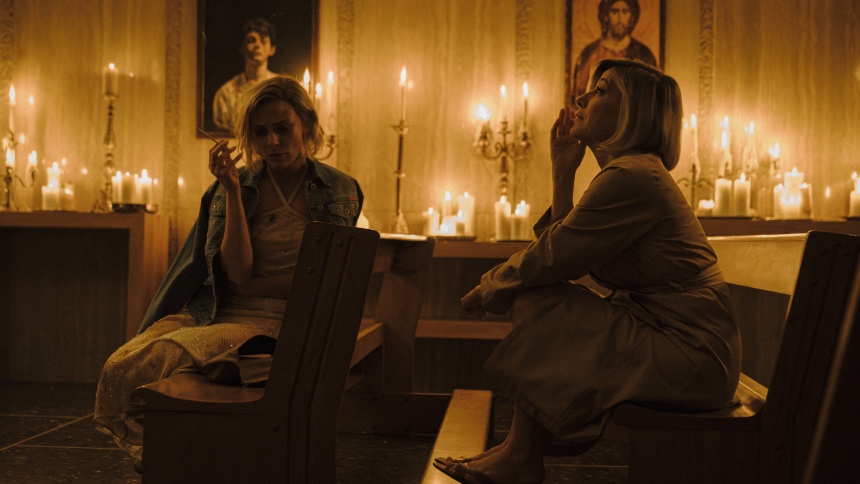
Paolo Strippoli's The Spiral is shaping up to be the most high-profile horror film to emerge on the international festival circuit since last year's Frankenstein and 2024's The Substance.
Having screened in Venice and Toronto, the film has also been selected as Italy's submission for the Academy Award for Best International Feature Film, adding an Oscar-season dimension to its journey to the Chicago International Film Festival. But its most interesting distinction may be the way it conceals its horror credentials in plain sight, allowing an apparently ordinary family history to curdle into something altogether more sinister.
At Venice, I noticed a curious kinship between The Spiral and its fellow competition title, Casey Affleck's Company. Both films withhold their generic identities until late in the game, structuring their narratives around storytellers whose accounts prove less than trustworthy, in the tradition of Verbal Kint in The Usual Suspects.
Yet the resemblance ultimately throws their differences into relief. Company offers little persuasive reason for its protagonist to recount her tale beyond the filmmaker's evident pleasure in the mechanics of narrative deception. In The Spiral, by contrast, the retrospective storytelling is not merely an elaborate exercise in misdirection; it lays the groundwork for a series of increasingly deranged actions. Here, the story is not simply a puzzle to be solved. It is a prelude to the reckoning.
The Spiral opens amid a downpour, as Anna (Jasmine Trinca) arrives unannounced at the apartment of her daughter, Alice (Romana Maggiora Vergano), insisting that she has something urgent to discuss. Alice is so blindsided by the visit that she must improvise an explanation for the presence of Lucille (Mathide Serre), who appears to be her live-in girlfriend: She is, Alice tells her mother, a director there to workshop a sketch with her. The awkward subterfuge establishes an immediate tension between what this family is willing to acknowledge and what it would prefer to keep hidden. Though her urgency initially has Alice wondering if someone died, Anna then takes her sweet time rehashing the family history.
She takes us to Bari in 1999, which sees the family enjoying a life of considerable affluence in a palatial home financed by the success of Walter (Adriano Giannini), who has transformed an inherited mom-and-pop shop into a prosperous business. Their fortunes seem to be ascending further when 7-year-old Alice (Gabriella Telegrafo) lands a part in a Barilla commercial. But the promise of child stardom is abruptly derailed when she suffers a serious injury in a dog attack.
Strippoli does not spare us the graphic particulars of the encounter, which briefly introduce a note of bodily horror. Even so, the scene registers less as a declaration of the film's genre than as an unpleasant rupture in an otherwise recognizable family drama. The wound is visible; the nightmare has yet to reveal itself.
That transformation begins in a hospital chapel, where Anna, praying in desperation, is approached by a stranger (Valeria Bruni Tedeschi) offering what amounts to a Faustian bargain. Anna accepts, without fully anticipating that her decision will inaugurate a succession of deals with the devil, each carrying consequences that spread through the family and compound the stakes.
Strippoli's handling of this supernatural premise is strikingly restrained. Rather than announcing the arrival of the fantastic with a barrage of portentous effects, he lets the unearthly insinuate itself into the everyday, the film maintaining a matter-of-fact register that makes the bargain feel less like an incursion from another world than a terrible extension of the one we already inhabit.
The narrative device complicates matters further. Everything we know of these events comes through Anna, whose account is delivered in retrospect, leaving open the possibility that her version of the family's history is distorted by desperation, guilt, or some less readily identifiable pathology. Perhaps she is mentally unbalanced; perhaps the supernatural machinery is a construction of her own mind. Yet the film never seriously presses the question of her sanity, and its restraint cuts both ways: The ambiguity lends the story a welcome unease, even as it asks us to accept Anna's account without fully interrogating the consciousness through which it reaches us.
As in Company, the present in The Spiral initially seems insulated from the past, as though the act of recounting could be kept separate from the consequences of the events being recounted. But where Affleck's film leaves the narrator's purpose frustratingly opaque, Strippoli gradually reveals why Anna has come to her daughter and what she hopes to accomplish by telling her story. The present-day encounter is not a framing device that the film can simply discard once its flashbacks have done their work. It is the mechanism through which the past acquires its terrible, immediate significance.
In The Spiral, storytelling is less an act of remembrance than a way of preparing the ground for horror. Anna's tale, initially delivered with the apparent remove of a family chronicle, becomes the instrument through which the film's disparate pieces converge. What seemed like an extended detour into the family's past turns out to be a calculated approach to the present, and the narrative's delayed revelations acquire force precisely because Strippoli has resisted the temptation to telegraph them.
The film's slow-burn method is therefore more than an exercise in withholding. By keeping its supernatural elements at a distance and allowing the family drama to establish its own plausible rhythms, Strippoli makes the eventual eruption of horror feel like a violation of the film's carefully cultivated normality. By the time the film reaches its climax, the understated proceedings have furnished the horrors with something more potent than shock value: the accumulated weight of everything we have been led to accept.
The film screened at the 2026 Chicago International Film Festival.


