
Netherlands 2026: DOWNTOWN Opens Festival, Wins Dutch Film Critics' Award

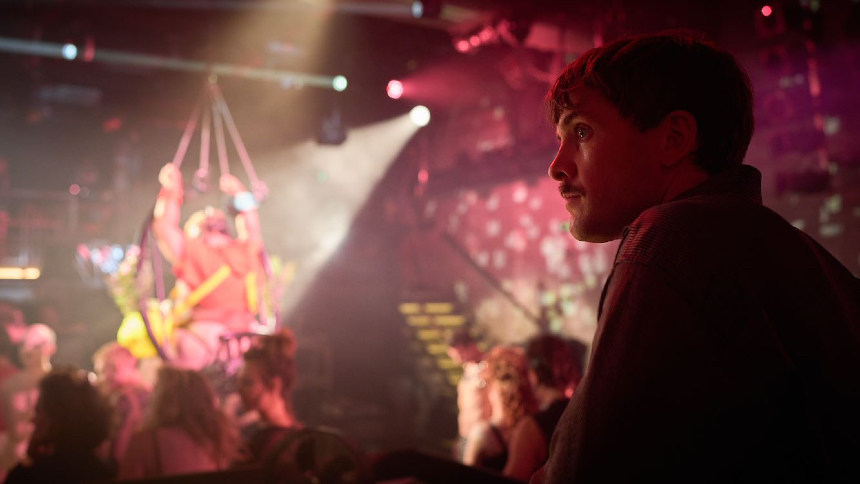
There's something special going on with Michiel van Erp's new film.
That the cast and crew received a standing ovation at the opening of the Netherlands Film Festival (NFF) last Friday isn't all that unusual (festival opening, enthusiastic audience), but here something different seemed to be happening. First there's the film's subject: three men who, in the midst of one epidemic, corona, look back on another, entirely different but even deadlier epidemic of the 1980s, and on their lives and love within it.
What's special about it, and it's easy to forget this after the largely positive reception, especially from the Amsterdam in-crowd and the media around it, lies particularly in the film's dramatic structure and execution, which is nearly flawless.
Of course, the film does something Dutch feature films have barely done before: it portrays the onset and aftermath of the HIV/AIDS crisis of the 1980s in Amsterdam from the inside. It's also notable that the roles of the three friends (Ron, Lennart, Bas), lovers back in the 1980s, are played 35 years later by older actors. They look back, and the viewer looks back with them.
An important layer of meaning here is that the three older friends see each other again in 2021, in the midst of the corona epidemic, an epidemic that, in its own way, was just as deadly, given how much more widely it spread, as the HIV virus. It was a cruel irony of fate that both viruses had their own target groups: HIV mainly affected promiscuous gay men and Africans, while corona mainly struck the elderly and people with weaker health.
The young men back then, played by Daniël Cornelissen as Ron, Sebastián Mrkvicka as Lennart, and Thor Braun as Bas, have grown old by the film's present (around 2021). Now, in the same order, they're played by Yorick van Wageningen, Hans Kesting, and Roeland Fernhout. Their characters remain clearly recognizable: the driven, responsible Ronnie, the volatile Lennart, and the carefree, somewhat naive Bas, both in their 1986 versions and in our very recent past of 2021.
In 1986, during the height of the HIV epidemic in Amsterdam, those three young men don't look ahead, not only because they're young and living life to the fullest, but soon after also because the HIV virus makes any speculation about the future unstable for them.
Frank Houtappels' screenplay is precisely constructed, cleverly and "imperceptibly" weaving flashbacks and flash-forwards together. The real story is that of a disaster that befell an entire, carefree subculture living life to the fullest, a disaster that mirrors the corona pandemic, which likewise picked its own victims, this time based less on promiscuity and more on physical resilience.
The direction and the acting are just as precise: the volatile Lennart, the cheerfully carefree and somewhat naive Bas, and the most mature of the group, Ronnie. Young and old alike, they're all drawn with just enough character, beyond themselves, to carry the kind of universal traits that let viewers, whether male or female, gay or straight, relate to them.
While ultimately this is a drama about "the illness," about "the virus" (with corona as a kind of modern-day, "childhood" counterpart as its contemporary backdrop) set in the specific biotope of Amsterdam, the film, through its clever use of narrative techniques (a grand love story, a love triangle, time jumps, and a kind of parallel with the corona epidemic), manages to rise above being a genre film defined purely by sexuality or illness.
That wasn't the intention of the filmmakers, director Van Erp and screenwriter Houtappels. Of course they wanted to make a good film, but they also explicitly wanted to make a film about the HIV epidemic in Amsterdam at the time. Judging the film primarily on that latter intention, however, does it an injustice.
The acting, like the direction supported by the editing, sits precisely on that fine line separating good performance from overacting or underacting. The "older" portion of Downtown is conceived, made, and performed as a kind of Chekhovian character drama, with the caveat that in the time and country of the Russian master, there was of course no wild, untamed gay club scene like the one at the MAZZO, complete with all the late-20th-century affluence that had already largely leveled out the differences between spoiled boys like Lennart and more ordinary strivers like Bas and Ronnie.
The skillful use of narrative technique, together with the acting and the mise-en-scène, makes Downtown, for all its relatively uncomplicated story, genre film or not, an excellent film.
A jury from the Kring van Nederlandse Filmcritici (the Circle of Dutch Film Critics, consisting of Sasja Koetsier, Nico van den Berg, and Ronald Glasbergen) unanimously chose Downtown as the winner, praising its direction, acting, and its smooth, compelling storytelling for making Downtown a universally human drama.



-thumb-80x80-107109.jpg)

