Locarno 2026 Interview: THE DAYS OFF Filmmaker Lucila Mariani Discusses Internet Nostalgia

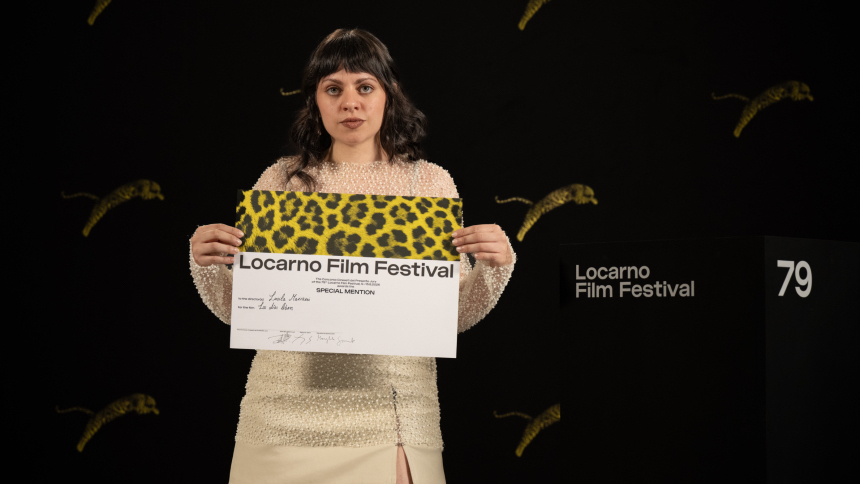
Argentine filmmaker Lucila Mariani makes her feature debut with The Days Off, awarded a Special Mention in Locarno’s Concorso Cineasti del Presente.
Set during an endless summer in the near future, the film follows 12-year-old Bego as an approaching solar eclipse, a mysterious online friendship, and the practice of “shifting” draw her towards alternative realities.
Mariani talked to Screen Anarchy about reclaiming the early internet as a space of anonymity and connection, using the eclipse to evoke adult complacency, blending genre with intimate realism, and turning an international production, and music itself, into a shared creative language.
Screen Anarchy: THE DAYS OFF is set in the near future, yet its images evoke an earlier digital era. What interested you in constructing the future through retro aesthetics, and whose nostalgia are we experiencing, given that Bego is too young to remember that version of the internet?
Lucila Mariani: It was the need to want to mix my own memories with the characters’ memories.
At first my film was set in 2001, during a huge socioeconomical crisis in Argentina. When I decided to set the film in the near future, I still wanted to keep some of that nostalgia. I feel it’s a film for people who lived in the same era as me.
You describe the film as a love letter to an internet that no longer quite exists, a space of discovery, anonymity and refuge, but also of uncertainty. How did you balance affection for that world with its more unsettling possibilities?
I think I choose to focus on the positive aspects of it. Internet can be a dark space, especially now that it focuses so much on our image.
But it used to be a place for anonymity, where you could be yourself and no one knew you. And I think that’s why it used to be so honest and why it was so easy to make such strong friendships. I think there are still some forums and places where you can find that, but now it is a mainstream place, whereas it used to be a place for alternatives.
Why was it important to place Bego at the age of 12, on the threshold between childhood and adolescence? How did the “endless” summer break help you portray coming of age as a state of suspension rather than a series of conventional milestones?
The reason I’m a filmmaker is because I want to show people in a vulnerable, intimate place. The place where you never get to see from your friends, family and even your partner. You can only access that secretively through storytelling. And being bored, especially as a child during the summer with no pressures, no responsibilities at all, really helped me to observe this.
I also wanted to portray how kids are left behind in some adult matters, such as economic instability, yet they are aware of everything that is going on. That was the starting point.
The title THE DAYS OFF suggests both freedom from routine and a period in which the usual rules have been suspended. What does this unstructured time allow Bego to discover, or perhaps invent, about herself?
I think she uses that time to explore the different versions of herself that she could become, as we all do between childhood and adolescence. I think in the end there is a film about accepting who you are and going along with it, even if it’s not that comfortable.
The approaching eclipse operates as both a physical event and a metaphor; the synopsis says that people and animals around Bego are being “eclipsed.” How did you use this motif to deepen the film’s mystery without reducing it to something the audience must simply solve?
I wanted to use the metaphor to show how people sometimes ignore what is happening around them. They just get used to it. And I think there is something interesting about being a teenager, that energy, that you feel like you are never going to end up becoming the thing you hate.
Then, you grow up, and you hang out with people you don’t like, you have to do things you don’t like, and I feel like sometimes, only sometimes, it is a good thing to go back to that energy. To feel strong enough to stand up for what you believe that is something that happens a lot during adolescence and that I admire about teenagers.
“Shifting” exists at the intersection of lucid dreaming, online community and a belief in alternative realities. What drew you to this phenomenon, and how did you decide what the film would treat as psychological experience, adolescent imagination or potentially supernatural reality?
I always knew that as a filmmaker I wanted to blend genre with a more realistic cinema. I think that is what I’m good at as an artist. I wanted to have two metaphors, one for the people around Bego, the eclipsed, and one for the internet as an escape, shifting.
I discovered shifting during the pandemic and, navigating through forums and Discord, I realized those teens were feeling exactly like me as a teen, exactly like Bego. And the fact that is a form of storytelling was really interesting for a film.
Some viewers may connect the film to Jane Schoenbrun’s I SAW THE TV GLOW, since both use retro media, genre and an alternative reality as refuges for a young person struggling with identity and belonging. Did you feel in dialogue with that film, and where do you see THE DAYS OFF taking a distinctly different path?
I think there’s clear dialogue between the films, mostly because I think me and Jane Schoenbrun grew up in a very similar world, both being very online, at the same “era”. I guess there is also the fact that you can’t escape a certain contemporary vision and sensibility.
But I think both films explore identity in a very different way and with different intentions. I think that the real world is more important for me than it is for her, not in a bad or good way, I think my film is settled in the real world, and exploring real relationships outside the character’s relationship with media, whereas I feel she tries to create an alternative version of the world, taken by media.
The film appears to move between coming-of-age drama, mystery and horror without settling completely into any one genre. How did you calibrate that instability across the cinematography, editing, sound design and color palette so that the retro elements would feel emotionally meaningful rather than merely nostalgic?
To be honest, it’s hard for me to answer this because I do it in a very intuitive way, I don’t really know exactly what it is but just following my instincts. I think I’ve been trying to create this kind of mood or vibes even through my shorts, so it’s basically the way I know how to direct. I guess it’s all about being honest with yourself, in a way, and following whatever feels good for your art.
Apart from that, I worked very closely with the cinematographer Victoria Pereda, the editor Maximiliano Passarelli and musician Punto y Pacífico. With Victoria, we even started at a real eclipse and shot it together; we had a sort of sleepover and lighted candles to ask the universe to let us shoot my film.
With Maximiliano, we only had six weeks of editing so we also became very close and it was very sweet for me to spend so much time with him, his cats, his girlfriend, I felt very taken care of.
With the musician we did many drafts of the songs even from last year, and together with the cinematographer we used those drafts during shooting, following the steady cam listening to those songs, trying to communicate with the crew, who spoke Portuguese, through that language as well.
It was great. I remember also going to set and the art crew were always preparing stuff before while listening to a Spotify playlist that I made as a “vibe” for the film. We were all trying hard to create this atmosphere during every phase of the preproduction, shooting and editing, and I think it shows. I was very lucky to be put together with people that truly appreciate art and crafting it.
Bego’s relationship with REN__, an online friend, seems central to the film’s exploration of female identity and connection. How did you work with the actors to give an apparently mediated relationship the same emotional and physical presence as the relationships in Bego’s offline life?
Actually, since REN__’s actress Luiza Quinteiros doesn’t live in Argentina and Bego’s actress, Antonia Robolini does, we actually did a couple of Zoom [sessions] together. Just reading some dialogues, trying to understand how the characters would feel about each other. It was very sweet.
The casting for Brazilian actresses was really interesting because, since I wasn’t there before the shooting, they could only send me prerecorded castings, and it really worked, because basically that was what I needed to see. As soon as I saw Luiza, I knew she was supposed to play the character.
She holds this anguish as she was reciting the texts. I feel so lucky to have met her. Before shooting REN__ scenes in Brazil, I asked Antonia to join me and Luiza in a studio and we recorded, together with the sound directors and technicians, all the voice-overs in the film. It feels so intimate, just the three of us on the floor, around a microphone, reading the lines. They connected very quickly, they are really great. Mostly it was about making everything intimate, and people responded to that.
THE DAYS OFF is an Argentina-Brazil-Mexico-France co-production, made in Spanish and Portuguese. How did THE international process shape the finished film, and how did you preserve the cultural specificity of Bego’s world while preparing it to speak to international audiences?
This is a very interesting question because I feel like in general, coproduction, when it’s not needed by script, really tends to fuck films up. I was very worried about this, but the Brazilian coproduction literally saved my film. It was not going to be made unless we shot it there, and so I decided to trust my destiny and the film’s destiny, and it came out so great I actually see myself doing another film in Brazil.
I think what really made it work was the fact that we had a character that could be from literally everywhere, and the distance, the physical distance, between Bego and REN__, allowed me to explore the fact that they can never be together. Some people told me they read that romantically, but everything is romantic when you’re a teen.
Admiring someone can be very platonic. I think it took me so long to make this film that I knew every detail about their world, I could answer any question about my characters, and that’s why it was so natural to speak to the crew and be like “this works for Argentina, this doesn’t” and at some point I also started choosing locations despite working for Argentina, or not, because I realized it wasn’t important for the film anymore.
I was very worried about that and the cinematographer pushed me in that direction, which I appreciate so much. I think it’s a film that feels very international and will speak, I see it now as the reactions from Locarno and how it was received, to many other people who had a similar experience with internet, and not fitting in. It’s the nature of the film, I just went with it.
Image courtey of Locarno Film Festival / Ti-Press.