Locarno 2026 Interview: MANHUNT Director Wayne Wapeemukwa on Humanizing Killers, Settler Mythology, and Cinema Without Sermons

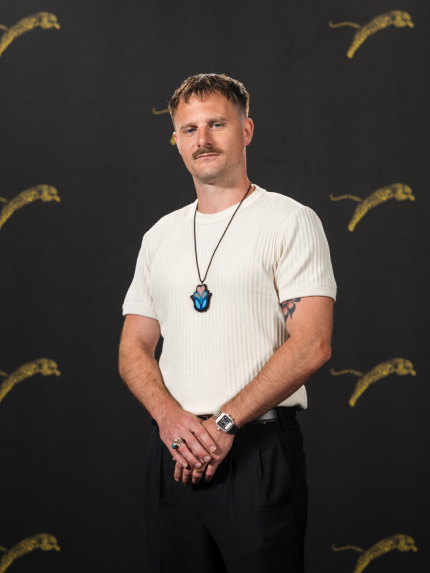
Canadian filmmaker and philosopher Wayne Wapeemukwa has built his work around the intersection of poetic realism and political inquiry.
His 2017 debut feature Luk’Luk’I won TIFF’s Best Canadian First Feature Film award for its collaborative portrait of marginalized lives in Vancouver’s Downtown Eastside. His sophomore feature Manhunt world-premiered in the Concorso Internazionale at the 2026 Locarno Film Festival.
Co-written with Anna-Lena Theobald, Manhunt draws its initial inspiration from the 2019 Northern British Columbia murders, following two alienated young men whose attempted escape from a depleted rural community descends into misogynistic violence. Wapeemukwa emphatically avoids the conventions of true crime, instead examining why Canadian society gravitates toward sensational killers while overlooking the continuing dispossession of Indigenous peoples.
The film reframes online gaming, masculine isolation, and the mythology of the frontier through a settler-colonial perspective, with Indigenous knowledge providing both its narrative frame and an alternative to the protagonists’ militarized nihilism.
Speaking with Screen Anarchy, Wapeemukwa discusses Manhunt as a contemporary reworking of Taxi Driver with the influences of Scorsese, Haneke, Bresson and Malick. He also details the street casting of nonprofessional leads Harris Lowe and Landon Tunold, an improvisational three-week shoot in which accidents became material, and the resistance the project encountered from Canadian funders and festivals.
Screen Anarchy: How did MANHUNT begin?
Wayne Wapeemukwa: I was road-tripping through the interior of Canada in 2019. My dad is white, and my mom is of Indigenous and non-Indigenous heritage. I was checking in with relatives and visiting historical sites at exactly the same time as the 2019 British Columbia manhunt.
Two boys from a rural part of British Columbia were also travelling, but with very different intentions. They were on a random killing spree, and the country’s attention gravitated towards them.
I started thinking about how Canadian society gravitates towards sensational true-crime stories instead of the ongoing genocide and dispossession of Indigenous peoples that I was trying to reconnect with on that trip.
The film is inspired by that case, but it is not true crime?
Exactly. The 2019 story was our starting point, but the film draws from several sources.
They came from Port Alberni, a run-down community where natural-resource jobs in fishing and lumber had disappeared. They worked the night shift at Walmart.
I visited the community, and there was very little to do and not much of a future. Even if you get an education, what are you going to do with it?
I can understand why they wanted to take off. What I cannot understand or agree with is the violence. Those were the choices they made.
Sadly, there is no shortage of mass murderers or misogynists. We also researched Columbine and other cases. The women in the film are fictional, the 3D-printed guns are fictional. We made fiction.
The video game in the film initially suggests a familiar story about online radicalization.
The boys in the real case played Rust, and the game in our film resembles Rust, PUBG and Fortnite. In Rust, you harvest resources, shoot people, make temporary alliances and steal to survive. It became an analogue for Western expansion.
Like the boys in the third act, the player is alone, killing people for their possessions and trying to start a new life. We displaced the settler-colonial mythology of North America into the virtual world.
Would you describe Joey and Kit as incels?
They are lonely young men. Technically, if this is a film about incels, Kit is the incel because he is the one who does not get laid, Joey does.
What matters to me is not the label but their misogynistic consciousness, their language, their attitudes towards women, the circulation of non-consensual pornography, and the way sexism motivates the violence. Anna-Lena Theobald, my co-writer, wanted women who challenged the boys’ assumptions that women are dainty, that they are not good at games, and so on. The women are not there simply to confirm the boys’ worldview.
Why was the Indigenous prologue and epilogue so important?
The real manhunt eventually depended on local Indigenous assistance. Indigenous trappers helped search and could read the land through relationships developed over generations, the bodies were subsequently found in that area. The institutions could not close the circle without Indigenous knowledge.
Our prologue is grounded in that history, although the film takes it in a more fictional direction. Manhunt could have been made elsewhere, because there is no shortage of young terrorists, but it would have to be rearticulated through that place’s conditions. To make it in Canada, it had to be grounded in Indigenous values and the history of Western expansion with men, imagining that they can make themselves anew in a new world, and the way that utopian masculinity defeats itself.
Does the Indigenous frame also offers an alternative to the boys’ trajectory?
Yes. It says that we can heal if we reconnect, if we re-family ourselves. Without a real political alternative, young people will look for something else. If they find zero options, they may resort to a militaristic form of nihilism, which is much scarier.
The boys’ real ideologies were irrational and contradictory. They could admire Nazis and criticize totalitarianism at the same time. They were looking for a military, a community, a family, but in the worst possible way.
The film combines slow observational passages with more stylized, almost pop images. What traditions were you bringing together?
European and American references are very legible here such as Michael Haneke, Robert Bresson, Terrence Malick and, in my upbringing, Ulrich Seidl. American viewers often see the American references first.
Somebody described it as a Harmony Korine film directed by Terrence Malick.
Scorsese and Taxi Driver were essential. We were trying to merge different canons.
TAXI DRIVER was the central American reference?
One hundred percent. Travis Bickle might be one of the first incels. Manhunt is a kind of retelling, a 2.0 version. When I rewatched Taxi Driver, I realized how much I had plagiarized. I think that is a good thing.
What about BONNIE AND CLYDE or BADLANDS?
Yes, Bonnie and Clyde meets Badlands. In Bonnie and Clyde, the gun is a phallus. In our film, the vape is the phallus. That is why the sex scene cuts to the shadow of the vape, it is the phallic object Joey identifies with.
The surface is simple, two guys killing people, but there is a lot moving underneath it. I like films like that.
How important was Seidl specifically?
He is not the most important reference for this film, Manhunt is more grounded in Haneke, Bresson, Malick and Scorsese. But watching Seidl when I was young was very inspirational.
I am interested in filmmakers who take risks, do new things and sometimes overextend. I am not interested in every risk, but I am interested in the act of risking.
Harris Lowe and Landon Tunold were non-professional actors. How did you find them?
We wanted to tell the story authentically rather than cynically. Truthfulness was the standard, so we looked for people who resembled the characters. We street-cast for months, in rural communities, online and at gaming conventions.
We found Harris shopping for rings downtown. He wanted to be a filmmaker and had appeared in one commercial. Landon had done a student film, but nothing on this scale.
The women opposite them were trained professionals who had acted in films and were filmmakers themselves. Mixing non-actors with trained actors created an interesting symphony of acting styles.
How did you rehearse with the non-professionals?
Extensively, but rehearsal changes according to what the actors need. With the boys, part of rehearsal meant teaching them to drive, fill a car with gas and handle guns safely. Driving is a large part of the film, and Landon had never driven because he has never driven a car. We wanted the practical questions resolved before the set so they could improvise and remain present.
We also spent weeks reading the script and working through objectives. I work the same way with professionals and non-actors. Acting is acting.
How was the film shot?
We shot for three weeks and largely in chronological order. We shot the first act first because chronology opens possibilities for improvisation later. The second act was a week on the road, with the whole unit moving in a convoy. The hot springs are real, so we camped there.
After the scenes with the twins, the unit became just me, the cinematographer, the camera assistant, a producer and the two boys going into the bush.
The truck gets stuck in the film because the truck was actually fucking stuck.
We had to shoot there. That was the method, circumstances become material.
How much of the dialogue was improvised?
We shot the script and always knew where the film was going and how it would end. We knew the objective of each scene. But much of the dialogue and banter was improvised.
Kit’s final monologue grew from the actor’s research, films I sent him, books I asked him to read, and writing he did in his journal as acting homework.
So you are not a dictator on set.
Certainly not. When you have as little money as I do, you cannot be a dictator. Everybody has to enjoy themselves. But after the murder in the story, I stopped the set for a serious conversation.
We were allowed to have fun, and filmmaking should not feel like war, but once the film crossed that line we had to become sober. The boys were no longer our friends or our family when the cameras rolled. We had to remain critical. It could not become only fun and guns.
Were there regrets in the editing room?
There are always regrets. I did not make a perfect film. But I am very happy that we made the film we did under our constraints and despite a hostile political and institutional landscape.
What resistance did the project encounter in Canada?
We submitted it to a funding jury, and the jury said the film had no audience, that it humanized the boys and therefore endorsed their behavior. They would not support it for those political reasons.
To me, that sounds like a preacher rather than a funding institution.
It is difficult to have serious and vital conversations about this subject. The film has also been rejected by Anglophone festivals in Canada.
My suspicion is that there is some cognitive dissonance or internal resistance to confronting the problem, but I am not a mind reader. I believe this is an important film for Canadian audiences.
So making a polarizing film was part of the point?
That is the point, is it not? I am interested in artists who take risks and filmmakers who do new things.
Humanizing a character is not endorsing his behavior. Cinema should be able to look at somebody without turning the film into a sermon.
What are you developing after MANHUNT?
I am writing a project closer to Manhunt, about ecological militants and ecological terrorists in Canada in the 1980s, but that film would adhere more closely to what happened.
Are you a genre-film devotee?
I watch genre films, we all do. I do not have anything coherent to say about whether something is “genre” or “elevated genre”. I am interested in movies.
Horror rarely says something important about society, but sometimes it can. I want to make one of those films, and if I make it, it will not look like any other horror film.
What attracts you to horror as an industrial form?
The opioid crisis is everywhere in North America, and it has affected me personally, friends of mine have died. The question is how genre can pierce the mainstream in order to say something critical about the mainstream.
As Manhunt shows, I am not afraid to criticize society. Horror might be a way to do that, but it is also an experiment. I have never done it before. That is precisely why I am interested.
The film screened earlier this month at the Locarno Film Festival.