Locarno 2026 Interview: DONKEY PRINCESS Filmmakers Cristóbal León and Joaquín Cociña Say "Jan Švankmajer Is Our Father"

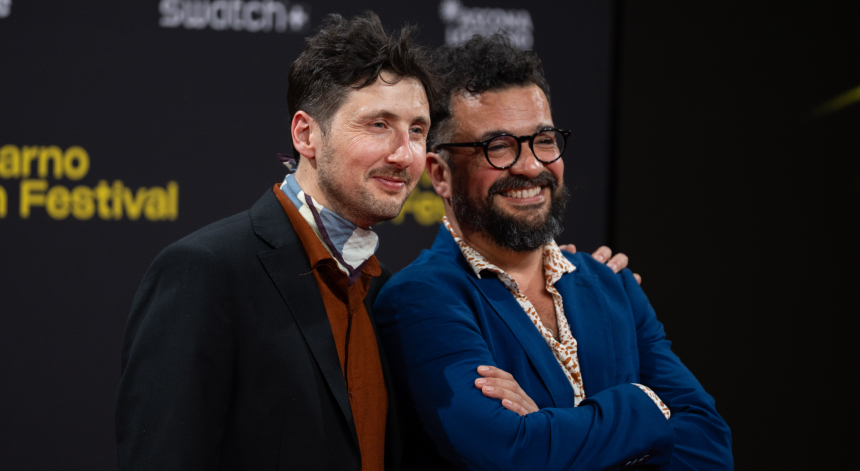
Chilean filmmakers Cristóbal León and Joaquín Cociña, the acclaimed duo behind The Wolf House and The Hyperboreans, have spent two decades dissolving the boundaries between animation, live action, puppetry and performance.
Their latest feature, Donkey Princess (orig. Princesa Burro), premiered in the main competition of the Locarno Film Festival. It transforms Charles Perrault’s Donkey Skin into a shape-shifting fairy tale influenced by childhood VHS favourites, music videos and their distinctively handmade imagination.
In this interview, they discuss the profound influence of Jan Švankmajer and Terry Gilliam, the unexpectedly difficult leap into live-action filmmaking, their marriage-like collaboration and the fluid identities at the heart of their forthcoming animated feature Hansel and Gretel.
Screen Anarchy: DONKEY PRINCESS reminded me of Terry Gilliam, mostly TIDELAND. Does that connection make sense to you?
Cristóbal León: I think this may be the first time we have heard that comparison. But I understand it, because there is a connection between materiality, technique and the magic of cinema. There is also always something a little ridiculous and beautiful about Terry Gilliam.
Joaquín Cociña: Gilliam is perhaps not someone who is very present in my conscious mind, but he may be in my subconscious. Tideland is very special to me, maybe my favorite of his films. It is like a very dark version of Alice in Wonderland, and it is a film I often mention to students when I am tutoring. I also remember watching The Adventures of Baron Munchausen when I was very young, and I continue to dream about it. There is something magical there.
Cristóbal León: And, of course, the Monty Python films are part of our culture. Gilliam's early animations for Monty Python are beautiful and were very influential for us. The sequence in which the elderly office workers sail away in their building to attack the young yuppies is hilarious. We should revisit his work.
What was the original idea behind DONKEY PRINCESS, and how did the film take shape?
Joaquín Cociña: It is very hard for us to establish a linear path, because the film came from many things.
When we finished The Wolf House, our first feature, the only thing we knew was that we did not want to make another animated film. We had spent five years on it and were tired. We also felt that if we immediately began another animation project, we would simply copy ourselves.
We wanted to make something fresh, so we decided to make a live-action film because we thought it would be faster. It was not.
We had many ideas. At one point, we considered adapting Roberto Bolaño, but the rights would have consumed the budget, and we are not especially respectful of original ideas. The material would inevitably change in our process.
Then the pandemic arrived, and Cristóbal, our co-writer Alejandra Moffat and I were locked in our respective homes, writing, rewriting and erasing everything. We ended up with one very complex, bad script. We split it into two bad scripts. The Hyperboreans absorbed the political horror and esotericism, while the family drama and love story remained in Donkey Princess.
Cristóbal León: One of the central ideas, first for The Hyperboreans and then for Donkey Princess, was to revisit our real film education. We went to art school, not film school, and we did not want to return to the filmmakers we claimed to admire when we were 20.
Cristóbal León: We wanted to return to the films we actually watched on television and VHS as children, The NeverEnding Story, Indiana Jones, Back to the Future. When I was younger, I might have dismissed those films as garbage. I was a moron. Now we can openly acknowledge how much we love them.
Joaquín Cociña: That is why the film moves from one world to another. The character is revisiting that childhood education just as we are. We also tend to use fairy-tale structures to build our films. We began by inventing a fairy tale of our own, and at a certain point Cristóbal realized that we were actually adapting Donkey Skin, the tale by Charles Perrault. Jacques Demy also made a film from it. Once we recognized that connection, we changed the script to bring it closer to the tale.
Cristóbal León: The film is about our childhood films, but also our teenage films. The music-video universe of Michel Gondry and Spike Jonze, for example. The music was composed by Jean-Benoît Dunckel of Air, so that world is present too. Fairy tales are among the first narratives we absorb, they form a basic body of myths. As a child, I did not really hear Chilean folklore. These were the stories I heard. In that sense, the film is about our artistic education as children.
I also saw the influence of Jan Švankmajer in the film. How important is his work to you?
Joaquín Cociña: Of course. We rarely name Švankmajer because the influence feels so obvious, especially in The Wolf House, where it is everywhere. Asking whether he influenced us is almost like asking whether your father influenced you. He is our father.
Cristóbal León: We have never met him, although we would love to. I also admire his writing. I have a Spanish-language collection of his manifestos and texts, the title is something like To See Better, Close Your Eyes, which includes his ideas about tactility and seeing through the hands. That tactile theory is very important to us, as are the films themselves.
Joaquín Cociña: Alice was life-changing for me. I saw it as a teenager and had no tools with which to process it. The same thing happened when I first encountered David Lynch in a cinema without any prior information.
Before the internet shaped every viewing experience, you could enter a cinema without a clue and emerge changed. Alice and Faust were like that for me.
Joaquín Cociña: We used to watch Faust on YouTube in a strange transfer that made all the actors look blue. We thought Švankmajer was a genius who had painted every performer blue. Later, we saw a proper copy and found it almost disappointing.
Cristóbal León: More broadly, Czech and Czechoslovak animation may be our deepest influence, even if we sometimes forget to mention it, the way one forgets to mention one's parents. Jiří Barta is very important, as is Russian animation. Yuri Norstein is like a god to me, and his name even appears in Donkey Princess.
What was the transition from stop-motion animation to live action like for you?
Joaquín Cociña: We began working together on stop-motion pieces, but then spent years mixing animation and live action in more experimental, performance-based work. Even The Wolf House was not conceived as a purely stop-motion film at the beginning. It was going to be mixed media.
Only later did we decide to make it entirely in stop motion. Because the production lasted five years, we became animators simply by animating every day. At the same time, we always thought of ourselves as artists who could work in any form. After The Wolf House, we wanted to make something simpler and more live-action-based.
The Hyperboreans became a way to learn how to work with actors. That is partly why it has one principal performer and relies on puppetry for almost everything else. Antonia Giesen was extraordinary and helped us understand that process.
Cristóbal León: We had also worked with friends and non-professional performers before. The Witch and the Lover, for instance, combines puppets with an actress and is close to Švankmajer's hybrid films. We have made music videos in which the musicians perform for us. So we never felt that we were only animators, even if animation is the work for which we are best known.
The most challenging transition was not the actors. It was the crew. Our earlier films were made by the two of us on a daily basis. The Hyperboreans had a two-week shoot, and Donkey Princess had a five-week shoot with 50 or 60 people.
Suddenly we were inside a highly organized, almost militarized system of departments and hierarchies. You are not supposed to cross from one department into another, while we are accustomed to making everything with our own hands. That was strange and difficult for us.
How do you divide the directing responsibilities between the two of you?
Joaquín Cociña: We do not have rules about that. When we animate, we may work together, or I may animate one day and Cristóbal the next. When we moved further into live action, we decided not to assign fixed roles, and it worked.
Some days one of us is tired and the other takes charge for a few hours. We have worked together for 20 years. It is like a marriage, a marriage protected by the fact that we do not have sex.
On set, I love knowing that if I go to the toilet in the middle of a shoot, Cristóbal will direct and I can take my time. We both have families and children, so sharing the work is not only artistically nourishing. It is practical. If one of us needs to arrive late, the other is there.
Cristóbal León: We made our first short film Lucía almost 20 years ago with another friend, Niles Atallah, whose films are also very interesting and connected to an Eastern European aesthetic. For perhaps the first day or two, we imagined we would have defined roles. But almost immediately, I wanted to operate the camera and Joaquín wanted to draw, and we realized that the process was more enjoyable without those divisions. From that first film onward, fixed roles felt like limitations.
What are you working on next?
Cristóbal León: As soon as we return to Santiago, we will begin work on our next fully animated feature, Hansel and Gretel.
Joaquín Cociña: We have a script, but with animation we do not entirely know what the film will become until we make it.
Cristóbal León: At the moment, it is about the instability of bodies and identities. The first change is that the children are not a boy and a girl but two boys, at least at the beginning. They are versions of us: Joaquín is Hansel and I am Gretel. In that sense, it is very Jungian, as all our films probably are.
Joaquín Cociña: We are also going to write another live-action film, an adaptation of a short story by a living Bolivian writer. We cannot name the writer yet. It will be a Brazilian production.
Cristóbal León: It is our first real commission. Normally, our producer Catalina Vergara works with us through our own production company: we apply for funds and build the project ourselves. This time, another company is hiring us to make the film.
It comes at a useful moment because public support for art and cinema in Chile is not in its best condition under the new far-right government. We will see what happens.