FRESH KILL Blu-ray Review: A Timeless Queer Punk Eco-Fable

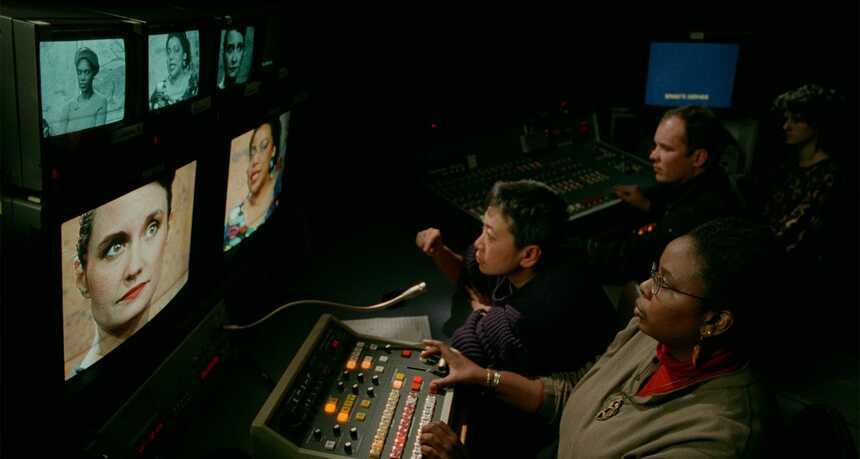
We often call those artists, writers, and filmmakers whose work presents a possible future that turns out to be fairly accurate, prescient. But what is more true is that they look at the world around them, the patterns of history, the movement of social and political life, and can make an educated guess at a direction. Shu Lean Cheang's Fresh Kill is one of those films.
There are many genre and subgenre labels that can be attached to it: ecofeminist, ecoterrorism, cyberpunk, noir, thriller, erotica, though Cheang herself used the suffix 'noia'. At 30 years old, it feels both set in its particular era of a world on the cusp of the world wide web, about to enter a frightening stage of late capitalism dystopia. And that means that is has stood the test of these 30 years, and why it's making its debut with The Criterion Collection.
Given its experimental cyberworld feminist punk aesthetic, that while there is something of a narrative, it's more about how we perceive the story, through what channels (literal and figurative) that we view it, than a focus. As it is, couple Shareen (Sarita Choudhury) and Claire (Erin McMurtry) are struggling artists and mothers raising their daughter Honey in a converted garage at the far reaches of Staten Island. While Shareen spends her days searching the local landfill dump for what they can use or sell, Claire works as a waitress at a sushi restaurant. That local landfill is being used to dump toxic waste, which is affecting the local food supply, including a popular brand of tinned fish. But the fish at the sushi restaurant might also be damaged, tube TVs are everywhere broadcasting the same channel with reassuring propaganda, and Shareen, Claire, and their friend Jianbinn (Abraham Lincoln Lim) are working to infiltrate the corrupted airwaves.
Cheang was part of the queer political movement to bring attention to the AIDS crisis; she witnessed the indie film and art scene of 1980s New York, and became a part of it in the 1990s. This was also the dawn of the internet being more widely available. It's a confluence of media and how it was created and absorbed, and this is the intergrel material of her film. One of the first scenes shows Shareen bringing an old tube TV to a vacant lot that has become something of a tent city, she places it as part of a wall of similar TVs, most of which show the same channel. Even in this open space of those without any material wealth, the scraps of capitalism much reach and indoctrinate them.
At the seemingly opposite end of this is the restaurant. Customers of the most haughty type, businessmen who think their power makes them immune from this media propaganda, whose tastes and wants are part of that capitalist consumption which force people like Shareen and Claire to live as they do. And yet, there is something in the lipsticked fish: it both hides and reveals its toxic nature, one to which the restaurant patrons think they are immune, or which they welcome. If it's in fashion, it's what they eat.
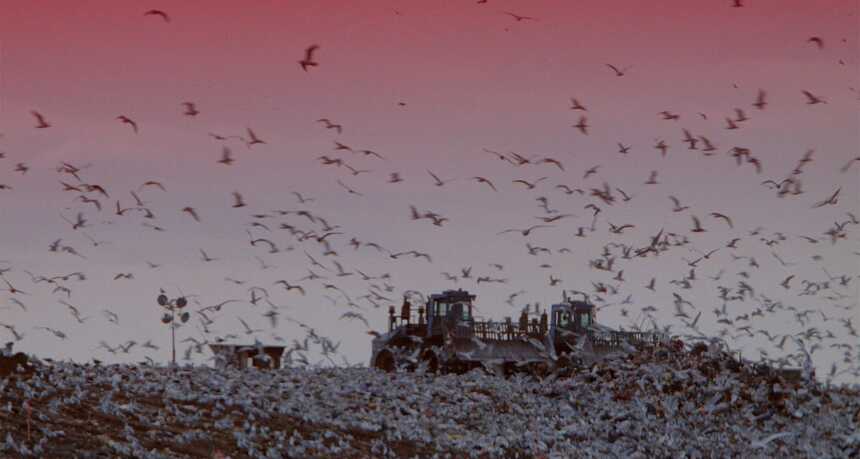
Cheang presents a world of sensual details in the personal lives of its characters, with inventive sex toys and the shine around Shareen's mouth after she has given pleasure to her wife; to the ways the public of the 90s were starting to be under constant surveillance. Security cameras, televisions and computers in every household with more and more hooked up to the internet. Many characters break the fourth wall, looking into the camera as if they can see into your own living room, asking you if you realize how much you are watched.
The opening shot, and several shots in the film, show Orchid Island, off the coast of Taiwan, which is the site of a nuclear waste dump. The indigenous community is seen fishing in their traditional boats, and it's not hard to make the connection between this place and Staten Island. These moments are both a moment of respite from the tech-covered world Cheang presents in New York, and a reminder that no where is safe from capitalist greed.
If Fresh Kill is agritpop, it is subversively so. It's not hard to identify with Shareen, Claire, and Jianbinn as they do their best to reject the pressure of the heteronormative in both their sexual and romantic lives, and their daily existence, but it's also impossible to do so. They find their rebellion within the system, and resist conformity wherever and however they can. Big acts of rebellion such as hacking the internet to expose corporate lies, as well as small acts in their existence and expression, or the poet who gives out condoms, or the use of community access television to spread messages of revolution. Not all media is in the hands of the corporate, and Cheang shows how a person can find ways to reach a wider audience, even if we are forced to live under a capitalist system.
At that precipice of the internet age, Fresh Kill feels both 'fresh' in that it had its pulse so firmly on the technological revolution, in how it could harm us and how we could resist it, and timeless in how that technology is so integrated, and Cheang's film saw that integration. It's a mosaic of storytelling, blending the old ways with the new, and how the human factor can never be written out of the future.
 Special Features
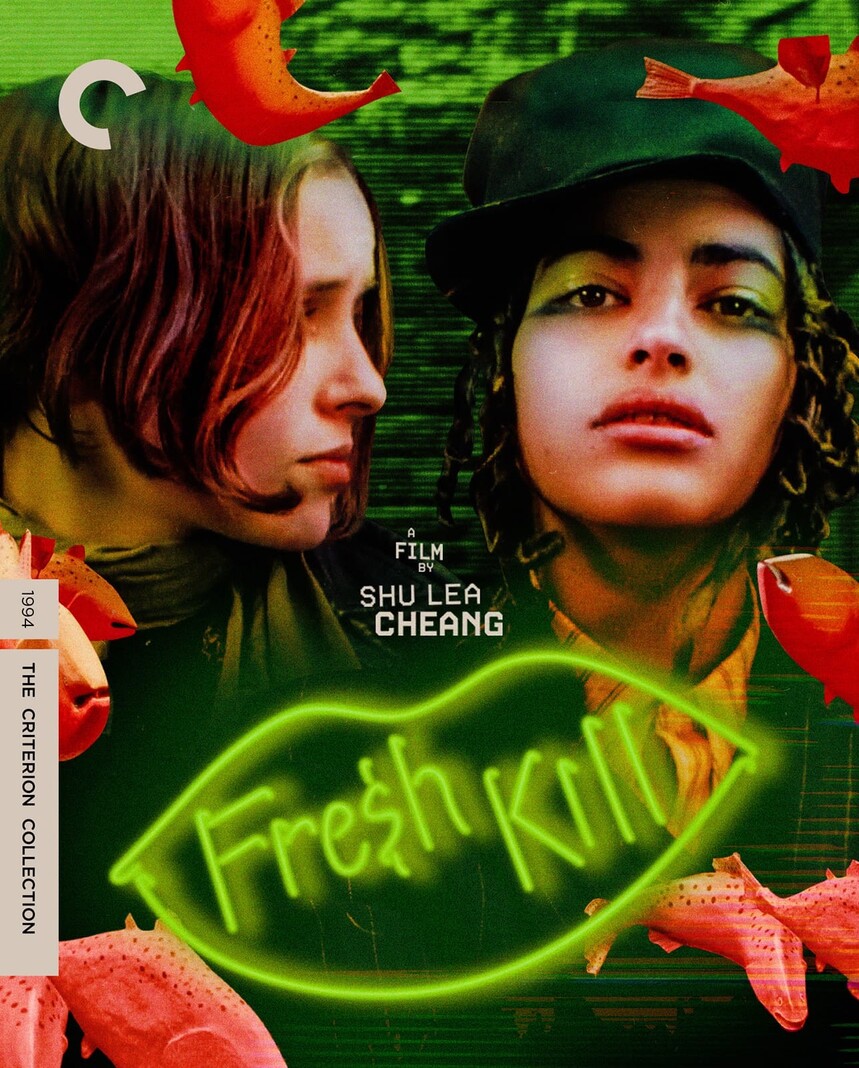
It's always an advantage to have the filmmaker oversee the restoration of their film to 4K, and especially so for a film such as Fresh Kill. This is a film about different forms of audiovisual media, how it is used, how it is processed, and how it is manipulative. Cheang and her director of photography Jane Castle worked with the team, using the 35mm camera negative. And as there is always a risk that a 4K will make a film too clear (i.e. lose the rough edges that make print film beautioful), supervisors Bill Brand and Mackenzie Lukenbill did a terrific job.
There are two interviews made especially for this release, one with Cheang, and another with Choudhury. Cheang discusses how her love of film began with watching movies at various consulates in Taiwan, the vibrance of the underground film and queer scenes in New York in the 1980s and 90s from which she found her inspiration, and how political activism of the AIDS crisis fuelled her creativity. Choudhury remembers her beginning as a dancer before turning to acting, the challenge of acting in an avant garde film, the joy of an all-women crew, and how she finds the film timeless, and the positive effect it had on the growth of her craft. There is a short profile of Cheang from when she was awarded the LG Guggenheim award, which showcases some of her other films and video installation work. As well, an on-stage interview with Cheang, hosted by Jinga Desai, is perfect to watch after the film.
The most interesting blu-ray extra is a short documentary from Jazz Franklin, covering the road trip that he and Cheang took with the restored print. It's the kind of self-distribution that was not common in earlier cinema years, and even less so now. But that physical connection to the print, the weight of this precious piece of art being driven from city to city, carried in and out of indie movie houses, connects the filmmaker to the spaces in which their film will be viewed. To quote Franklin in this doc, "cinema holds private moments inside a collective experience."
Artists and technologist Mindy Seu's essay 'Fluid Transmission' gives both insight into Fresh Kill as well as insight into Cheang's artistic goals and methods. Seu examines how Cheang's work "centers technology's entanglements with sexuality, power, and alternative social systems." Cheang has retained her underground spirit that stems from this film and into her artistic and video work, her method of non-traditional casting, her queer political spirit; Seu's essay is ideally read after watching the film and before the on-stage interview.
Fresh Kill is now available to order at The Criterion Collection.
Fresh Kill
Director(s)
- Shu Lea Cheang
Writer(s)
- Jessica Hagedorn
Cast
- Sarita Choudhury
- Pedro Pietri
- Ching Gonzalez