
MISTURA Review: Feels Like Comfort Food
Barbara Mori and César Ballumbrosio star in director Ricardo de Montreuil's undemanding and good-natured, if familiar story.

Peru is a very divided country, both politically and socially; it’s generally difficult, some might say impossible, to get its people to agree on anything.
But if there is one thing that can unite Peruvians across every social strata, it’s our cuisine, which at this point has become internationally recognized, time and time again. Conventional wisdom says to never disparage Peruvian food online; the resulting hate campaign can bring down even the strongest giants.
Food is the one thing this country does well – it’s definitely not politics or sports, and you can quote me on that – so it makes sense that Mistura, from director Ricardo de Montreuil, wants to celebrate its multicultural origins and variety.
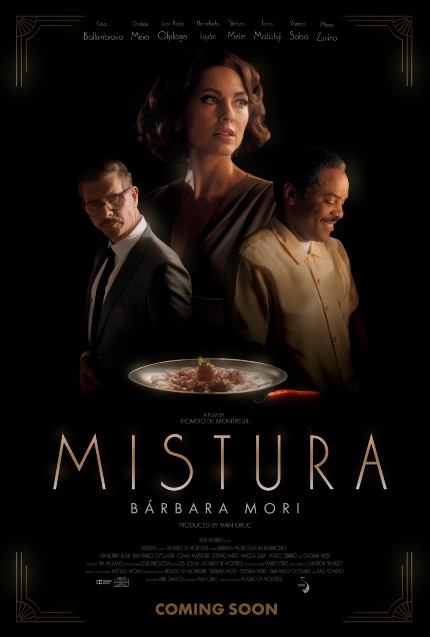
It’s the story of Norma (Bárbara Mori), a high-society woman in Lima in 1965, whose philandering husband (Christian Meier) cheats and then walks out on her. Attempting to move on with her life and find something to do, she decides to open a French restaurant, with the help of her ever-loyal chauffeur Óscar (César Ballumbrosio); in the process, she’ll rediscover her long-lost joie de vivre.
At this point, you can probably guess how most of this will play out, and you’d be largely correct: the stuck-up, pampered Norma goes on her own personal Eat Pray Love journey and rediscovers the world away from her life of privilege, all through food. Of course, her dickish cad of a husband will show up at some point to throw his weight around and attempt a reconciliation, and she’ll know enough to kick his ass to the curb.
It’s all very predictable and safe, but goes down easy thanks to its two central players, who have a Driving Miss Daisy dynamic going; Uruguayan-born Mori is wholly believable as a snobby, upper-crust limeña and Ballumbrosio, who’s more known as a musician – and he gets a couple chances to show off his skills with the cajón – is a warm, friendly presence as Norma’s loyal driver.
While the simplistic plot is nothing to write home about, the movie gets better when it focuses on food. In yet another predictable development, a French restaurant gets Norma nowhere, so she turns to the ever-varied pleasures of Peruvian cuisine, with massive success. And it’s in this celebration of different cultural backgrounds, flavors and ingredients coming together to form a whole that this movie soars; the lovingly photographed shots of dishes can make your mouth water, courtesy of chef Tomás Matsufuji, who pretty much plays himself.
Mistura is set in a picture perfect Lima of over 50 years ago. There’s some lip service paid to the fact that in 1965, Peru was under the military dictatorship of Juan Velasco Alvarado, a regime with a heavy nationalist bent which attempted to bridge the massive social and economic differences – a French restaurant would probably never thrive in that particular climate – but that’s all in the background; this movie isn’t aiming to preach on the matter or be particularly realistic.
This is an almost romantic view of the country, where there’s no problem or divide that can't be resolved through a tasty, elaborate dish; and that’s usually what unites everyone here. Mistura is an undemanding, good-natured story you’ve probably seen many times before; it feels like comfort food, the same kind that every Peruvian has probably sampled since birth.
Mistura is currently playing, only in movie theaters, in New York and Miami; it opens in Los Angeles on May 8, with other cities to follow. For more information, visit the Outsider Pictures website.
Mistura
Director(s)
- Ricardo de Montreuil
Writer(s)
- Ricardo de Montreuil
Cast
- Bárbara Mori
- Cesar Ballumbrosio
- Christian Meier

Do you feel this content is inappropriate or infringes upon your rights? Click here to report it, or see our DMCA policy.


