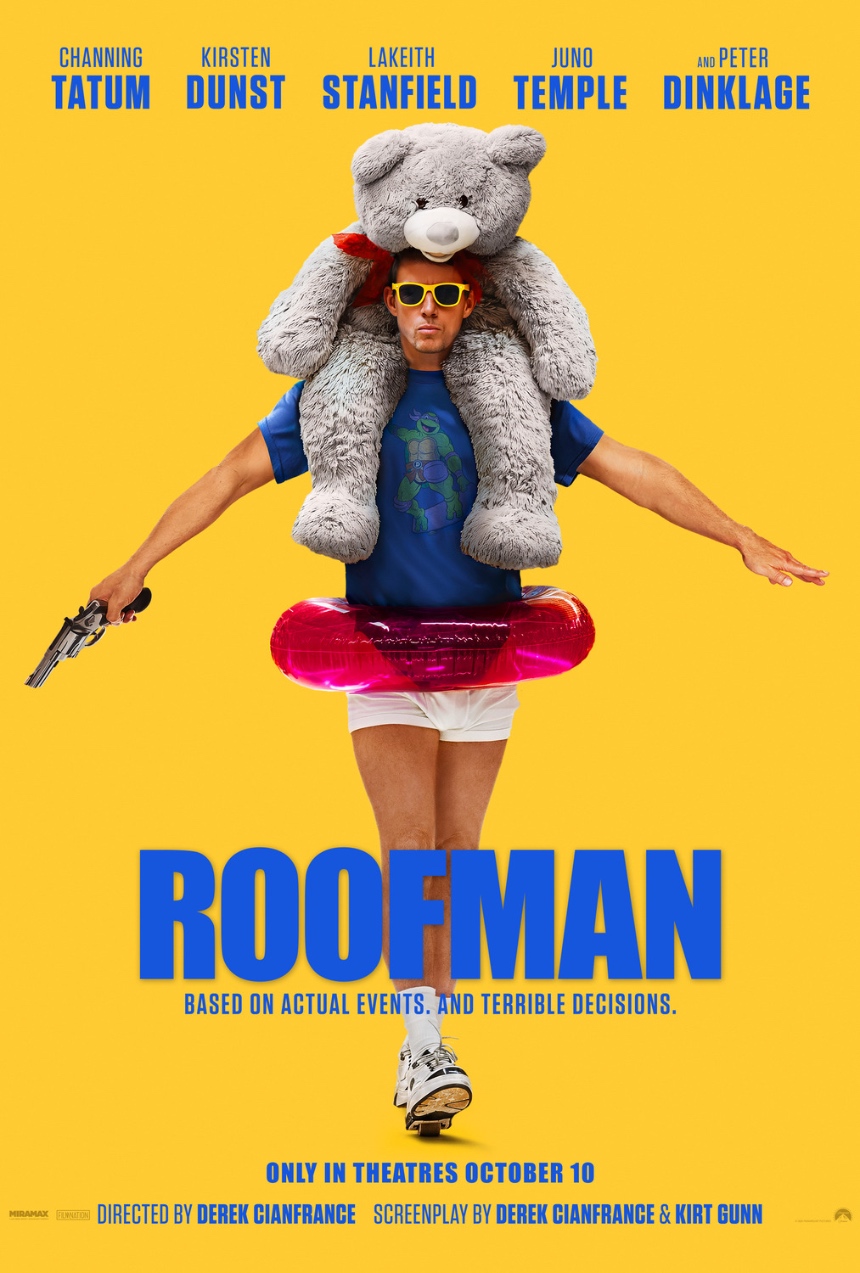
ROOFMAN Review: Warm, Funny, and Affecting, But Not Quite an Awards Contender
Derek Cianfrance's new film stars Channing Tatum and Kirsten Dunst.

Every year as we enter awards season, I find myself growing suspicious of new releases' intent.
Are they pieces of art or are they calculated awards bait seeking to lend their makers glory in the form of Oscar gold? Or both? Roofman feels like both, with a larger dose of the former than the latter.
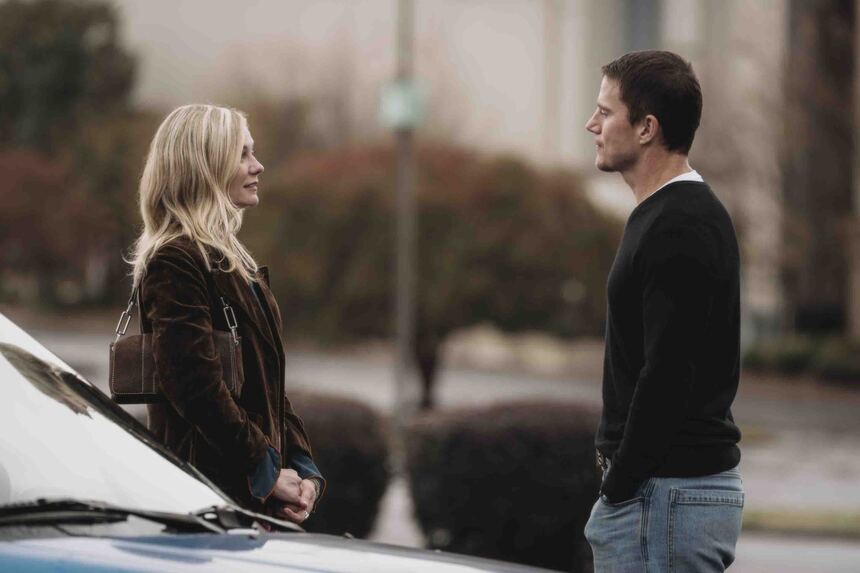
Like many of its awards-bait peers, Roofman is based on a true story. The titular "Roofman," Jeffrey Manchester, robbed a variety of fast food franchises (limited to McDonalds in the film), was caught, escaped, and then lived in a Toys "R" Us and (absent from the film) abandoned Circuit City for months before recapture. Also true, is the love story between Jeffrey (Channing Tatum) and Leigh (Kirsten Dunst), a spirited and openhearted employee of the Toys "R" Us.
Co-writers Kirt Gunn and Derek Cianfrance (who also directs) balance the romance with the crime story well and pepper both with enough humor that Roofman sometimes feels like a classic 2000s rom-com (this is a compliment). Or any other kind of com of the period, really; the film begins in media res with Jeffrey mid-robbery and pauses the action just as a foot chase starts so he can bring us back two years via voiceover. There's no record scratch, but it wouldn't be out of place.
Through the flashback, we learn Jeffrey is an Army veteran who, like many veterans, was left unsure what to do when he returned from his tours of duty and floundered financially. That leaves him unable to buy his daughter Becky (Alissa Marie Pearson in a remarkable child performance) the bike she wants for her birthday, and her mother Talena (Melonie Diaz) seeking divorce.
It's on the nose and effective when Jeffrey talks about robbing 45 McDonalds as a way to "win your family back." And he does for a bit, before he's caught and sentenced to 45 years in prison. The scenes of Jeffrey calling Becky from prison while Talena tells the child to hang up and a new boyfriend attempts to more sweetly coax Becky off the phone are heartbreaking and do their job of establishing Jeffrey as a man who just wants to care for his family.
But when he escapes, he actually listens to his friend and fellow veteran Steve (a reliably charismatic LaKeith Stanfield) and stays away from his family so he won't get caught. Of course, it doesn't take him long to find a new family that he wants to care for. Shortly after escaping prison -- in a sequence that's elaborately choreographed and surprisingly tense -- and holing up at the Toys "R" Us, he sets up baby monitors as his own CCTV cameras.
He's immediately attracted to Leigh, who frequently clashes with almost-too-evil-to-be-believable store manager Mitch (Peter Dinklage) over taking time off to be a mom and his mistreatment of other employees. And before long Jeffrey's leaving his makeshift hidden room to donate to the toy drive she's organized at her church.
From here, we're treated to an equally funny and affecting courtship as he unleashes so much charm that she questions whether he's gay before asking him out. Her daughters complicate things and also draw Jeffrey in as they offer an opportunity to bring some kids joy, something he desperately wants.
Seeing him slowly become a member of their family is wonderful. It's also painful because we know that the more he ventures out into the world, the sooner he'll be caught. The film never overplays that duality, though, and instead almost completely morphs into a quirky dramedy about a man coming into a dysfunctional family of women, leaving the audience to hold onto the awareness that he's constantly endangering himself.
During this significant portion, Roofman is a delightful quirky dramedy. The cast, featuring Ben Mendelsohn, Juno Temple, Emory Cohen, and other recognizable faces in supporting roles, make even the smallest scenes memorable. The soft grainy look, courtesy of cinematographer Andrij Parekh's 35mm photography, invites the audience to join this warm world without any hard edges.
A singles dinner attended by over ten women and Jeffrey as the only man is hilarious. A reckless driving scene that culminates in Jeffrey handing Leigh's oldest the keys reminds us of the danger, while also feeling familiar for anyone who's seen enough films of this ilk from their 2000s heyday.
But two things can be held against Roofman. The first, for which mileage will vary, is the prominence of generic Protestant church music. There are at least three scenes that play out with the milquetoast sounds of that not quite choir, not quite soft rock music that's given birth to a slew of memes about Catholicism's aesthetic superiority.
The second is the clear desire for awards attention. While none of the performances in the film are bad, there are moments where you can see the actors trying. Tatum is capable of shouldering the film's varied tones, but both he and Dunst are too clearly Acting in a few scenes towards the end. They're both great actors who can and have done work where you can't see the seams, so it may be Gunn and Cianfrance's script and/or -- I say this as someone who adores The Place Beyond the Pines -- Cianfrance's direction that pushes them into these performances; one scene in particular reads as a readymade "the clip" for awards shows.
It almost makes you wish the film kept things lighter, but that would be false. And the vast majority of Roofman registers as authentic in its retelling of this story, which is why it's such a success overall. Like life, none of the movie is just light or just heavy. Just as everpresent as the threat of capture is the knowledge that every choice Jeffrey makes is borne out of a desire to make a family happy, which brightens the darkness of the film's most devastating moments.
The film opens Friday, October 10, only in movie theaters, via Paramount Pictures. Visit the official site for locations and showtimes.