
BEAST OF WAR Review: Kiah Roache-Turner's Shark Horror Thriller is Full of Teeth -- And Purpose

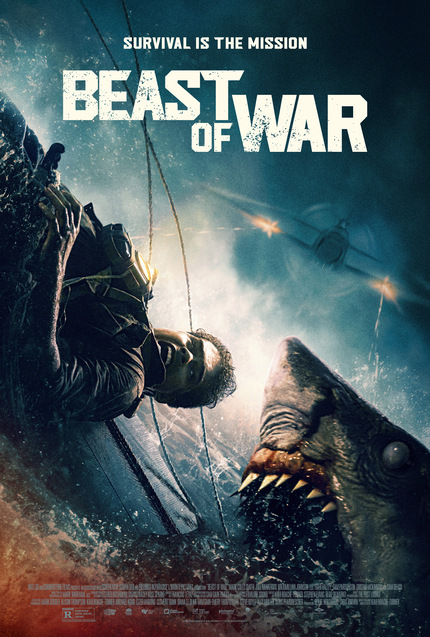
The year 1942. Only a few months after Japan joined World War II, Australia began shipping its troops over from the city of Darwin to defend Timor Island in Southeast Asia. To reach their objective, they had to cross the Timor Sea by boat. It is a distance of only a few hundred nautical miles, but it is a treacherous one.
A batch of young soldiers, including Leo, a physically and morally strong indigenous man, huddle together in the hull of such a transport ship when it is attacked by Japanese aircraft, who breach its hull. Grabbing his best mate, Leo escapes the sinking ship and finds some wreckage to float on and wait for rescue. Other members of their troop join them, including Leo's nemesis during basic training, a super-racist bigot named Des Kelly.
When the Japanese aircraft fly off, they think they are in the clear, but it becomes clear very quickly that they are not out of danger, for the Timor Sea is teaming with Great White sharks, and one in particular has begun to hunt these survivors, one by one. Do these young men continue to tear at each other's throats, or do they put their differences aside, band together, and defeat this shark before it takes them all to a watery grave?
When you mention the words "sharks," "sinking boats," and "World War II," in most cases, thoughts immediately turn to Spielberg's classic shark film, Jaws, and one of cinema's greatest monologues, Quint's "The Indianapolis Speech," a speech delivered by one of the film's central characters. It is a masterful scene, and if anyone tells you otherwise, you must immediately disown them.
Presented with the opportunity to make their own water-bound thriller horror but intent on making one with an identity that marks the filmmaker and their focus on their homeland, Australia, writer/director Kiah Roache-Turner (Wyrmwood, Sting) went to the history books. They pulled influence from Australian war history, the sinking of the HMAS Armidale. A story not unlike the USS Indianapolis, the Armidale was sunk somewhere between Darwin and Timor Island and the survivors had to brave shark-infested waters while rigging wreckage together so they could ride back home, towards rescue.
Roache-Turner inserts layers of character, emotion, and racial politics beneath the spectacle of the shark horror thriller genre. Beast of War is not afraid to comment on systemic racism in WWII-era Australia, where Indigenous soldiers were paid far less than white ones, yet performed the same acts of heroism on the battlefield. They spilled the same blood in the same mud, yet were treated horribly. There’s a clear anti-racist and anti-war undertone, and Roache-Turner frames the story as a journey toward unity through survival. The war context becomes a metaphor for male bonding through trauma and redemption.
The responsibility to carry that message through the film relies on the cast. By giving the audience someone to care about, it creates an emotional investment that elevates Beast of War above its B-movie framework. Cue Indigenous actor Mark Coles Smith as Leo, who is the film’s emotional anchor. Leo is heroic, layered, physically capable, and culturally significant, with a steely gaze that leaped from the screen and felt like it pierced my soul. Like, does Coles Smith know who we are now, though we have never met? That kind of piercing.
Sam Delich, as the bigot, Des Kelly, is small and dangerous. Other actors like Lee Tiger Halley and Joel Nankervis give youthful authenticity and chemistry, while Sam Parsonson's mentally fractured Thompson nibbles at the frayed edges of the group's desperate state while they fend off the deadly shark.
It is all in support of Mark Coles Smith’s performance, which is both heroic and symbolically powerful in a story where his director uses familiar genre language (monsters, survival, camaraderie) to examine racism and masculinity, in the past and in our present.
Those who cannot remember the past are condemned to repeat it - George Santayana
Roache-Turner is using the Beast of War’s themes to comment on contemporary and ongoing Australian issues: ongoing racism and Indigenous struggles for recognition. Does that mean that they wish for a conflict that would unite Australians in a common cause? The film’s message is 'shared suffering dissolves prejudice'. By no means does he. No one should wish upon anyone the amount of suffering that a global crisis like a world war inflicts upon a nation. Roache-Turner hopes that we never have to reach that stage before it happens.
Moving on from themes and message, how are the genre elements, Andrew? What is the bloody shark like, mate? We can gleefully share that Roache-Turner’s 'Bruce' is, for the most part, a practical effect — in the water alongside the soldiers. On this production, she was named 'Shazza', because she is a female shark, and, if the internet has not led me wrong (because when has it?) 'Shazza' is slang for, like, a white trash lady. Don't yell at me, yell at the internet!
Using a practical shark puppet is a significant creative statement — a rejection of cheap CGI that risks taking the audience out of each moment it appears. Anything computer-aided was left for fill shots of 'Shazza' deep beneath the makeshift raft and such. Instead, we now have a shark that is deeply scarred, monstrous, and tactile. The physicality of the shark adds credibility and terror. Real weight equals real fear.
Equal to the task are the gore effects, of which there are no shortage of. As 'Shazza' rips through the first wave of survivors, while our small band of soldiers gather their whits about them, bodies bob on the water like bloody, ruined tops. Rows of teeth rip through flesh like it was paper and limbs are lost throughout the struggle to remain alive. Then, the introduction of a wildcard towards the climax only adds to Beast of War's explosive finale. Gore hounds will not be disappointed.
The film was primarily shot as a contained, chamber piece, hearkening back to classic cinema where survival tensions played out in a single location. To keep the setting from becoming stagnant, the backgrounds shifted through hyper-saturated colors, featuring bold palettes of firelit reds, dusky blues, golden yellows, and bioluminescent greens. Together, they kept the single location visually dynamic and way more stylized and artful than the average shark thriller.
In just a handful of films, Roache-Turner is expected to do a couple of things: “button porn” and quick-cut close-ups of weapons and actions. At least one of those trademarks still appears, if in a limited setting. There are only so many buttons around when the rest of the ship you were previously sailing in now lies at the bottom of the Timor Sea. There still is a quick-cut close-up scene, though, much to our delight. Beast of War's tone balances humor, action, and sincerity, in line with earlier films like Wyrmwood and Sting, but here it’s tempered by tragedy and history.
Beast of War is a reinvention of the shark movie — a blend of genre thrills, historical drama, and social commentary. It came with an unexpected emotional weight behind a premise that sounds like pure pulp. Artistically, Roache-Turner remains visually ambitious and will be praised for his commitment to practical effects. One of us, one of us, one of us!
Beast of War is in theaters and on Digital, Friday, October 10th.

Do you feel this content is inappropriate or infringes upon your rights? Click here to report it, or see our DMCA policy.
More about Beast of War (2025)
- THE FORBIDDEN CITY's Wildly Entertaining and Affecting Thrills Come Home on 4K UHD
- Shudder in January: MOTHER OF FLIES, CHAIN REACTIONS, BEAST OF WAR and More!
- BEAST OF WAR Interview: Director Kiah Roache-Turner, Sharks, Soldiers, And The Soul of a Nation
- BEAST OF WAR Official Trailer: WWII Horror Action Flick From Kiah Roache-Turner Coming in October


