Toronto 2025 Review: STEAL AWAY, A Fable of Desire and Danger

The words uttered at the beginning of a story don't have to be precisely 'Once upon a time' to lure the audience into a fairy tale. But the form continues to resonate for a reason: we understand that such a story is a truth wrapped in a fable, one in which some kind of supernatural or fantastical element can stand in to explore that which is dark and harsh in our own world. Especially if that fairy tale adheres to how dark and often horrific the originals were.
Canadian filmmaker Clement Virgo, even in his more 'realistic' work such as Brother and The Book of Negroes, has always tinged his work with something that hints at the dark fantastic of the world, so it's nor surprising that he would want to dive further into this rich pool. Steal Away, co-written by Virgo and Tamara Faith Berger, explore racism, slavery, coming-of-age, sexual desire, love, and brutality in a film that mostly succeeds in combining these elements in its contemporary take on the fairy tale.
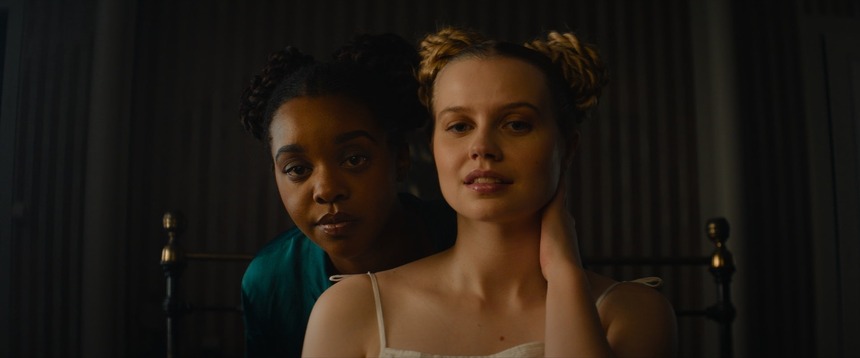
In a world parallel to our own, Cécile (Mallori Johnson) and her mother Mary (Isabelle Menal) have escaped the Congo, to the home of Florence (Lauren Lee Smith), a wealthy white woman who seems to take in refugees, providing them with false papers until they can either get legal ones, or make their way further north to safety. Florence's daughter Fanny (Angourie Rice) has just turned 16 and is almost immediately infatuated with Cécile.
The girls form a bond as Cécile tries to adjust to life in this country that feels something like formerly coloniozing Europe, it's not hard to make the connection of it as a metaphor for a stop on the Underground Railroad, and there is a constant danger that Cécile and her mother could be arrested by the authorities on the street and sent away (a symbolism even Virgo likely would not have predicted literally playing out in the USA as I write this). But Cécile is confident and bold, her colourful clothing and gorgeous hair and make-up drawing in Fanny's admiration. And eventually, Fanny's jealousy, as Cécile becomes involved with Rufus (Idrissa Sanogo Bamba), the estate gardener.
But is it jealousy of Cécile, or of Rufus? Cécile is not the first young girl to pass through Florence's home, and Fanny seemed to want to be friends with each of them. Or more to the point, many girls were made a companion to Fanny, and it's not hard to see parallels with times in which a young black girl would fill this role (think Belle or Alex Haley's Queen). Fanny wants her hair styled the same way as Cécile's, she follows her and watches as she and Rufus make love, and attempts to copy her companion with a town boy.
There is a richness to the tone and visuals of the film that make it feel almost fecund; this adds to the lush atmophere that can either swell with the budding sexual desire of the heroines, or stiffling in its danger. Setting the story in an unclear time and place makes it feel both like fantasy and retro-science fiction, a mirror to our own world in which we understand what our place might be, were we there. We know that 'north' is safe, but how far would Cécile have to travel? We know that Florence has made a home for many girls in the past, but what happened them, and what is the illness that plagues her?
It is not that Cécile is ignorant of the danger she faces, she is just young enough and bold enough to accept the risk. Fanny, on the other hand, is so sheltered in her privilege that she is unaware, and that sexuality that she is just discovering might not quite realize, at least until later in the film, that the true object of its desire is Cécile. Fanny at first might be 'play acting' with Cécile and the other black workers on her mother's estate, a position that she, as a white girl, can pick up and drop as she wants. But soon she must make a decision if her infatuation with Cécile is superficial, or if she will show just how deep that love goes. There is great chemistry between Rice and Johnson, and it's not hard to believe in their bond.
While the first half of the film seemlessly blends this fanatstical tone and the covert (and occasionally overt) parallels with our world, the second half loses some of that magic, as it seems to want to make sure the audience understands its themes through more direct and simplified language and presentation. It starts to feel a little too obvious, especially considering the strength of the first half. The various twists of the story work well both in this fable world and I wish that mode had been trusted to carry the laod of those twists. Then it almost rushes back to that fairy tale magic at the end, as if suddenly remembering what worked best.
Overall, Virgo has crafted a strong film in Steal Away, taking time to create a believable strange land with inhabitants all too eerily uncanny, and a pair of teen girls who take a difficult route through desire to find their truth.
Steal Away
Director(s)
- Clement Virgo
Writer(s)
- Tamara Berger
- Clement Virgo
Cast
- Angourie Rice
- Mallori Johnson
- Lauren Lee Smith