HIM Review: Marlon Wayans Tries to Convert. But HIM Punts.
Marlon Wayans, Tyriq Withers, Julia Fox, Tim Heidecker, and Jim Jefferies star; Justin Tipping directed.

As two of the dominant forms of popular entertainment in the western world, there has always been a massive interest in the crisscrossing worlds of sports and cinema.
Almost since the beginning of filmmaking as a commercial venture, depicting the world of professional athletics from the point of view of our those who play has played a central part in the movie business as a whole. From dramatic classics like Pride of the Yankees (1942), Rocky (1976), and Hoosiers (1986), to romances like Bull Durham (1988), Challengers (2024), and Heaven Can Wait (1974), and universally beloved comedies like The Bad News Bears (1976), Slap Shot (1977), and one of the greatest films ever made, The Waterboy (1998) – I will hear no dissent on this point – it feels like sports is inextricably linked to cinema in just about every genre. Then there is horror.
While there have been attempts at sports horror over the years – The Fan (1996), The Battery (2012), and a few other low budget B-movie entries – I think it’s safe to say that none have really cracked the canon of the greats. With Him, co-writer/director Justin Tipping attempts to deliver on that long unfulfilled promise and sadly comes of short through an at-times painful mix of underdeveloped ideas and overwrought execution.
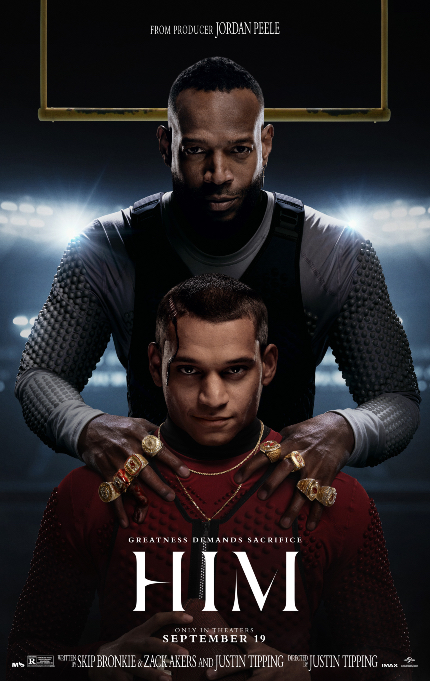
Him begins by introducing an alternate world in which the USFF (standing in for the NFL) is dominated by an aging quarterback named Isaiah White (Marlon Wayans). White was struck down by injury in his prime before the events in the film’s main timeline, but made a miraculous recovery and proceeded to win eight championships in a row for his San Antonio Saints, essentially rendering the league less of a competition and more of a personal highlight reel.
However, age comes for everyone, and rumors of retirement are everywhere, leading the world to hunt for a new G.O.A.T., and in steps Cameron Cade (Tyriq Withers). A schoolboy prodigy, Cade is poised to take on the legacy of Isaiah White, all he has to do is show up at the combine and do his thing, but on the even of his great unveiling he is attacked and injured, rendering him unable to perform for the scouts and placing his seemingly inevitable future in doubt.
All is not lost, though, as White invites Cade to his personal training facility for a week’s worth of intensive try outs. When Cade arrives, starstruck and grateful for the opportunity, what starts as standard – if a little over the top – workouts, quickly devolves into mind games, violent confrontations, and bizarre happenings that leave him unsettled and jeopardize not only his future chances but also his very life.
The outline of Him is pretty solid, however, the film is unsatisfied to play it in a way that is either cohesive or emotionally resonant. Instead, Tipping and his co-writers Zack Akers and Skip Bronkie decide that every moment in the film should abandon metaphor and subtext in favor of the brutally literal. Overwritten and over stylized to the point of absurdity, Him spends ninety minutes stacking hats on top of hats, hamstringing some not altogether terrible performances from its leads into an absurdist vision that takes a hammer to subtlety and trust in the audience’s intellect.
Adopting music video cum TikTok edit aesthetics, Isaiah White’s world in Him is a desert dystopia. A minimalist compound surrounded a desert populated with cultish fans who see him as the literal next coming of Christ. The training sessions themselves are populated with what the kids these days would call NPCs, video game jargon for non-player characters, mostly nameless, characterless bodies whose only purpose is to be punished in the service of White’s – and now Cade’s – greatness.
As for Wayans and Withers, it’s barely a competition. Marlon Wayans takes a character who is so clearly coded as evil from the jump and breathes life into it in a way that almost saves the film from itself. Him is painfully serious about itself and its motivations, even as the most ridiculous actions unfurl on screen, and our only respite as the audience is through Wayans’ obvious gift for bringing levity to serious situations. He even manages – in spite of the film itself – to be frightening, in large part due to his ability to shatter the manufactured tension with a deftly delivered “boop”.
Withers on the other hand feels as though he’s sleepwalking through the film. For a character who spends so much of the film sweating, running, throwing, hitting and being hit, Cade almost never even cracks a smile. There is a definite visible apathy that is endemic to many members of Gen Z, a blankness of expression that plagues performers of the generation that feels like it is meant to be a substitute for coolness, but instead registers as clueless. Withers appears to have walked into every scene unaware that he was even in a movie and that it would require him to emote.
Stack that seriously lackluster co-lead performance on top of the excess of muddled visual and aural styling and Him doesn’t seem to know what it wants to be. Is it allegory? It can’t be that, allegory leaves the viewer to interpret metaphor, which we’ve already established it a level of intelligence the writers have decided not to test. Is it meant to be literal? In these days in which half of the United States subscribes to irrational pseudoscience and conspiracy, that’s actually more of a possibility, even as the film eventually lays out its more supernatural underpinnings in its later stages. In either case, it is wildly unsuccessful as it attempts to comment superficially on too many topics to ever really make a solid case for any of them.
Director Tipping is clearly throwing everything and the kitchen sink at Him, and the film fumbles every play. Is it about the pressure to be the best, on a surface level, sure, that’s a part of it. But it is also about the fact that even the best is nothing more than a tool of the billionaires in charge. I mean, yeah, that too, but the way it’s handled lacks clarity of thought and sidesteps the real conversations that should be had in that debate. Is it about what it’s like to be a multiracial icon in today’s sports and media landscape? Sure, let’s throw in a joke about that, too. Or maybe it’s about the excesses that consume our heroes and lead to their very public destruction. Fuck, man, why not?
For better or for worse – actually, definitely for worse – I’ve thought more about Him than a lot of other films this year. Perhaps the only other film with as much on its mind is Ari Aster’s glorious clusterfuck of half-cocked ideas, Eddington, but the difference is that film is executed with great intention and focus, despite the seemingly haphazard nature of the narrative.
Him wants to be Rosemary’s Baby on the gridiron, it also wants to be a Christ story. It wants to be a lot of things, but what it actually is couldn’t be further from its intentions. It’s a mess, it’s ugly, it is superfluously loud and brash in a way that I don’t think the film even realizes. It leaves no room for introspection, no room for interpretation, it simply throws a messy spiral right at the audience’s face and expects them to catch it before it destroys the bridge of their nose. Well, consider my nose busted, because Him can’t throw for shit.
Him
Director(s)
- Justin Tipping
Writer(s)
- Zack Akers
- Skip Bronkie
- Justin Tipping
Cast
- Marlon Wayans
- Tyriq Withers
- Julia Fox