New York Asian 2025 Review: MA - CRY OF SILENCE, Brutal, Yet Inspiring View of Myanmar Labor Resistance
The Maw Naing's powerful drama follows a young woman working in a Myanmar garment factory, who hesitates when her colleagues strike.

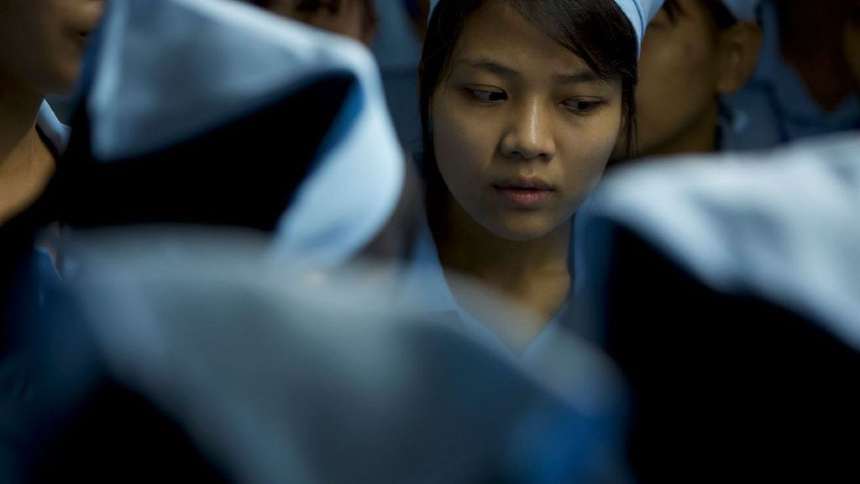
MA - Cry of Silence begins with onscreen text that gives historical and current context for the story we are about to see.
We're informed of Myanmar's "long history of military coups" and how the current military rulers, who forcibly took power in 2021, systematically burn villages and repress dissent by killing and arresting political opponents. This has forced young people to move from their villages into the cities, where they work in textile factories. It's in one of these factories, in the city of Yangon, where the story takes place.
But the first image we see is vertical cellphone footage of a massive fire in the distance, an image that is clearly not staged. The shot holds for a remarkably long time, with only the ambient noise from the recording. Finally a young woman's voiceover comes in, poetically reflecting on the cruel events that have befallen her and her nation, questioning, "Are we coming out of the darkness, or are we heading directly into it?"
This question hangs over the film, as some of the women who work at a factory -- and are owed two months back pay -- decide to strike. Their collective, though not factory-wide, action is inspiring, and the response to it is horrifying.
Before they even begin their battle for the money they are owed, we see the cruelty of their working conditions. As they sit in rows at sewing machines, they are bombarded with commands to go faster from a supervisor, whose face we never see, who smacks their workstations with a ruler to emphasise his authority. He also touches some of the girls as they work, dragging his hand along their faces to amuse himself with how little recourse they seem to have.
They are economically stuck, they work non-stop at the factory and are still barely able to afford the room and board costs of a nearby dormitory. The possibility of going without pay for a period of time, or losing income altogether, is almost unthinkable.
This is especially true for Mi Thet (Su Lay) who lies to the dorm manager about not having enough money for rent so she can send some to her family, living in a remote village. When her friend, Nyein Nyein (Kyawt Kay Khaing), first proposes taking a stand and refusing to work, Mi Thet cannot bring herself to join the strike. Director The Maw Naing and editor Nicholas Bancilhon regularly intercut more cellphone footage of villages burning and military arrests of dissidents to ensure viewers never forget Mi Thet's fears are warranted.
It's only through a relationship she develops with U Tun (Ko Nanda), an older man living at the dormitory, that Mi Thet begins to feel that something must be done, no matter the cost. U Tun participated in the mass protests of 1988, against the government that took power via a coup in 1962. Those protests were ultimately violently ended by a new coup, installing a different, similarly brutal and oppressive regime. As Mi Thet speaks with U Tun about his experiences, and he shares books with her about political action, The Maw Naing and Bancilhon begin to include older video footage of past protests and vicious governmental response to them (including footage of real death).
MA - Cry of Silence is always about history. The opening text mentions the 1962, 1988, and 2021 coups, but it says nothing of the resistance to them. That is left to U Tun, a man whose back is covered with scars. It's meaningful that Mi Thet's decision to join her fellow workers is motivated by an older person who was politically engaged in his youth and has the signs of that engagement on his body.
The film does look forward, though. The director, together with cinematographer Tin Win Naing (whose lighting throughout makes everyone's skin glisten with sweat), creates powerful images of the women as they strike. An early shot from above shows how the women gather tightly around Nyein Nyein when she first suggests striking in their lunch room.
Once they begin to strike, and sit outside the factory chanting slogans, long-held static shots communicate both their intractability and the apparent impossibility of changing the factory's position. One moment hits particularly hard: we see them through the closed, barred gates of the factory, as if in a prison, or outside demanding the release of those inside.
In only 74 minutes, MA - Cry of Silence delivers a rattling and motivating call to collective action that speaks directly to Myanmar's history of oppression and legacy of resistance. That the film is not an energetic jolt of radical propaganda, but an almost slow cinema consideration of its nation in microcosm, makes it even more special.
The film enjoys its North American premiere at the 2025 New York Asian Film Festival.