
Karlovy Vary 2025 Review: THE LOVE THAT REMAINS Finds Poetry in a Family Coming Apart
Icelandic auteur Hlynur Pálmason composes a lyrical and slightly surreal portrait of domestic life in quiet dissolution.

A mother, an artist, three children constructing a knight figure, a father unmoored after separation.
The Love That Remains unfolds over the shifting seasons of a rural household, moving between the quiet rhythms of domestic life and the understated tensions of emotional distance. Directed by Icelandic auteur Hlynur Pálmason, the film immerses the viewer in an atmosphere shaped by accumulated time: gestures repeated, moments quietly endured, and emotions that both connect and isolate. The result is a layered but fragmentary family portrait that approaches a kind of mundane surrealism with lyricism and strange humor.
Though The Love That Remains departs from Pálmason’s more visually austere and temporally exacting work, most notably the 19th-century expedition drama Godland, it retains a comparable sensitivity to landscape and atmosphere. Where Godland explored colonial displacement and spiritual erosion within a sublime yet hostile terrain, The Love That Remains focuses on the familiar, the unresolved, and the emotionally granular. Framed as a deadpan family dramedy, it filters dreamlike elements through the mundane, tracing the fragile boundaries between beauty and violence.
-thumb-800x450-99341.jpg)
Since his debut Winter Brothers, Pálmason has developed a slow, meditative cinematic language that emphasizes texture, repetition, and gradual transformation. A White, White Day, his second feature, already signaled an interest in private grief and intergenerational tension, conveyed through an opaque protagonist mourning a loss he is unable, or unwilling, to articulate.
The Love That Remains is less a narrative in the conventional sense than a sustained observation, structured episodically through vignettes from the lives of Magnús (Sverrir Gudnason), Anna (Saga Garðarsdóttir), and their three children: the precocious teenager Ída (Ída Mekkín Hlynsdóttir) and her two unruly twin brothers, Grímur (Grímur Hlynsson) and Þorgils (Þorgils Hlynsson).
Anna and Magnús are separated. While Magnús continues to visit the family home to spend time with the children and carry out occasional work, reconciliation is no longer on the horizon. Anna, an artist, juggles the demands of caring for three children while trying to sustain a creative practice.
Magnús, meanwhile, occupies a parallel narrative strand. A fisherman attempting to redefine his role in a family he no longer inhabits, he is marked by quiet melancholy and a restrained sense of frustration. His presence is often conveyed through absence, frequently shown at sea, the physical distance underlining both his emotional remove and lingering attachment.
The film offers no appeal for sympathy or judgment; instead, it presents both parents as flawed, weary, and tethered to a past they have yet to relinquish.
The director’s own children play a central role in the film, both as performers and as narrative anchors. Their ongoing project, constructing a life-sized knight from wood and hay, then gradually destroying it with arrows, emerges as one of several recurring motifs.
Cycles unfold: the seasons change, the roof is taken down and rebuilt, artworks are damaged and partially restored. Time advances without regard for resolution. Throughout, the camera adopts a deliberately unobtrusive stance, often handheld or positioned at a fixed remove, observing rather than interpreting.
What sets The Love That Remains apart within Pálmason’s oeuvre is its emphasis on the figure of the artist, not as a heroic or tragic archetype, but as a working mother negotiating the uneasy balance between creative persistence and responsibility for children and household. Anna’s sculptural practice, drawn directly from Pálmason’s own, functions as both metaphor and narrative device. Iron plates left outdoors to rust and weather over the winter months evoke the emotional residue of a relationship’s collapse: irreparable, yet retaining shape and presence.
-thumb-800x449-99344.jpg)
This idea of form, partial, weathered, shaped by external forces, is central to the film’s aesthetic. Rather than following a conventional dramatic arc, the film builds through the gradual accumulation of moments, many of them seemingly incidental. A goose nests in one of Anna’s installations. A neighbor drops by. A child is injured. An argument is suggested but left unresolved. These fragments accrue meaning through repetition and juxtaposition, consistent with Pálmason’s earlier work, though here approached with a lighter, almost diaristic sensibility.
The film’s darker, surreal humor offsets its occasional melancholy, allowing it to move through a wide emotional register while avoiding conventional narrative patterns. In portraying familial disintegration without rupture, The Love That Remains sidesteps the familiar tropes of separation and divorce drama. Instead, Pálmason finds the lyrical and the surreal within the everyday, tracing the quiet unraveling of a family as they drift away from a father and husband who remains stranded, both literally and metaphorically.
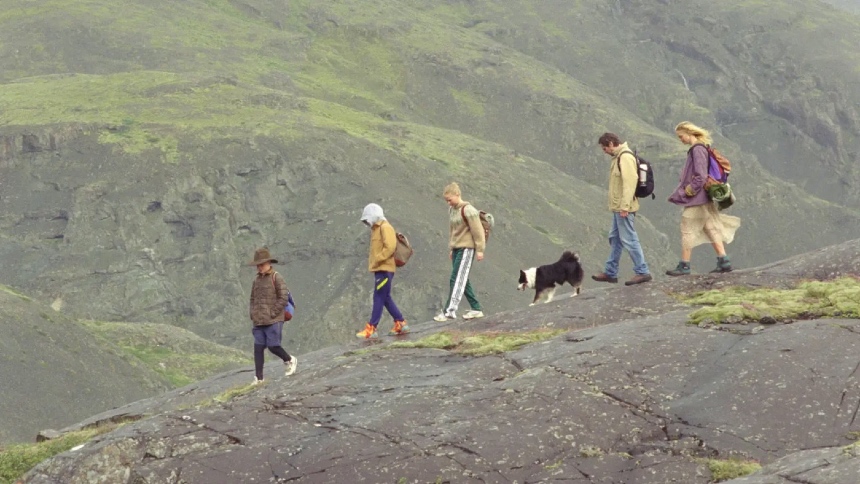
The Love That Remains may be Pálmason’s most elusive work to date, incorporating interludes and inserts that invite interpretation, and at times, perplexity. Expansive vistas of Icelandic nature are punctuated by hallucinatory visions, including recurring appearances of a giant, aggressive rooster reminiscent of something out of Jurassic Park.
These surreal intrusions, often linked to Magnús, suggest a descent into psychological unease, perhaps symptoms of separation anxiety or depression. Pálmason’s latest film unfolds as a slow-burning lyrical and imaginative portrayal, guided by implicit storytelling in which images gradually supplant dialogue, reframing a family drama about divorce into something more eccentric, more attuned to the rhythms of artistic inquiry.
The Love That Remains
Director(s)
- Hlynur Pálmason
Writer(s)
- Hlynur Pálmason
Cast
- Ingvar Sigurdsson
- Sverrir Gudnason
- Anders Mossling

More about The Love That Remains
- Criterion in July 2026: CRUEL STORY OF YOUTH, THE CRYING GAME, Mike Mills Trilogy
- THE LOVE THAT REMAINS Review: Normal People and Normal Problems Paint Unusual Family Portrait
- Opening This Week: Sam Raimi's SEND HELP, Ann Hui's JULY RHAPSODY, Much More
- Karlovy Vary 2025 Interview: THE LOVE THAT REMAINS Hlynur Pálmason and Julius Krebs Damsbo on Crafting Cinema from Intuition, Image, and Instinct


