Karlovy Vary 2025 Interview: DON'T CALL ME MAMA Director Nina Knag Talks Power, Privilege, Ethics of Desire

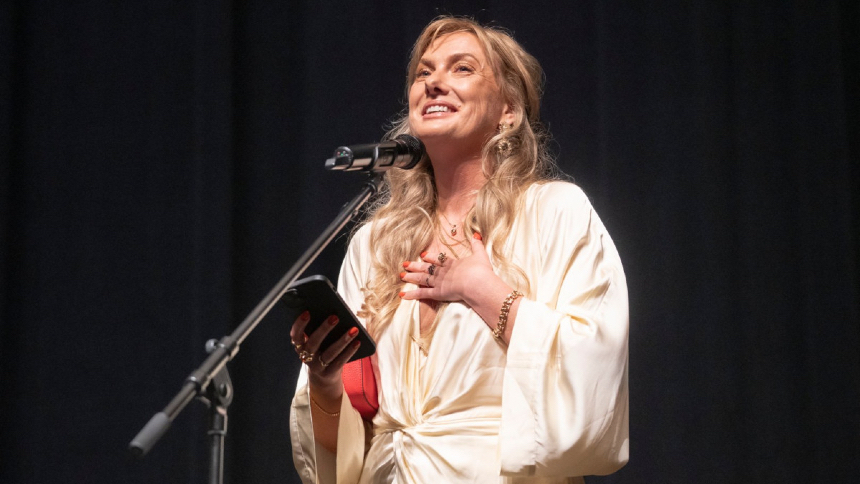
With Don’t Call Me Mama, Norwegian screenwriter and director Nina Knag makes a bold, unsettling feature debut.
Selected for the Crystal Globe competition at Karlovy Vary, the film unfolds as a quiet, slow-burning character study of a woman navigating the fraught terrain between empathy and exploitation, compassion and control. At its center is Eva, a married literature teacher in a stagnating marriage, who develops a complex and ultimately destructive connection with a much younger refugee.
Knag’s approach is unflinching but never didactic. Co-written with Kathrine Valen Zeiner, Don’t Call Me Mama resists simplistic inversions of familiar narratives. It doesn’t offer a "Lolita in reverse" or a mere provocation, but rather an intimate, morally ambivalent exploration of female desire, social privilege, and the institutional power one person can wield over another.
In a talk with Screen Anarchy, Knag reflects on the origins of the project and the challenges of writing an ethically ambiguous protagonist. She also delves into working with intimacy coordinators, the gradual genre evolution from domestic drama to psychological thriller, and the creative risks involved in portraying a woman who both reclaims her agency and loses her moral footing.
You found the story by accident. Was it during research, or how did the idea come about?
Nina Knag: Yeah, actually, I was researching another project, a drama series I was writing at the time. And in that process, I met a lot of young refugees living in Norway, and also quite a few women volunteering. Then I suddenly came across some news during my research, reports about middle-aged women who were helping young, especially Syrian, refugees, and who started having sexual relationships with these young men they were supposed to support.
That was really shocking to me. I mean, I’d met both the women and the boys, and it just never crossed my mind. So I was a bit like, wow, is that really possible? And I became very curious, who are these women? At first, I judged them. I had this image in my head of what kind of woman would do that, and I felt pity. I couldn’t relate to it at all.
But then, as I started writing the character, well, you can’t really judge a character you’re writing. So I tried to put myself in her place and ask, what if this were me? Or you? Or anyone? And that’s how I started developing a character I actually liked. I wanted her journey, and the boundaries she crosses, to feel complicated, even painful.
My goal was to create a complex character with both good and bad sides. And it was also very much about power dynamics. We’ve seen a lot of stories, especially post-#MeToo, about men misusing their power. But we haven’t really heard as much about women doing that, and that really interested me.
Especially the fact that he, this boy, was a refugee, an asylum seeker. So it wasn’t just about her being older and him being younger. It was more about her being in a position of power, and him really needing her help. That creates a very interesting power dynamic.
The screenplay credits also Kathrine Valen Zeiner as a co-writer. Did she come in early or later in the process?
So I worked on it alone for many, many years. I had consultants here and there, but I wrote the script myself. And then, around four months before shooting, because of the budget, we had this very strict timeline: 20 days of shooting, that’s it. And I had a 90-page script, and I knew we’d have to make compromises.
So I asked Kathrine Valen Zeiner to take a look at it, initially just as a script doctor. But I really loved her notes. By that point, I was so blind to the material that I asked her, “Would you like to write one or two drafts?” So that’s how she came on board, very late in the process, just a few months before shooting.
The whole story was already there, but she helped me tighten it, make the compromises we needed, and work on the dialogue, to make it better, sharper.
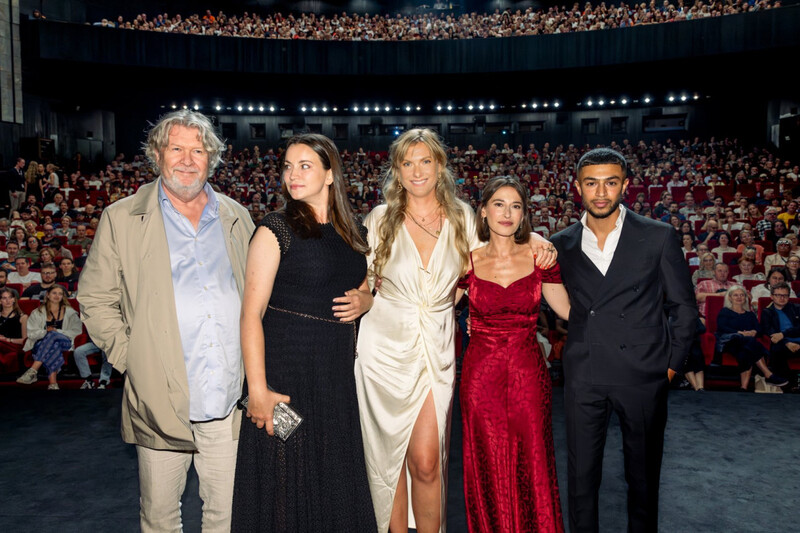
Producer Per-Olav Sørensen, Director of Photography Alvilde Horjen Naterstad, Film Director Nina Knag, Actress Pia Tjelta and Actor Tarek Zayat
But the film really shifts between genres; you touch on psychological drama, forbidden romance, paranoid thriller, even revenge drama. Was that part of the script from the beginning?
Yeah, I think so. For me, it was a drama from the start. But as I was writing, I felt I wanted to make it an intense drama, and then, over time, it just naturally started touching on thriller elements, and also the erotic side.
As I developed the character more deeply, it kind of became more erotic in a way. So I’d say it’s a drama with erotic and thriller elements. I don’t know how you see it, but I wouldn’t call it erotic in the surface sense.
I didn’t find the film really erotic.
Yeah, I get that. I don’t mean erotic like spicy or explicit. For me, it’s more about Eva, the character, and how disconnected she is from her husband. She feels like she’s dead, as a woman. Her sexuality is gone. And then she meets this young person, Amir, who sees her. And she feels awakened again, as a human being.
So it’s not just about sex, it’s about reconnecting with herself, with her own sexuality. And that might, through Amir, even help her reconnect with her husband, or at least with her sense of self. That’s what I mean by erotic, it’s more psychological. It's not about making something spicy.
So you never intended to make it more explicit?
No, no. That wasn’t the intention. I didn’t want to go in that direction. For me, it was important to show her sexuality in a realistic way, but it didn’t need to be explicit.
Still, the actors are physically quite close in some scenes.
Yes, but we used an intimacy coordinator, which was really important to me, especially because the relationship is between a mature woman and a young man. It's a story about power and imbalance, and I wanted to make sure the actors felt safe. Without that, things could’ve become uncomfortable, especially for the actors.
Pia Tjelta, who portrays Eva, is very experienced, but Tarik Zayat, who stars as Amir, is not. So our intimacy coordinator, Camilla Glaister, worked closely with us. She’s actually also the co-casting director on the project, we cast the film together, and she’s one of the first trained intimacy coordinators in Norway.
So how did that work on set?
We had conversations with the actors before shooting, and we choreographed the scenes together, me, the intimacy coordinator, the cinematographer Alvilde Horjen Naterstad, and the actors. It was almost like a dance. We planned every movement. Even though the film itself is shot very freely, handheld, those intimate scenes were very carefully structured.
So the actors knew exactly what was happening, and they felt protected, there’s no actual skin-to-skin contact. That kind of preparation helps create safety on set, and I think it’s incredibly important, especially with younger or less experienced actors.
Is using an intimacy coordinator required by law in Norway?
No, not by law. But it's becoming more and more common. It’s definitely something I chose to do, I could’ve said no, but I really believe it should become the norm.
And were the intimate scenes rehearsed beforehand?
Yes, we rehearsed them. We had to figure out how to make it look authentic, because sex on film is never real. It has to feel real, but it’s all pretend. And that can be really tricky. You think it’s just acting, but it’s actually quite hard to get it right.
I read that it was difficult to find your lead actress until Pia Tjelta came on board. Why do you think that was?
I think I met a lot of skepticism, because of the subject matter. Some actors were judging the character. Others were afraid of the intimate scenes. But mostly, I think it was about the theme, a mature woman having an affair with a young, vulnerable man. That’s still a bit taboo, you know? We’re not really used to seeing female characters cross those kinds of uncomfortable boundaries.
But Pia, she loved it. That’s her dream role. She wasn’t afraid at all. I even asked her, “Are you sure you want to go into this?” And she just laughed. She said, “Afraid? No! That’s why I’m an actor, I want to push boundaries.” And I just knew, this is the actress I need. Someone who’s not afraid of controversy, someone who can embrace the character without judgment. And for me, she’s the best actor we have in Norway.
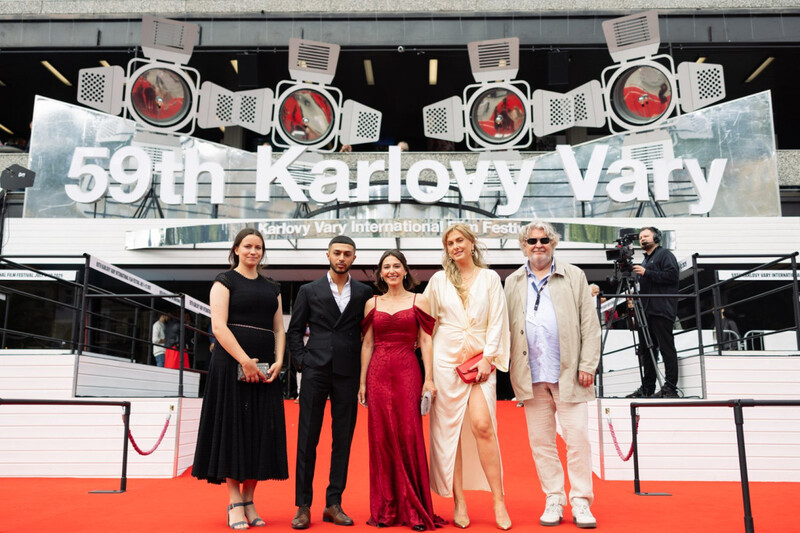
Director of Photography Alvilde Horjen Naterstad, Actor Tarek Zayat, Actress Pia Tjelta, Film Director Nina Knag and Producer Per-Olav Sørensen
Do you think the film will create a controversy?
I think… maybe. Some people might be provoked by the choices Eva makes. But I don’t want to be moralistic or preachy. I want to raise difficult questions, about power, about desire, about responsibility, but I don’t want to provide all the answers. I’d rather the audience reflect on it themselves.
Hopefully it’s a film that stays with you after the screening and can be interpreted in different ways. I don’t really want to tell people what to think.
I see. But in terms of controversy, LOLITA is from 1955, so that kind of story has existed for a long time. Why should this be considered provocative now? I mean, older women with younger men doesn’t feel like such a social taboo anymore.
Yeah, I agree. That part doesn’t feel provocative to me either. I think what's more provocative is that it’s a woman, an older, white, privileged Norwegian woman, who ends up using her power over a vulnerable young refugee. That imbalance is what I think makes people uncomfortable.
She’s idealistic. She’s married to the mayor. They’re left-wing, they believe in helping people. “We must open our homes, do the right thing,” you know. But when he, the refugee, gets too close and threatens their carefully curated facade, suddenly he’s not welcome anymore. That’s the hypocrisy. There’s this fragile line between empathy and judgment, between desire and destruction. And I think many people live right on that line.
It’s also about how far you’re willing to go to protect your own skin. That’s human. I wanted to look at this from her perspective—the perspective of someone privileged, someone who genuinely wants to do good, but ends up doing harm when her comfort is threatened. She turns, and it’s not out of cruelty, but out of fear and desperation to cover her own lies and save herself, her marriage, her image.
And then it becomes cynical. But still, I think every character in the film has a deep need to connect with another human being. For Amir, it’s life or death. He’s trying to get his asylum status, his “golden ticket” to stay in Norway, if he fails, he’s sent back to Syria, to war.
For Eva, it’s about loneliness. She’s lost connection with her husband. She needs to feel seen. And Amir sees her. And for Jostein played by Kristoffer Joner, her husband, it’s also about connection. He’s made mistakes, he’s done something stupid, but he still loves her, and he wants to rebuild what they had. So everyone is trying to connect. But it ends up turning into something really cynical.
Honestly, the first thing I thought of while watching wasn’t LOLITA, but Medea. That sense of female rage, and the destructive force it can become.
Oh, Medea! No, I didn’t think about that while writing, but that’s an interesting comparison. Really. I mean, I can see it. I actually thought more about Shakespeare at times.
You know, if you look at it a certain way, it’s like: there’s this married couple who’ve lost their connection. Then a stranger enters. And the wife connects with him emotionally and physically. And through that, there’s maybe a spark that reignites something in the marriage too. But then, it’s like, “get rid of him,” and they go back to their life.
-thumb-800x533-99118.jpg)
So like accidental marriage therapy?
(Laughs.) Yeah, maybe! But the thing is, Eva’s done something she’ll have to live with. She’s broken inside. So even if she gets her life “back,” it’s not without consequences. And so you have to ask: who’s the winner here? Are there any? Or are they all losers in the end? I don’t know. I really don’t.
Did you work with psychologists, like marriage counselors or therapists, while preparing the script?
Me, personally? No. But Pia did a lot of work on her character, and I know she talked to a psychoanalyst or someone like that. That’s how she works, she really dives deep into the psychology.
For me, no, it was more about a lot of conversations. I involve the actors a lot in the process. We talk, we discuss, we try to figure out the psychology of the characters together. Because for me, film is psychology. So it’s something I explore a lot, but I didn’t officially consult anyone.
Was there any improvisation on set?
Yeah, there was! But it was really important for me to have a strong script first. If you have a good foundation, then it’s much easier to be free. I always do long takes, no cuts, and then I let the actors be more playful. So we’d always do one version close to the script, and then sometimes we’d try something looser.
Especially with Kristoffer Joner, he loves giving me different versions. He’d say, “Nina, I know you want it this way, but I’m gonna give you something else too.” And that often led to really exciting moments. I won’t reveal too much, but yeah, he really enjoys that process. And I think it brings something alive in the scenes.
Aslo Amir writing the poem wasn’t in the original script. I knew I wanted him to read something, a poem, but I just couldn’t write it myself. I tried, but it didn’t work. We looked for Norwegian poets who could maybe help, but it didn’t click. Then Tarik said, “I can try to write something. I’ve done some research.” And I kind of laughed, like, “Wait, have you ever written poetry?” And he said, “No, but I can try.” So I said, “Okay, good luck.”
And two weeks later, he sent me two poems, and I was so touched. They were emotional and so genuine. So in that scene, where he reads the poem, he was reading his own words, out loud, for the first time. And Pia had never heard them before. So her reaction is real. It surprised her. That kind of surprise,that truth, it makes a scene special. I’m really proud of that one. Sometimes the unplanned moments turn out to be the most powerful.
Are you working on another project, maybe that series you mentioned earlier?
I’ve been working on the series for years. But the TV industry in Norway has been a bit slow lately. I’m hoping that now, after this film, it might be easier to get financing.
It’s an eight-episode drama series. I’m the creator and director. It’s about a 17-year-old Afghan boy who comes to a small town in Norway and falls in love with a Norwegian girl. He’s going to be deported, so they decide to escape together, it becomes a road story from Norway to Paris. It’s a first love story, but it also has a political dimension underneath.
And I’m also working on a new feature film. It’s still very early, but it’s more personal, more intimate. It’s a love story about losing someone, but also about how you go on afterward.
Actress Pia Tjelta won the Best Actress Award for her role in Don't Call Me Mama at the Karlovy Vary International Film Festival 2025.
Photos courtesy of Karlovy Vary Film Servis.