
Destroy All Monsters: More Niche Than Niche, And Other Lessons From Kevin Smith's TUSK

Spoilers for Tusk in the article below!
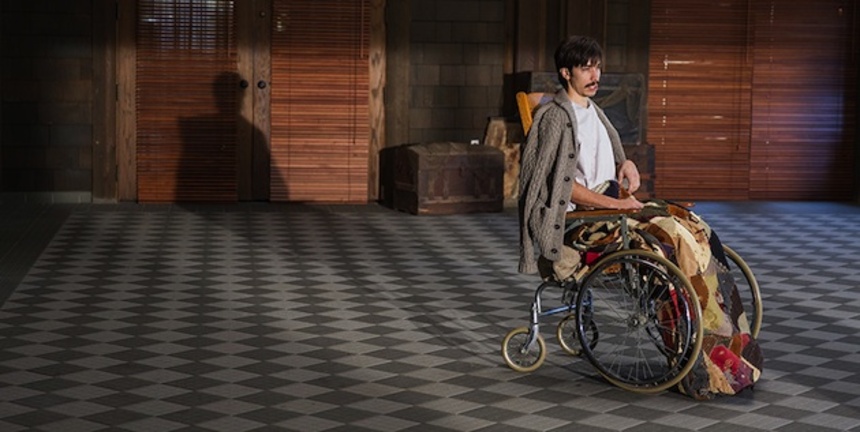
In Tusk, a dipshit podcast host with the world's most ridiculous moustache (Justin Long) gets abducted by a madman, surgically altered, and sewn into a fleshy walrus suit. His captor, who goes by many names and is played to sun-dazzled perfection by Michael Parks, once survived a shipwreck and spent the next several months in a period of unparalleled bliss, living on an island with a benign walrus he named Mr. Tusk. Now, this man periodically enslaves passers-by and implements his transform-into-walrus scheme, and forces them to participate in recreations of those happy, walrus-adjacent months.
This is cinema.
It's cinema of a certain type, certainly; the payoff of Francis Ford Coppola's long-ago assertion in Hearts of Darkness: The Making of Apocalypse Now that when filmmaking technology had become sufficiently democratized, personal cinema of the future would be made by "a little fat girl in Ohio."
Skip forward a couple of decades, throw in the content-creation free-for-all of the internet, and swap out "boy" for "girl" and "New Jersey" for "Ohio," and you have Kevin Smith and Tusk.
The particulars of how Tusk was conceived and financed aren't important. What is important is that it was conceived and financed, and made and finished and all of those things, and premiered as a Premium screening in the Midnight Madness program of the Toronto International Film Festival. Tusk is the nutshell inside which the future of cinema is jiggling.
For a while now I've been tracking a theory that cinema is in the process of splitting in two, possibly into two new forms we aren't even going to call "movies" any more. But at the very least, I believe there will continue to be the very high end, "blockbusters" style entertainment that exists to drive moviegoers into very large cinemas (at very high price points), and will supply them with sensoramic light-and-sound shows that can't be duplicated in the home environment.
And at the same time, I believe there will continue to be the very low end, "streaming media" style material that will exist independently of the traditional distribution chain, surviving as endless pipe-grease for the omni-sized content pipeline that is the online world.
Tusk is a prototype of what will be daring and useful about the second category, because it's the sort of movie that seems to suggest that broad marketability - for the low-end stuff, if never for the high-end stuff - can be seen to be a thing of the past. I don't know how much Tusk cost to make and I don't want to play pundit on its ability to make that money back in a traditional distribution system (the film is being released traditionally, unlike its predecessor, Red State); but I'd argue that at some point in the near future, you won't have to be Kevin Smith to make a movie that is this defiantly uninterested in being anything other than exactly what its filmmaker wants.
Smith's an interesting guy. He becomes fascinated by the very far boundaries of human social interaction; if urban legends didn't exist before him, he'd have had to make them up to satisfy his interest. That's what his expansive podcast network is fed by: raconteuring of the absurd and the hilarious in a variety of streams, but all returning to the same core principle, the ability to recognize and exploit a "holy shit" story.
There was a bit of that urge in Clerks II, which concluded with an on-stage sex act between man and donkey (reportedly the reason Rosario Dawson signed onto the film), for no seeming reason other than that it delighted Smith to contemplate the transgressive weirdness of gathering one's friends to observe an act from the far side of the boundaries of acceptability.
Tusk (and to a lesser extent, Red State) are further notches down that pole (Tusk is much further down that pole). The "urban legend" approach to storytelling has inflected his writing since the beginning (what, exactly, did happen to Julie Dwyer in that pool?), but with Tusk, Smith has sorted out that it's no longer necessary to reel his entire audience back in with a standardized genre template or soothing set of mainstream deliverables.
He wanted to make a movie where a hapless doofus gets forcibly turned into a walrus, with a maximum of body horror, a sad song over the end credits, and an unrecognizeable Johnny Depp as an American's bird's-eye version of a French-Canadian police detective... so he just went and did it.
His marketing focus group? A podcasted request for listeners to tweet with the hashtag #WalrusYes if they wanted to see the movie he'd described, and #WalrusNo if not. According to Smith (in what is almost certainly another one of his personal fables), he only got one #WalrusNo.
And that's it: that's the new paradigm for content readiness in the streaming age. If you want it, and we can reasonably make it, we will do it, and make no concessions whatsoever to any mainstreaming beyond the tiny pocket of pop culture that you (the tweeters of #WalrusYes in this case, along with Saturday night's Midnight Madness audience) specifically represent.
It closes the loop in a weirdly specific way on Kevin Smith's work style from day one; what might have been considered a detriment in the Clerks days is a virtue in the era of Tusk. The world finally caught up.
Smith's in a vaunted position from which to make these kinds of Brechtian monstrosities, but whoever makes the next instance of a Tusk won't be. Getting high with your friends and riffing shit on your podcast is getting closer and closer to the middle of the content-creation process. The streams are widening, and on the low end, we are really going to start to get inside peoples' heads.
Destroy All Monsters is a weekly column on Hollywood and pop culture. Matt Brown is in Toronto and on twitter.

Around the Internet
Recent Posts


