
D.W. Griffith on Blu-ray: THE BIRTH OF A NATION & WAY DOWN EAST

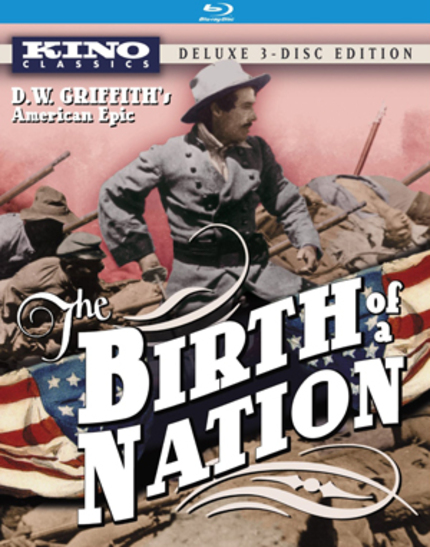
Thanks to Kino, I've seen more silent films in the last few months than in the entire first thirty years of my life. Their latest releases are the Griffith films Way Down East and the notorious The Birth of a Nation. Both films share several attributes and lead us to understand something about Griffith's character and beliefs, but they also act as opposites, with Way Down East, and Intolerance before it, almost acting like apologies for The Birth of a Nation. Kino have done a fine job with the restoration of the latter film, and the two discs worth of supplements are very interesting and worth the time of anyone interested in further exploring the film. Way Down East also has some interesting supplements, but those are logically less for the lesser film.
Almost a century after its release, THE BIRTH OF A NATION remains one of the most controversial films ever made... a landmark achievement that continues to fascinate and enrage audiences. It is the epic story of two families, one northern and one southern, during and after the Civil War. D.W. Griffith's masterful direction combines brilliant battle scenes and tender romance with a vicious portrayal of African Americans. It was the greatest feature-length blockbuster yet to be produced in the United States, and the first to be shown in the White House. After seeing the film, President Woodrow Wilson declared it was "like writing history with lightning!" In cities and states across the country, the film energized the National Association for the Advancement of Colored People (NAACP), which tried to have the film banned, or at least the most gruesome scenes censored. The film also inspired African Americans to move into filmmaking as a way to offer alternative images and stories.Whenever anyone talks about The Birth of a Nation, they always throw in a big "but". As in, "This is one of the finest American films, BUT the inherent racism is truly rancid", or something like that. Well, I can really see what they're talking about, though I see Birth as a gateway to other great films more than just being a great film in itself. With this film, Griffith introduced scale into feature films in a new way. The action was big, the drama was big, and the emotions were all big. There are segments of The Birth of a Nation that are thrilling to watch, however, these are inevitably juxtaposed against some hideous characterization of power-drunk blacks in the south. The result is a highly untrustworthy narrative that smacks of retroactive propaganda.
The first half of the film deals with the the Civil War, or the War Between the States as it was known in the South. These segments are largely unoffensive, if one can screen out the numerous actors in blackface. However, they are also filled with ridiculous moralizing and pedantry. The characters are shown to move from opulence to poverty in the aftermath of the war, which was accurate enough, but they are also shown has having slaves (in blackface), who'll do anything to keep their "massas" happy. The intertitles provided when blacks are speaking are just horrendous, unintelligible phonetic gobbledygook. Yet the southern drawl isn't written out phonetically, in fact, all of the characters seem to speak with a Bard-like eloquence. This is only the soft racism in the film.
Once part two opens up and the South loses the war, the racism becomes overpowering. Apart from the most famous plot twist which has a mulatto man abducting a white woman, who must be saved by the Godly Ku Klux Klan, the film is saturated with sickening depictions of blacks. They are seen as shiftless layabouts, even when blacks are elected to post-war positions in South Carolina's legislature, they are shown as pontificating and gyrating all while eating fried chicken, picking their toes, and swiggin' whiskey on the House floor. Griffth attempts a caveat at the opening of the film and at the intermission stating that these depictions in no way reflect on current times, that they are based on historical documents, but that assertion fails on a number of accounts. The most damning proof being that while the Civil War sequences were meticulously researched for authenticity, Griffith relied mostly on Southern political cartoons for his depictions of blacks.
The Birth of a Nation certainly has earned its place in film history. The epic three hour length managed to cement the idea of the feature as the film going experience of preference. The action is pretty astounding, and Griffith's cinematography of those outdoor action sequences is very dynamic, despite the lack of camera movement. Birth is a riveting experience for someone in the mood, however, its drawbacks are almost too heavy to bear. The transformation of the Ku Klux Klan into heroes is nauseating. The blackfaced depiction of blacks is insulting even for 1915, and the moralizing and intolerance of the film are almost unbearable. Which leads us to Way Down East...
When watching Way Down East consecutively with The Birth of a Nation, the differences in approach are startling. Way Down East is essentially a story of tolerance, and an apology to the women of the world for the poor way in which men have treated them. Griffith faced such a firestorm of rage after the blatant racism of Birth, that his next work was titled Intolerance and was one of the largest productions ever mounted in Hollywood. Way Down East is another appeal to decency from Griffith, which features even more moralizing than Birth, if that's possible, but under the guise that tolerance is the highest quality a man can possess. It's as if he is simply trying to show the world that he's not the asshole he just spent three hours convincing us that he was.D.W. Griffith's penchant for Victorian melodrama reached its height of expression in WAY DOWN EAST. First performed in 1898, Lottie Blair Parker's play was one of the most successful stageworks ever written, a theatrical chestnut, heavy with sentiment, that cried out for the touch of the master. Griffith captured the appeal of Parker's original, while embossing it with devices borrowed from other popular melodramas, such as the climactic chase across an ice floe (inspired by stage adaptations of Uncle Tom's Cabin).
Lillian Gish stars as a small-town girl who is seduced, impregnated, and cast aside by Lennox Sanderson, a wealthy playboy (Lowell Sherman). To escape the shame of having a fatherless child, Anna changes her name and starts a new life in a small farming community, where she meets David, an icon of male virtue and decency (Richard Barthelmess). Their delicate happiness is threatened when Lennox arrives in town, and word of Anna's unsavory past begins to spread.
Way Down East is a far more conventional story than Birth. The plot is hackneyed and melodramatic, sort of like a silent Douglas Sirk, only with less going for it. The Victorian morality on display is at odds with the impending freedom that the 1920's ended up being known for. Perhaps Griffith saw the Roaring '20s coming and was hoping to stop them dead in their tracks, who knows? However, Way Down East is certainly easier to stomach than The Birth of a Nation, at at a mere two and a half hours, it practically whips by.
While not as epic or ambitious as Birth, Way Down East has some genuine appeal. First of all, there are several genuinely likable characters in the film. Anna Moore, the downtrodden protagonist, is a warm soul who has been mistreated by everyone she encounters in the film and you'd have to have a heart of stone not to empathize with her. Similarly, her rescuer, David Squier, is as upright a human as you are likely to find anywhere. The photography is less flashy than Birth, but climatic ice floe rescue sequence is still dazzling today, and well worth watching.
As different as these two films are, they both indulge in kitchen sink melodrama and questionable pontificating. With Birth, Griffith takes a definite stance for the Ku Klux Klan, which was still a viable political force in 1915 America, even though they'd fallen out of favor among the middle of the road Americans. He chooses to use contemporary documents to illustrate his point, without the acknowledgement that perhaps those documents may be skewed in their view of reality. Way Down East attempts a complete 180 in terms of tolerance, but only to say that women deserve better than men have given them. A noble and kind outlook, perhaps, but naive and old fashioned, even for 1920. Of the two films, Birth is certainly the more engaging. For all of its faults, the film is still, at times, rollicking and exciting, once you get past all of that pesky bigotry.
The Discs:
For this three disc edition of The Birth of a Nation, Kino have repackaged their old two disc version with an additional Blu-ray. The new disc includes a new and vastly superior restoration of Birth along with two uncompressed audio accompaniment tracks. Also new to the disc are materials from the film's 1930 re-release, including a conversation between Griffith and actor Walter Huston, and original Intermission cards from that version. That is all for the new material. The ported material includes a 24 minute featurette on the making of controversy following Birth's release, a 1993 restoration on DVD, and a number of early Griffith Civil War shorts. This stuff is neat, but it is really the featurette and the handsome new restoration that make this disc worth owning.
Way Down East gets a good treatment, though not quite the thorough treatment that Birth does, and understandably so. The image quality on Way Down East is a big step down from Birth, the source materials look to have been in pretty dire condition with lots of print damage and several missing sequences, as well as newly created intertitles. The audio accompaniment is very nice, though, and supports the narrative well. In terms of extras, Way Down East gives us a one minute excerpt of a 1903 adaptation of Uncle Tom's Cabin that served as inspiration for the former film's incredible ice floe sequence, as well as 20 pages of text giving background on the differences between the stage play and filmed versions. It sounds boring, but after watching the film, it wasn't painful reading.
Kino has committed to conserving silent films in a big way, and they deserve our support for that. These two packages are certainly worth checking out.

Do you feel this content is inappropriate or infringes upon your rights? Click here to report it, or see our DMCA policy.


