ANONYMOUS Review

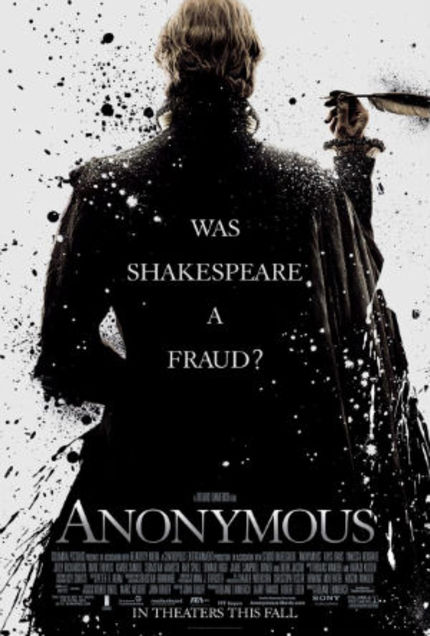
Roland Emmerich's Anonymous is a disaster movie of another kind. Over the past 20 years or so, Emmerich has steadily pumped out large-scale action pictures that provide a reliable source of entertainment for the masses. Thus, it's completely fitting that he turn his attention to popular entertainment of the late 16th and early 17th centuries.
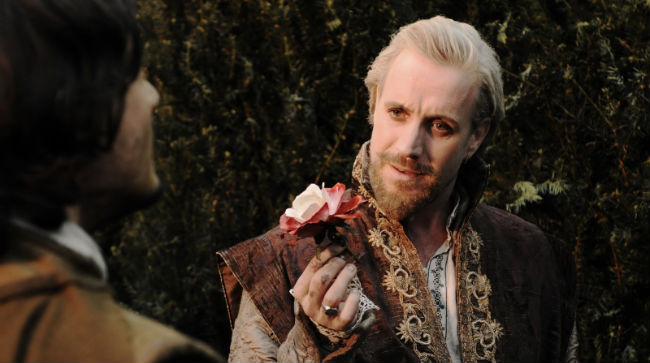
As with all of Emmerich's films since 1992 -- Universal Soldier, Stargate, Independence Day, Godzilla, The Patriot, The Day After Tomorrow, 10,000 BC, and 2012 -- his newest endeavor mixes together the best visual effects possible, a mawkish sense of drama, and intermittent attempts at comedic relief. Occasionally, there is a surprising performance that stands out, and that distinction in Anonymous belongs to Rhys Ifans as the Earl of Oxford.
The Earl is a tragic figure, coming to the royal household of Queen Elizabeth I as a dashing, confident young man who desires to express a creative fire that burns within his soul, but also wishing to be a mighty man of war, as well as a protector of the young, flighty monarch.
The Earl and the Queen, played in their younger years by Jamie Campbell Bower and Joely Richardson, respectively, enjoy a comfortable, familiar relationship, which only serves to put Lord William Cecil (David Thewlis), the Queen's most trusted advisor, further on guard. Cecil has his own agenda, which he discloses to no one in full, but he definitely doesn't want the Earl and the Queen to get too close.
Forty years later, the Queen (Vanessa Redgrave) is coming to the end of her life, and the question of who will succeed her is paramount in the thoughts of Lord Cecil (still played by Thewlis) and his hunchbacked son Robert (Edward Hogg), while the Earl (played by Ifans) has his own strong feelings about the matter. In secret, the Earl has expressed himself creatively by writing dozens of plays, exposing the backstage intrigue of the royal household by setting them in earlier historic eras.
Plays are officially frowned upon, and to admit authorship of a play would demean the Earl's standing in life. Still, he's convinced that the underlying message of his comedies and tragedies need to be heard by the people, so he begins to pass his plays along to young Ben Jonson (Sebastian Armesto), a struggling playwright. The Earl insists on strict anonymity, but he's willing to pay handsomely, and Jonson reluctantly agrees to get the plays mounted and staged anonymously. When the first play is met with wide popular acclaim at its first performance and cries of "Author! Author!" echo through the theater, Jonson's friend William Shakespeare (Rafe Spall), a boorish, illiterate actor, cannot resist bounding up on stage and claiming authorship.
And that's why the wrong man has been credited for centuries as the greatest playwright to ever live. The end.
Except it's not, because Emmerich is much more interested in the royal intrigue, and so most of the movie is devoted to the machinations of Lord Cecil and/or his minions, along with the Earl of Oxford and his confederates, as they scheme and struggle to have "the right person" to wear Queen Elizabeth's crown after she dies. To further that intrigue, the film shuttles back and forth endlessly between the two main periods -- let's call them B.S. (for "Before Shakespeare") and A.S.C.C. (for "After Shakespeare Claimed Credit") -- which makes it devilishly difficult to track the relationships between characters and how they have shifted over the decades.
The narrative confusion in the script by John Orloff is furthered by the decision to have Thewlis play his character both as a younger and older man, the latter buried upon a mound of makeup. It's never easy to decipher how a young Earl relates to an old Lord, or how both relate to the Earl of Southampton, much less to a Queen played by two different women.
It almost seems as though Emmerich missed the ability to cut between different groups of characters dealing with large-scale disaster in different locales, as in Independence Day, The Day After Tomorrow, and 2012, and so in order to approximate that experience, he cuts wildly between different periods of time. There seems little other reason to structure the film in this often-incoherent manner; we gain no additional understanding of the characters, because we spend half the time trying to identify who they're supposed to be playing and what time period it is.
The most straightforward and enjoyable portions of the film comes from the staging of the plays, which were directed by Tamara Harvey. The loud, yowling reaction of the packed crowds are welcome reminders that the plays were immensely popular entertainment in their time, and intended to be enjoyed by the common man, though deeper meanings could be understood by the educated.
The odd thing about Emmerich's impulse to make the film, which he has developed over a number of years, is that it "restores" credit -- whether that's established historically or not -- to an educated, entitled royal, who is providing the masses with what they want and need. It almost feels as though he's condescending to supply the commoners with something simple that they can understand and enjoy, while sneaking in subversive messages that only the educated and privileged will fully appreciate.
You know, almost like an educated, entitled filmmaker giving the masses what they want with "spectacle" films that threaten the destruction of the world.
But maybe that's reading too much into it, though I couldn't help thinking that, even if Shakespeare did not write the plays, it misses the point of the plays to focus on authorship, which surely matters not to people dead for centuries. What's really remarkable about the body of work is that it's still relevant and it still speaks to people because of the beautiful poetry of the words and the eternal truths about the nature of mankind that the plays capture.
Standing apart from all the speculation, Rhys Ifans is pretty terrific as a haunted man crushed by a sense of duty and motivated by a love of country and his Queen. His performance alone is almost sufficient to make up for all the shortfalls of a tragedy that isn't as persuasive as it needs to be.
Anonymous opens in limited release (about 200 locations) across the U.S. today. Check local listings for theaters and showtimes.