
Bloody Double Crosses and Fast Tiny Cars: Fernando Di Leo Crime Collection (DVD Review)

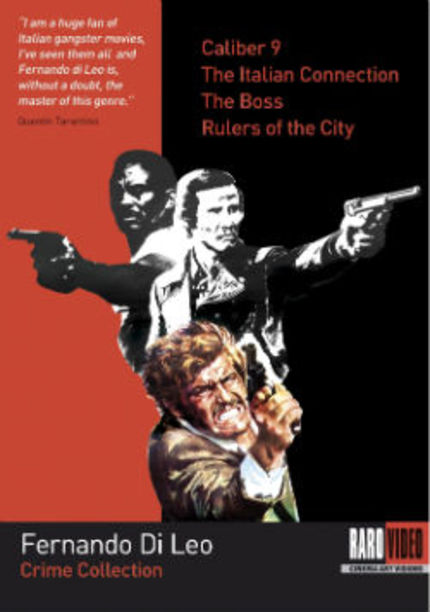
Entitled Fernando Di Leo: The Italian Crime Collection, the set features fine-looking transfers of Caliber 9, The Italian Connection, The Boss, and Rulers of the City, all directed by Di Leo and starring a handful of American stars (Lionel Stander, Henry Silva, Woody Strode, Richard Conte, Jack Palance) alongside stalworth Italian actors (Mario Adorf, Gastone Moschin, Gianni Garko) and stark raving beauties (Barbara Bouchet, Antonia Santilli, Gisela Hahn).
The first three titles make up the director's "Mileau Trilogy," all set in and around Milan and released in 1972 and 1973. Caliber 9 follows Ugo Piazza (Gastone Moschin), a small-time gangster who's just been paroled from prison. He was involved in a mission in which $300,000 went missing, and it's assumed by everyone that Ugo stole the money. Now that he's out of prison, vicious local crime boss Rocco (Mario Adorf) wants the money back. Even more so, Rocco wants to please his boss, The Americano (Lionel Stander).
Ugo is a stoic figure with piercing blue eyes. He stands by when his buddy Chino (Philippe Leroy) sticks up for him and gets roughed up as a result, but only up to a point; then Ugo joins in and beats up on Rocco and his goons. Despite his stoic nature, or maybe because of it, Ugo has loyal friends, including a beautiful girlfriend, a go-go dancer named Nelly (Barbara Bouchet).
Mario Adorf appears again in The Italian Connection, the hyper-kinetic second film in the trilogy. This time he stars as Luca Canali, a small-time pimp who is targeted for murder by New York crime boss Corso (Cyril Cusack), who sends hit men Dave (Henry Silva) and Frank (Woody Strode) to Milan to murder Canali. Corso believes that Canali has ripped them off, and so he wants him killed in a spectacular, attention-getting way, to instill fear in the Italians.
Quentin Tarantino says that Dave and Frank served as his inspiration for Vincent (John Travolta) and Jules (Samuel L. Jackson) in Pulp Fiction. There's no Scripture-quoting in Italian; Dave is a fun-loving guy who seems more comfortable drinking and chasing whores, but when he needs to get down to action, he gets it done. Frank is all business-minded and intensely focused. They're a dynamic duo, but they're well countered by Adorf as Canali, who can't understand why he'd be considered important enough to be targeted by such high-level assassins; all he does is pimp girls, after all!
[Important animal abuse / spoiler warning: a kitten is shot dead. It's not lingered upon, but it is there.]
Henry Silva stepped into the lead role in The Boss, again playing Lanzetta, a heartless killer. In the spectacular opening scene, he loads up a grenade-launcher and proceeds to annihilate a small cinema filled with gangsters. He's a trusted lieutenant in a family run by D'Aniello (Claudio Nicastro), who wanted to wipe out a rival gang in Palermo. Unfortunately for him, a survivor named Cocchi (Pier Paolo Capponi) promptly kidnaps Daniello's daughter Rina (Antonia Santilli), continually described as "a nymphomaniac and a drug addict." All this creates consternation for crime boss Don Corrasco (Richard Conte), who always puts the interests of the family ahead of everything else. "Business comes first."
[Important note of possible misogyny / spoiler warning: After Rina is kidnapped, she takes a stiff drink or two and then willingly sleeps with all of her captors, sometimes two at a time. At first it seems that she is enjoying being raped, but she's portrayed as being a nymphomaniac, which is the film's way of explaining why she enjoys sex under very questionable circumstances.]
Rulers of the City (AKA Mr. Scarface), released in 1976, completes the set. Tony (Harry Baer) is a fun-loving loan collector for a Mob family. He's quick-witted and skilled with his fists and legs, but his weak spot is his tendency to boast. That gets him in trouble when he boasts that he can collect on a debt from rival gang leader Mercuri (Jack Palance). Everyone in town is afraid of Mercuri, known as Scarface. Nonetheless, Tony is able to scam him out of the money owed, plus a lot more, which sets everyone in town against him.
The films are, above all else, smashing entertainment for boys and girls who love exploitation pictures. Shots are framed with fresh variety, the pace is breakneck, and the action is sometimes insanely brutal. Women are playthings and expected to keep their mouths shut and their legs open. Bodies get shot up with nary a tear shed over their demise. Men are "real men," with no tenderness or kindness to be displayed. Surprisingly, perhaps, the men in Di Leo's world still constantly express their emotions. It's just that the only acceptable outlet for them is sexing or killing.
At the same time, throughout all the films, Di Leo weaves in social commentary about the Mafia and criminals in general, about how they were dominating life in Milan and how that affected the rest of Italy. A couple of times the films simply stop for a spirited debate on the best ways to combat gangsters. But it's such an engaging argument that you can't help but feel caught up in the spirit of the times. And the truth is that the debate rages on today, not only in Italy and around the world. Brave to Mr. Di Leo for incorporating a sense of reality into his work.
But Di Leo never permits reality to get in the way of a good story, and always manages to incorporate furious vehicular mayhem, with tiny cars filled with bad men slamming through streets, running into pedestrians, and being used as murder weapons even after they've been smashed into oblivion. Forget Detroit's muscle cars; all Di Leo needed was four wheels and an engine.
The DVDs ...
... Look very good, especially on smaller monitors, with film-like textures that look marvelously clean and unblemished. The mono audio tracks, available in Italian and English sound fine, but there's nothing extraordinary to be found in the sonic textures. Ordinarily I'd point toward the dubbed Italian language track, which boasts improved English subtitles, but the English-language tracks give you the opportunity to listen to the American actors speaking their native language (though, of course, the non-English speakers are dubbed).
As far as extras are concerned, there's a bounty. Caliber 9 includes a 29-minute documentary on the film, which includes interview with Di Leo, key members of the cast (Barbara Bouchet talks about the challenge of being an actor in Europe and learning other languages constantly) and crew, and writers who provide specific reasons why Di Leo deserves praise. and another on the director, plus a photo gallery.
The Italian Connection includes another documentary and photo gallery. The Boss includes yet another doc and so does Rulers of the City. As soon as I get to these, I'll post updates.
Rounding out the package is a good-looking 22-page booklet containing an interview with the director, illustrated with photographs.
Fernando Di Leo Crime Collection is another great release from Raro Video USA and a valuable addition to the library of any fan of 70s Euro-crime, which should be everybody reading this!

Do you feel this content is inappropriate or infringes upon your rights? Click here to report it, or see our DMCA policy.


