Cinemalaya 2010: SAMPAGUITA, NATIONAL FLOWER Review

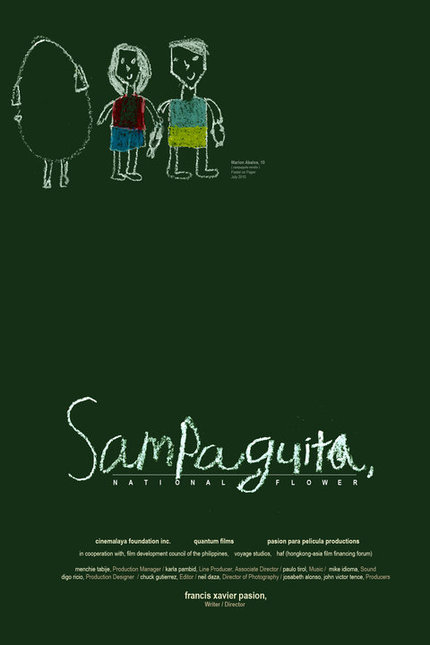
It is more than instructive
to look at Francis Xavier Pasion's Sampaguita,
National Flower with the merits of his much-celebrated first feature Jay (2008) in mind. The first feature is
essentially about eponymous Jay, a television producer who travels to Pampanga
to create a TV-documentary on the life of gay teacher who was recently
murdered, his family, and his close friends, is more than the immediate subject
matter, it delves further into the power of media, and its abuses, all in a
fine satire that is so self-aware, it reveals its own fabrication at the very
end. In a very important scene in the film, the producer, having discovered
that vital footage of the victim's mother's initial reactions upon seeing her
dead son in the morgue was corrupted and rendered unusable for his program,
instructs the mother to visit the morgue, reenact the grief, crying and
wallowing in front of a stand-in pretending to be her dead son. In all its
hilarious absurdity, the scene ponders on the very thin line between media's
role as exploiter and its duty to expose.
Sampaguita, National Flower opens with Philippine national symbols as paraded by
Filipinos living in the margins of society under the proud melody and rhythm of
the national anthem. The ironies are instantly and efficiently made obvious by
Pasion's cinematic irreverence. The narra, the national tree, plays private
quarters to a gay man and his underage victim. The Philippine eagle, the
national bird, and the bahay-kubo,
the national dwelling place, are only prints on faded t-shirts worn for
convenience, hardly for pride. The sampaguita, the national flower, pure in its
whiteness and alluring with its distinct fragrance yet produced and peddled in
the streets by the most exploited of Filipinos, is perhaps the biggest and most
readily apparent irony of them all.
In Sampaguita, National Flower, Pasion puts himself in the position of
Jay, utilizing the power of the moving image to expose social ills and in turn,
to elicit even from the most cynical of souls some sort of guilt or pathos for
the sorry state of his several subjects who are a handful of children deeply
entrenched within the sampaguita trade. Thus, he fashions his film like a
charity ad with the children over a white background answering questions thrown
by Pasion that probe deep into their shared poverty. Bulk of the film however
places the audience outside the comfortable controlled environment of the
interview room. He follows the children as they walk the streets selling fragrant
necklaces adorned by sampaguita buds, begging for leftover food, or just
gallivanting, allowing the night to pass. Clearly, these films are directed,
with the scenarios derived from children's experiences, aspirations and fears,
and the children themselves acting out their lives.
It's effective filmmaking,
to say the least. If Pasion's intent is to emphasize the pathetic state of the
country, where the moneyed middle class inhabit the same space as the poorest
of the poor, with the former accepting the obvious inequity as if it were a
normal part of life, then Sampaguita,
National Flower is a triumph. There are more than enough images of
dehumanizing suffering inflicted on the innocent to disturb the most stubborn
of spectators. However, above exposition, is there anything else to be gathered
from the film? If there are, they have been so overshadowed by this initial and
most obvious intent.
Jay worked
in so many levels: as an exposé of the murders of homosexual men; as an indictment
of media as tool for exploitation; and as an earnest reminder that cinema,
although harbinger of certain truths, is still a human creation. In comparison,
Sampaguita, National Flower feels
like an abandonment of all these themes and directions. There is a feeling that
Pasion has regressed from the self-conscious and self-aware cinema of his first
feature to this feature, where his function as director is disappointingly more
provocateur than auteur.
(Cross-published on Lessons from the School of Inattention.)