Director Jon Knautz Talks THE SHRINE!

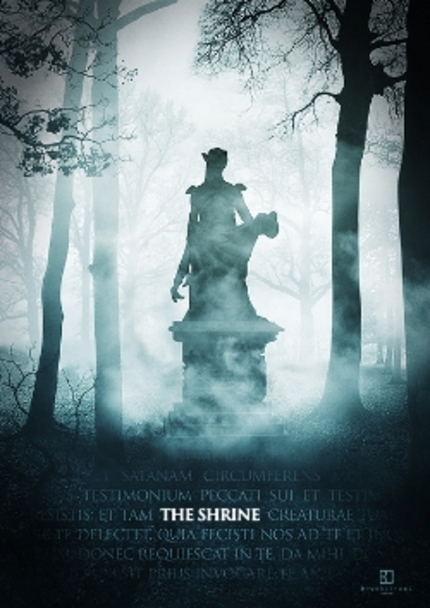
Canadian director Jon Knautz burst into international view with Jack Brooks Monster Slayer and with that film's release still fresh the entire team behind Jack Brooks is already hard at work on their sophomore feature, the much more serious-minded The Shrine. I had the chance to visit the set earlier this week and though it was just Day Two of the shoot they were already hard at it, shooting in a large scale underground temple set. Nothing like getting the blood out of the way early ...
After a young American backpacker goes missing in Europe, three journalists link his disappearance to a remote Polish village called Alvaina. Upon further investigation, the journalists discover that Alvaina has a history of bizarre cult activity revolving around human sacrifice. Hell bent on discovering the truth, they travel to the small village, but quickly find themselves pursued by a mysterious group set on killing them. Forced into the gruesome reality of true survival horror, the journalists soon discover that Alvaina hides a much darker secret than they could ever imagine.The Shrine stars Aaron Ashmore ("The Thaw," "Smallville," "Veronica Mars," "The Stone Angel,") Trevor Matthews ("Jack Brooks: Monster Slayer," "Moment of Truth," "Still Life," "Teen Massacre,") and Cindy Sampson ("The Factory," "High Plains Invaders," "Durham County."). More cast members to be announced soon. Jon Knautz returns as director for his second feature with Brookstreet Pictures, following Jack Brooks: Monster Slayer. He also co-writes with Brendan Moore. Trevor Matthews serves as executive producer with J. Michael Dawson producing. Director of photography James Griffith, production designer Craig Harris, special FX make-up David Scott, and costume designer Laura Montgomery complete the creative team.
TB: Tell me a little about the origin of this 'cause I think a lot of people were expecting that Jack Brooks 2 would be next for you guys, and it seemed like - I mean I've seen quotes from both you and from Trevor [Matthews, star of Jack Brooks and CEO of Brookstreet Pictures] that that was coming.
JK: Yeah, we developed a script for Jack Brooks 2. We developed a story and wrote a preliminary first draft but it's really not where we want it to be yet because it just needs a lot more time to get fleshed out. We need to go through a lot more drafts. It's also going to be quite expensive. Because the first one ends suggesting the next one is going to be much more of an epic adventure, it's just going to need more time and money and we're just not at that place right now to do that. When the time's right we will definitely go back to Jack Brooks 2. When? I can't say, though.
TB: So where did The Shrine come from?
JK: The Shrine kinda came from a concept that I had that was sort of based around a pretty simple concept that had a little twist at the end. I've always had the idea in my head but I wasn't quite sure how I can fit it into a story line. Then Trevor and I decided we were going to do a horror film, that we wanted to do a horror film, something that pulled away from the comedy side of things, like Jack Brooks. So then I pulled out the concept and kinda just started developing around it and found this full-length story that was really all based on the original concept, that I can't really say because it has to do with the twist. And then we just sort of built from there. I don't want to give you book references either 'cause that might suggest a couple things.... And I looked at some Mario Bava films that gave me some inspiration as well.
TB: Nice.
JK: Yeah, and then we just fleshed out the whole story. Then we took it from there.
TB: You mention Bava. Obviously I haven't seen very much of this yet, of what you're doing, but it seemed Brooks was based very much in 1980s horror comedy -
JK: Yeah.
TB: - and this seems although totally really, really different, still kinda drawing from that same era.
JK: I wouldn't say as much 80s, I'd say this would be more 60s/70s. You could say the 80s...I mean Jack Brooks is definitely more in the Evil Dead type-stuff, and even moving into the 90s with Dusk Til Dawn and stuff like that. This is going back to a little bit more of the slower pacing that film makers were allowed to have back in the 70s. So I'm trying to push into that world a little bit, but still contemporary.
TB: What draws you to that era? Do you prefer the older horror films to what people are doing these days?
JK: (pauses) Yes......
TB: (laughs)
JK: I do. I mean... I saw an interview with Wes Craven, and I thought he explained it really well about how - and I guess it's really filmmaking in general - but the horror genre seems to be a bit of a circle: it comes and it goes. We lost it in the early 90s: I thought Candyman was one of the last good horror films - I think that was '92, I might be wrong - when it came out. Then I thought we kind of lost touch with the horror genre a little bit. And then it sort of came back in '96 with Scream, which was great. And then I felt like it sort of spawned a new contemporary style that I wasn't digging so much, and then it sort of moved into what James Wan wanted with Saw and Eli Roth coming in with Hostel, and I think those were really great too. But we're not really focusing - even though we have a lot of torture and sacrifice going on in our film, we're not really focusing so much on that. There's a supernatural element to the storyline.
TB: Yeah, which was a big hallmark in the 70s and 80s. Nobody does it anymore.
JK: That's exactly it. When you look at Saw, you look at Hostel, Cabin Fever - and I love those movies - they're all based in reality and could really happen kind of thing. We've got a supernatural element going on, pschychological supernatural stuff going on that I'm definitely pulling from the 70s: Carrie, stuff like that.
TB: Yeah. I'm assuming from that that you're a very much practical effects sort of guy.
JK: Oh yeah. I mean, there's definitely going to be. We're going to use some CGI in it as we did in Jack Brooks, but pretty minimal. In Jack Brooks we used it obviously for wire removal. Stuff when you use natural elements, fire, smoke, rain at times, I find CG works great to set a mood , a tone, and an atmosphere. But when it comes to the physcial creatures, or the physical effects of blood and impact and all that, I prefer to go with practical whenever possible. Use CG if you have to kind of thing. This is definitely very, very, very practically-based.
TB: Yeah. You're shooting this one on the red: have you ever worked with the Red before?
JK: No, this is my first time shooting on the Red. I think it looks fantastic! And I'm a film guy for sure, especially when you go back and look at Bava films and stuff from the 70s and 60s, you know, and just film in general: there's nothing better than 35. That's just the thing, I think that a lot of filmmakers would agree with. The Red cam is unbelievable, I gotta say. It's at a point where you throw that up on a big screen and you can't tell the difference. It looks fantastic.
TB: Yeah. Have you see Pontypool?
JK: I haven't seen it yet, no.
TB: It's all shot on Red.
JK: Cool, cool. I'm glad to see that other people are using the Red, and that it's not like... I think film has such a nice texture and I think everyone responds to film because when you look back at films from the 70s, obviously it's all on film. I think we're trying to recreate that tone. It feels like we should be on film, but the thing that's great about the Red cam is that it's mimicking 35 so well that I feel like I still can grab that film tone and feel from the 70s on the Red cam. It looks great. I'm really happy with it.
TB: I'm curious a little bit about the way....you have a really unusual working relationship with Brookstreet. The way the company is set up, the way your relationship with Trevor works.
JK: Yeah.
TB: How is that for you as a director? In the office, Trevor is the Executive Producer, but on set, you're in the commanding seat. So how does that work together?
JK: Yeah. We have a really, really good working relationship. First and foremost we're really good friends. We've been friends for a long time now, and we drank a lot of beer and played a lot of Halo, so that connected us pretty good.
TB: (laughs)
JK: But we both have a really similar appreciation for film and very similar tastes as well. When it comes to style, we're very much on the same page. And we're both executives in the company: Trevor's the CEO I'm the VP, but there's a really great mutual respect. And then we swap hats when we go to film a movie, and I jump on board as Director, and he jumps on board as an Actor, and he understands and respects the role of the Director and we just have a really good understanding of the decisions, what we need to do. It all just works, and we meet all the time to discuss things. It's fantastic to work for Brookstreet. I couldn't be happier.
TB: And you've made Trevor a villain in this film?
JK: Yeah. (laughs) He's one of the.... pivotal.......characters in the village. Yes.
TB: (laughs) And he enjoyed the change: a chance to be the villain instead of the hero?
JL: Yeah. I think it's so cool that Trev didn't want to play the male lead, though he has quite a large part. He has a very pivotal role, but it's a very different character than Jack Brooks. He will be a very memorable character when the film's over. He chose to play this role because the character Henryk, what he's playing at really interests him as an actor and I think it's cool that he didn't jump on board to take one of the main roles and to play a little more on the sidelines. I think that's respectable and cool.