Review: PRIDE AND GLORY

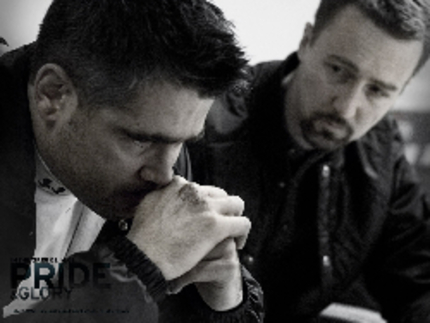
Superbly modulated and thrilling in its subtle intensity, Pride and Glory admittedly doesn't break any new ground. The elements are almost numbingly familiar: a family of cops, New York's mean streets, loyalty, brotherhood, and corruption. Yet director Gavin O'Connor and a top-notch cast led by Edward Norton, Colin Farrell, Jon Voight, and Noah Emmerich transform what could have been a routine story into a transfixing piece of darkly brooding literature.
Four police officers are killed in the line of duty, prompting the formation of a special task force to quickly find the culprit. The murders were committed in Washington Heights, a rough neighborhood at the northern edge of Manhattan, falling under the jurisdiction of Precinct Commander Franny Tierney (Emmerich). Tierney's father Francis (Voight) is a high-ranking police official, his brother Ray (Norton) is a detective in Missing Persons, and his brother-in-law Jimmy Egan (Farrell) is a cop on the beat under his command.
The family has tight bonds, helping each other deal with challenging circumstances. Franny's wife Abby (Jennifer Ehle) has cancer, Francis Sr. struggles with the bottle, and Ray's marriage to Tasha (Carmen Ejogo) has broken up. With his loving wife Megan (Lake Bell) and two cute young daughters, Jimmy appears to be the lucky one.
Francis Sr. offers to call in a favor and get Ray onto the task force; he wants him to get back on the streets and, without saying so, get back on the promotion track that he and Franny have followed. Ray has a nasty scar on his cheekbone and is clearly harboring emotional scars as well, but he bows to his father's wishes. His investigations reveal evidence that a dirty cop may have tipped off the gangster accused of killing the four police officers.
Before that happens, we already know the truth: warm, loving Jimmy is mixed up on the wrong side of the law.
A welcome degree of moral complexity is introduced early in the story. Forget about black and white, right and wrong, good and bad; instead, Pride and Glory suggests that everyone has different boundaries, lines of conduct that they will or will not cross. How much corruption can be tolerated in the name of reducing crime and getting gangsters off the street? How far will someone go to preserve family ties, especially when young children are involved? What must be done to protect the good name of the police when a few very rotten apples are in the cart, threatening to turn the whole thing over?
Everything takes place within a short period of time; correspondingly, the characters are revealed bit by bit, in between vigorous scenes of police work, as the film's perspective shifts from one to another. Like dull gems whose beauty doesn't shine until they're polished, the deeper and often conflicting emotions and motivations of Ray, Jimmy, Franny, and Francis Sr. don't show up immediately. When they do, they feel genuine and convincing.
Norton, Farrell, and Voight turn in note-perfect performances. Norton simmers in turmoil, with a degree of self-loathing but also steely determination not to make the same mistakes again. Farrell conceals a ball of furious, righteous anger under multiple layers of familial love and comfort. Voight is the grand patriarch, set in his ways, prone to overdrinking, deeply proud of his children, and still capable of commanding respect and obedience from them.
There are a host of other sharp turns; the large cast merges with their roles and blends easily into the background as needed, popping out into the foreground at unexpected moments.
The screenplay, credited to Joe Carnahan (Narc) and Gavin O'Connor, is excellent, especially in its intelligent manner of telling the story. Some scenes are heavy with dialogue, but not with exposition; there's no one standing around telling a close family member what they already know, just for the sake of making relationships or family history crystal clear to the viewer. It's assumed that you can make assumptions based on what you've seen and don't need everything spelled out; as a viewer, it feels mighty good to be treated with respect. The script also includes atmospheric touches that lend authenticity, like Ray being the only cop who speaks Spanish, despite the precinct's location in a neighborhood that's probably 99% Spanish-speaking -- the other cops constantly insult the language and berate the locals for not speaking English.
As director, O'Connor smoothly and seamlessly shifts from whispered confidences quietly exchanged to pulse-pounding police work to a truly scary interrogation involving a hot iron. He captures the realistic dynamics of family arguments, those uncomfortable, strained exchanges that can dance from quiet, anguished frustration to the highest pitch of near-hysterical, uncontrolled angry outbursts. And always ... the recriminations, all on display and popping up at the most unexpected times.
Perhaps I've seen one too many disappointing theatrical releases lately, but Pride and Glory strikes me as one of the finest dramatic films of the year.
Pride and Glory opens wide in the US on Friday, October 24, in Greece and Italy next week, and in the UK the week after that, with releases in France, Belgium, the Netherlands, and Argentina in December, and Germany and Norway in January 2009.