Review: Is CASSANDRA'S DREAM Woody Allen's Nightmare?

I still remember nearly falling out of my seat with laughter during Love and Death, endlessly quoting and analyzing Annie Hall, and being puzzled by the sober dramatics of Interiors. I don't go all the way back to the beginning of Woody Allen's career, but I'm old enough to have grown up with his films in the 70s, and then to be alternately entertained and disappointed by his steady stream of work throughout the 80s, 90s, and 00s.
Especially in recent years, though, I've learned to temper my expectations. What was once an automatic decision -- Woody Allen movie opens, go see it opening day -- has become a wait and see, maybe I'll catch it on DVD or cable proposition.
Many early reviews of Cassandra's Dream have not been very kind, yet I found it to be surprisingly engaging. It does have a couple of glaring weaknesses, which keeps it from rising very far above its essence as a solid, good-looking morality play.
The good looks are courtesy of master cinematographer Vilmos Zsigmond, who previously worked with Allen on the dispiriting Melinda and Melinda. Here, with a much wider range of locations and conditions, Zsigmond infuses each scene with a beauty that is appropriate to its setting and tone. One sequence in particular perfectly captures a late afternoon's fading daylight as it gently turns to early evening.
If only Allen could elicit the same tonal consistency from his lead actors ...
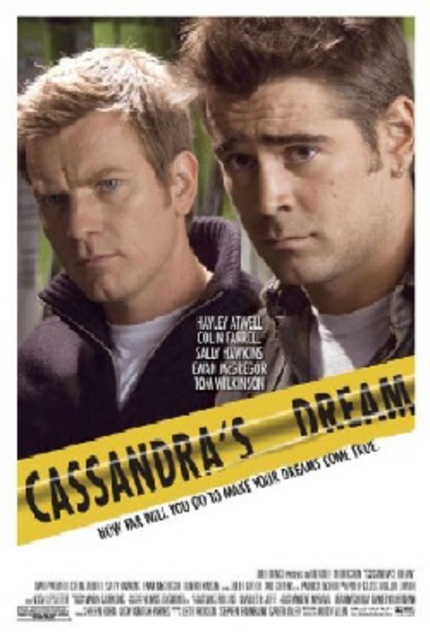
Ewan MacGregor and Colin Farrell are teamed together as ne'er do well brothers Ian and Terry. Ewan is the upwardly mobile one, constantly hatching business schemes while managing their father's restaurant. Auto mechanic Terry is an inveterate gambler; his winnings from a dog race make it possible for the boys to buy a small sailing vessel, which they christen "Cassandra's Dream" after the winning race dog.
Terry lives with longtime girlfriend Karen (Sally Hawkins), while Ian initially romances fellow restaurant worker Lucy (Ashley Madekwe). Ian quickly dumps Lucy once he spies gorgeous actress Angela (Hayley Atwell), who is flirtatious and quite forward, never mind that she appears to be dating several men already. Ian's latest and most ambitious scheme involves a couple of hotels in California, and meeting Angela motivates him to put that plan into motion. To do that, though, he needs a large sum of cash.
At the same time, Terry has been enjoying a good run at the poker table and entertains the notion of buying a home. One high-stakes poker night later, Terry is deeply in dept to loan sharks, with no idea how to pay the money back.
Enter Uncle Howard.
In the early scenes, Uncle Howard is almost a mythical figure, constantly referenced by Ian and Terry's mum, who is always bragging about her brother's accomplishments, to the irritation of Ian and Terry's father. Multi-millionaire Uncle Howard runs an ultra-successful plastic surgery clinic in California, yet never forgets his family, always coming to the family's rescue with financial assistance when needed. It just so happens that it's mum's birthday, and Uncle Howard will be in town for a couple of days.
The boys' eyes light up. Their savior has arrived.
They ask for a private meeting with Uncle Howard (Tom Wilkinson) and lay out their requests. Uncle Howard is open to the idea of helping them without judgment -- family is important, you know -- and then he lays a bombshell on them: he needs a favor in return.
That favor drives the rest of the story, but it also marks the point where Woody Allen's famous "hands off" approach to directing actors comes a cropper. Because neither Farrell nor MacGregor can negotiate the hairpin turn that is required. Oh, the words are the right words that should be said. The problem is not in the script, it's that neither of the actors are convincing in those sequences. Honestly, I thought I had misread the entire picture: was this supposed to be a comedy? I thought it was some kind of dramatic thriller. Some of the line readings, especially by Farrell, are way off. And it takes quite a bit of screen time until the two settle back into their characterizations.
All in all, it's a pity, because, other than those disastrously unbalanced sequences, it's a solid piece of work. There's nothing very surprising about the plot turns, and there are no real thrills, but the plot is well constructed and I very much liked the way that the brothers dealt with the aftermath of the favor requested by their Uncle. In those scenes, Farrell and MacGregor are just fine.
So: Cassandra's Dream is not a nightmare for Woody Allen or the audience, but neither is it essential viewing.