
CHRISTIANE F. 4K Review: Under the Influence
“We could be heroes,” sings David Bowie, if only these kids could get off the heroin just for one day.

Zoo Station: The Story of Christiane F., the non-fiction book upon which Uli Edel's 1981 film Christiane F. is based, was estimated to have been read by one third of the population in Germany in the latter half of the 1970s.
West Berlin was an island in communist-controlled East Germany, enshrouded in the Berlin Wall. A kind of Weimar renaissance was taking place behind the wall: a hedonist counterreaction to Cold War ennui and three decades of post-WWII rebuilding. David Bowie recorded three albums there in a row.
And down at Zoo Station, tweens and young teenagers were selling sex for heroin.
Ahead of Trainspotting by 15 years, Christiane F. was a lightning-rod social event upon its release, with its gruesome, heavily body-horror-inflected depiction of the titular Christiane, 13 years old -- who finds her way first into the club scene, then the drug scene, then sex work.
Incredibly, the filmmakers assert that, with Christiane F. and films like it, they were attempting to locate a "mainstream" German cinema between the New German Cinema of Fassbinder, Herzog and Wenders, and the lurid softcore sex films of the popular Schoolgirl Report series, for which -- director Uli Edel notes in Christiane F.'s supplemental features -- there were fifteen sequels.
Only by positioning oneself between cultural poles such as those could one end up with a film like Christiane F. as a presumptive offering for general audiences. The film is remarkably gross (complementary), a clear-eyed documentation of Christiane's journey into the darkest corners of the West Berlin nightlife (again, all based in fact). The desire to mirror documentary form as closely as possible, in fact, led to Edel having to fire his original cinematographer, replacing Jürgen Jürges with Justus Pankau, who was more able to work within the run-and-gun, high-key framework Edel was seeking.
Even the visual of Christiane is unnerving. Natja Brunckhorst was, indeed, 13 during filming, and looks it; the repeated, subtle underlining of the character's young age -- one moment, trying her first bump of heroin; the next, grinning sweetly as she helps her mother ice a bundt cake -- only make her determined interest in pushing further and further into high-risk behaviour more and more alarming. Brunckhorst is frequently costumed in high-heeled, low-ankled boots; she seems to teeter more than stride, as though the character is still in the process of learning how to walk.
Christiane starts going to clubs for the music -- she's obsessed with David Bowie, whose music features heavily in the first act and who performs a concert early in the film, intercut with Christiane's rapturous eyes in the front row, watching. At the clubs, Christiane meets Detlef (Thomas Haustein), a slightly older boy whose circle of friends are already into sex and drugs.
Detlef, to Christiane, is freedom, euphoria and adulthood all wrapped up in one. In the film's single unabashedly joyful scene, she and her new boyfriend run through the Berlin underground holding hands while Bowie's "Heroes" blasts through the soundtrack, as all the other members of the friend group tumble to the ground in unison around them, Detlef and Christiane the only ones remaining standing.
But teens are gonna angst, and in her furious efforts to prove herself as equal to Detlef's waning affections, Christiane pushes harder and harder into drugs, until she is shooting heroin to prove a point. The conjunction of Christiane's sexual and narcotic experiences is explicit throughout: a friend tells her that shooting heroin is like an orgasm, to which Christiane stodgily reports back: "That's not how I imagined an orgasm."
Director Uli Edel heavily loads his film with imagery that we would now call body horror, rendering Christiane's worsening cravings almost vampiric. A detox scene where Christiane and Detlef attempt to cold-turkey, locked in Christiane's childhood bedroom, recalls The Exorcist. An earlier scene, in which the couple makes love for the first time, first nestles itself into the gentle intimacy of their relationship, before the camera tracks out to find one of their friends with a needle hanging out of his arm just outside the door, an effective jump-scare.
Actress Brunckhorst, raised by hippies, recalls (in a 27-minute supplemental video interview from 2022) that the sexual content of Christiane F. was not itself embarrassing, but that the adult crew's squeamishness about it was. Indeed, Brunckhorst's performance is at its strongest whenever she is working through the more difficult embodiments in the film -- a fully-felt, purely visual encapsulation of active addiction and its effects on body and mind.
I also appreciate the degree to which Christiane F. refuses to let its titular character off the hook. It's neither judgmental of her decisions nor unafraid of the infernal mechanics of their consequences. Christiane and Detlef's first attempt at detox doesn't even last a day. A terrifying first attempt at sex work leads to a more transactional numbness, nonetheless shot through with revulsion and rage.
Most of all, every addicted character in the film knows they should quit and simply cannot, and the filmmaking never lets us misunderstand why.
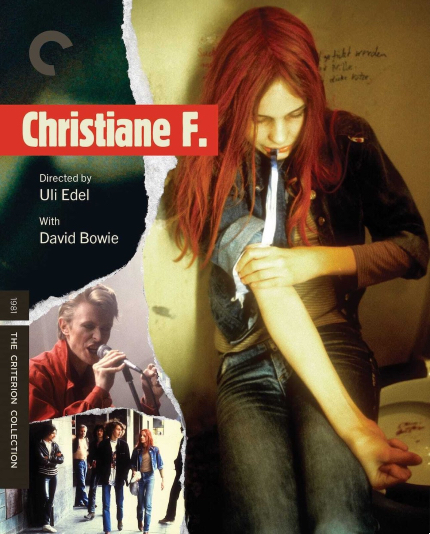
For its Criterion debut (spine #1330), Christiane F. has been restored in 4K (Standard Dynamic Range only) and approved by the director. The image is rich and detailed, with strong blacks (endemic to the production, which captured material largely on the fly rather than pre-lighting; one sequence, inside the communist-controlled interior of Zoo Station, was filmed without permission).
Newly-produced for this release, a 29-minute reflection by director Edel sums up the production in full, and a neat jacket essay by Hester Baer helps define the film within the wider history of German cinema, and of West Germany as a cultural centre in the 1970s.
Finally, there's a 15-minute jaunt through Sean Baker's poster collection (!), as the director of Anora and Tangerine gives insight into the marketing of the film -- skirting a line of "trauma voyeurism" which the feature itself handles better than the marketing materials -- and explains why Christiane F. is the reason Baker has included a vomit scene in every single one of his films.
The film is now available from The Criterion Collection in a two-disc 4K+Blu-ray edition, as well as a separate, single-disc Blu-ray edition.


