
APPOFENIACS Review: Nostalgic 90s Neo-Noir Grit Meets Present-Day AI Terror

We had to stop watching and check our calendar because for a moment, because we thought we were back in our college dorm room with a Pulp Fiction poster up on the wall, or roaming the halls, whispering, “You’re so cool.”, hoping someone equally in-the-know would pick up on the reference to Tony Scott’s True Romance.
A wave of nostalgia overcame us when we were watching Chris Marrs Piliero’s Appofeniacs. Once the violent and intense prologue—a sign of things to come—was out of the way, we were struck by how familiar it all felt. The movie demanded a moment to pause before the story really kicked in. The earliest impression is that you are watching an ode, a love letter to the neo-noir explosion in the 90s, a movement that redefined the crime thriller by injecting classic noir archetypes with a sexy, rock-and-roll energy.
The film revolves around a "five-minutes-from-the-future" sci-fi device. Instead of distant spaceships, we are grounded in our world of smartphones and rideshares. The central threat is an app that allows a chaotic troll to weaponize real-time AI deepfakes. At the time of this review, in real life we are experiencing a wild west moment in the rise of artificial intelligence, generative AI, and predictive machine learning, in a flood of apps and tools a finger swipe away—and this movie drops you into a scenario that we have already seen, heard and read play out throughout society.
Our core instigator is Duke, played with callous disregard by Aaron Holliday. As Duke explains to Cedrick, he holds more power in his phone than the computers that put astronauts on the moon. The problem is, Duke doesn't realize this is his "Uncle Ben" moment. He is reckless with that power; the second anyone crosses him, he opens his apps and triggers ruined reputations, paranoia, and bloody violence. He treats deepfakes like a contagious party trick—not to prove anything, but because he can.
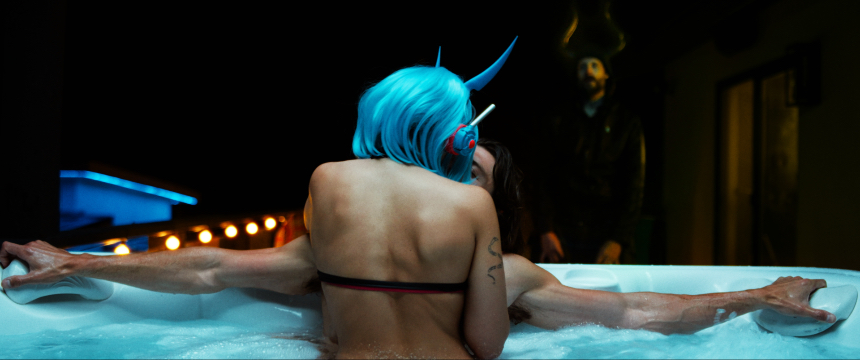
Duke isn’t the one who has to clean up the mess. The fractured, non-linear narrative utilizes intersecting character storylines to catch the fallout of his pastimes. We track Poppy (Simran Jehani) heading into the desert for a weekend of cosplay and foreplay, and Lazzy (Paige Searcy), a stranger who happened to pick the wrong line, the wrong coffee shop, and the wrong day to argue with this story's "Mr. Pink" about, of all things, tipping.
The cast holds their own and meets the manic energy and danger brewing in the script. The two recognizable faces are Sean Gunn, who has fully emerged from beneath his brother’s behemoth studio shadow, and Jermaine Fowler, who has been steadily building a resume within the genre space. Alongside them, Holliday, Jehani, and Searcy deliver standout performances as the chaos spirals.
Appofeniacs marks the feature film directorial debut of Chris Marrs Piliero, a music video director who has worked with pop stars like Britney Spears and Ariana Grande. Born in 1979, Piliero is around the same age most of the first wave of Anarchists are, and was a teenager when crime films like True Romance (1993) and Pulp Fiction (1994) hit theatres, and he clearly absorbed that era's cinema. He wears those Tarantino influences on his sleeve: the fractured out-of-order structure, the blend of violence and pitch-black comedic absurdity, and homages like characters arguing about coffee shop tipping etiquette. He even pulls a QT move and cameos in his own movie, just as QT did, four times on screen.
The movie relies on psychological horror, exposing our human instinct to believe what we see and hear. It captures that exact, stomach-dropping realization that you have lost complete control over your own reality, where a single malicious tap can instantly erase your privacy and weaponize your own face against you. When anyone's version of the truth can be created with the tap of a finger, the horror isn't the lie—it's what happens when people believe it.
But it also uses gore and violence to pack a visceral punch. From the very start of his story Piliero makes it clear, this will be a bloody affair taking his message to the extreme. The climax of Appofeniacs whiffs of Tarantino’s Once Upon A Time In Hollywood and Pulp Fiction, in admittedly spectacular fashion. We should not delight in violence in this context, but holy moly. Also, Jermaine Fowler’s part in this story may be small in comparison to the rest of it, but his character is absolutely chilling and ruthless, lending a hand in another of the movie’s big ‘Oh, shit!’ moments.
Appofeniacs is built for anyone who misses the grunge, the fast dialogue, and the moral ambiguity of 1990s indie cinema. It successfully takes the stylized violence of Quentin Tarantino and the tight tension of a Tony Scott shootout and anchors them to modern digital anxieties. It forces a hard look at our own confirmation bias and the ease with which we believe baseline lies, making it an easy recommendation if you want a thriller that handles nostalgia without losing its edge. Look at the mirror it's holding up.
Appofeniacs arrives in cinemas today.

Do you feel this content is inappropriate or infringes upon your rights? Click here to report it, or see our DMCA policy.


