
KUNG FU SOCCER Review: Stephen Chow's Dreadful All-Female Sequel Deserves a Straight Red Card
Stephen Chow's belated sequel to Shaolin Soccer follows an all-female team of no-hopers as they navigate a high-stakes tournament

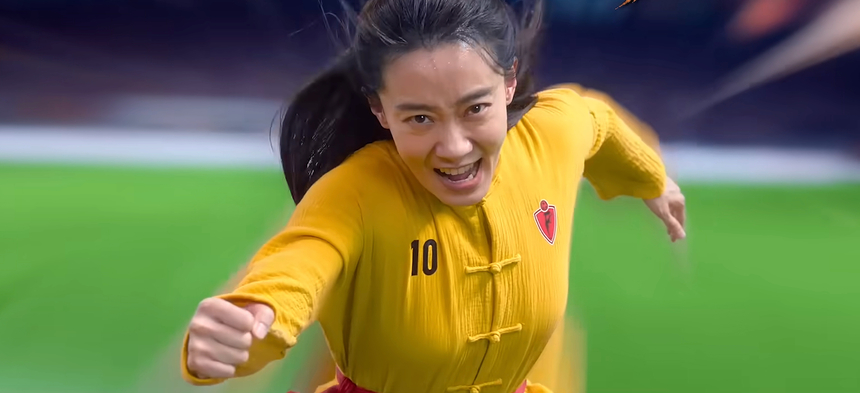
Twenty five years after scoring a resounding critical and commercial hit with the martial arts sports comedy Shaolin Soccer, Hong Kong film industry legend Stephen Chow unleashes an absolute howler of a sequel that fails to replicate anything that made its predecessor such a success. The most notable difference between the two films is deliberately obscured by its English title, as Kung Fu Soccer - or "Kung Fu Women’s Football" in Chinese - pivots away from Chow's earlier protagonist Fung, and his colourful collection of dextrous dribbling heroes, to focus on a new team of female football players. Much like how Ted Lasso has chosen to champion the women’s game in its latest season, so too does Chow here, but the results warrant an immediate VAR ruling.
Nominally set in Hong Kong, thanks to a handful of instantly recognisable locations, Kung Fu Soccer follows in the footsteps of all of Chow’s recent offerings by focusing its attentions squarely on a mainland China audience, with every character speaking almost exclusively in Mandarin throughout. The plot follows the changing fortunes of a team of mismatched underdogs as they compete in the “Supremes and Invincibles Cup”, hosted at Kowloon’s new Kai Tak Stadium, which is open exclusively to squads of enhanced female players hailing from the four corners of the globe.
Led by their headstrong yet over-the-hill captain and coach Shuang (Zhang Xiaofei), this rag-tag bunch of has-beens and never-will-bes must overcome limited funding, poor training facilities, a duplicitous manager, and persistent in-fighting even before considering anything as pressing as squad selections or on-field tactics.
But this quickly becomes the most glaring problem with Chow’s haphazardly assembled caper: nobody, whether on the field or behind the camera, appears to understand the first thing about football. Audiences coming to Kung Fu Soccer without any prior exposure to the sport might be forgiven for surmising that football matches are won not by the team who scores the most goals, but rather by the team with the most players still standing when the final whistle is blown.
It should be acknowledged that 2001’s Shaolin Soccer didn’t exactly display FIFA or Championship Manager levels of tactical nuance either when it came to dramatizing the beautiful game, but Chow’s erstwhile squad of prancing lovelies would have you believe that hacking your opponents to bloody ribbons before booting the ball as hard as possible towards the opposition’s goal is all that is required.
In both films, the teams elevate their gameplay by employing their notable dexterity and discipline in martial arts, but even here, Kung Fu Soccer fails to hit the target. Chow’s reliance on sub-par CGI and AI generated effects throughout the film smears the entire enterprise in an ugly sheen of weightless slop.
Players pirouette through the air, screaming like banshees, as though possessed by escaped Dragonball characters, before conjuring giant animals or weapons out of nowhere that not only sit uncomfortably within the context of a movie about a football tournament, but also look absolutely dreadful. Arriving so soon after the bruising, brawny exertions of Kenji Tanigaki’s The Furious, the lack of kinetic heft in Chow’s kung fu becomes embarrassingly apparent.
One might be willing to overlook these failings - although in a film called Kung Fu Soccer, I am not entirely sure why - if the final product scored as a rib-tickling comedy, or elevated and celebrated its female protagonists. Alas, all attempts at humour fly wide of the goalposts just as consistently as the action. That is not to say that the jokes are too base or in poor taste, simply that the screenplay, credited to a troublingly large number of writers, offers nothing more sophisticated that characters who scream and flail at one another.
The central drama - if we are to be generous for a moment - revolves around Shuang, an orphan who has dedicated her life to martial arts (under the tutelage of Carina Lau’s grandmaster) and football. As her 40th birthday looms, she is starting to question her choices - not least refusing to act on her romantic feelings for her slippery mentor, Xu Feng (Zhang Yixing). Shuang is also resentful of Jade (Dilraba Dilmurat), the rich kid who befriended her at a young age, only to abandon her to get married a decade ago. Now that Jade’s husband has left her, she has rejoined the team, but Shuang’s simmering resentment remains.
Both actresses commit themselves admirably to the material, but there is precious little on the page to work with, while the rest of the squad are reduced to interchangeable one-note archetypes, like “the fat one”, “the shy one” or “the blind one”. The same degree of laziness is levied at their opponents, who are saddled with some excruciating cultural stereotypes, from the pretty yet duplicitous Korean team, to the crass and overly physical Australians, dextrous Indian yogis and the unnecessarily violent villains of the piece, hailing from, where else, but Japan.
The film has even managed to court controversy in some quarters, with its depiction of the Koreans upsetting audiences on the Han peninsula, but such scheming subtext might be giving the creators a little too much credit. There are also cameo appearances littered throughout, from the likes of Jimmy O. Yang, Takeru Satoh and Japanese dance troupe Avantgardey, but none of them can get a clear shot off amidst such a relentless cavalcade of vacuous dross.
On home turf in mainland China (this really shouldn’t be considered a Hong Kong movie by any measure) Kung Fu Soccer has done extraordinarily well, earning over US$300 million in its first month of release. But box office figures have rarely been an accurate barometer of cinematic quality, and in this case speaks simply to the inevitable result of playing a high-profile new release more than 200,000 times a day, as was the case here.
The film ends with a desperate tease, suggesting that Fung and his teammates might fancy their chances in a match against the Emei women, and Kung Fu Soccer’s indisputable financial tally will almost certainly fast-track a sequel of some description. Whether that means Shuang and Fung will square off at some point in the future remains to be seen, but on the basis of this tawdry performance, everyone involved deserves to be shown a straight red card and sent for an early shower.

Do you feel this content is inappropriate or infringes upon your rights? Click here to report it, or see our DMCA policy.


