Tribeca 2026 Review: ONLY WHAT WE CARRY, More Poetic Than Profound
Jamie Adams directed, with Simon Pegg, Sofia Boutella, Charlotte Gainsbourg, Quentin Tarantino, Lizzy McAlpine and Liam Hellmann.

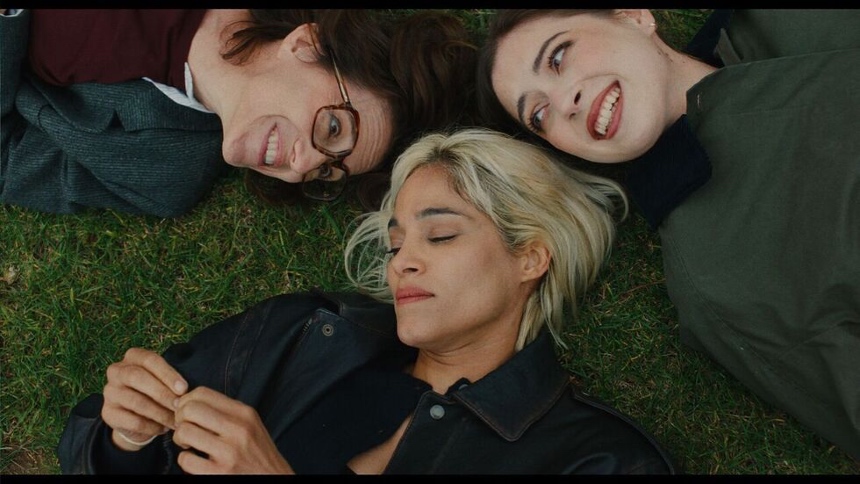
Only What We Carry, the latest feature work of British director Jamie Adams (Black Mountain Poets, She is Love), is one of those pieces that is composed of elements that could either make or break it. And while this new film will most likely find an audience that can relate to something in it, it unfortunately falls flat, brought down by the very thing that could’ve made it stand out: the absence of a definitive narrative, with the film relying heavily on improvisation.
Adams’ previous feature work, Pose, starring James McAvoy and Lucas Bravo, centered around two couples who unwittingly find themselves together at a remote location, thus establishing the ground for conflict and confrontations. Only What We Carry sort of mirrors this setup, featuring not two, but three couples of sorts. It foregoes the thriller route, though, choosing instead not to bow to any genre conventions at all.
The remote location in question is an empty hotel at the Normandy seaside, owned by a rich publisher, John (Quentin Tarantino), who lends it to his old pal and famous choreographer, Julian (Simon Pegg), so that the latter can focus on writing his memoirs. Meanwhile, Julian’s former protégé and Moulin Rouge dancer, Charlotte (Sofia Boutella), is triggered by a disparaging remark in his latest interview. So, she grabs her older sister, Josephine (Charlotte Gainsbourg), and the two head out to Deauville.
While Charlotte is busy confronting Julian, John and Josephine seem to be hitting it off, despite the latter being married. A young, newly formed couple (Lizzy McAlpine and Liam Hellmann) also tags along, for no reason whatsoever.
On tap for the discussions that ensue: power imbalance in creative collaborations and mentorships, grinding practices, elusive nature of love, grief, healing power of human connection, disillusionment that comes with age and experience, and the need to let go of the past, both personal and professional, and move forward. It’s all predictably too much, while also quite unsurprisingly being not enough, since the film refuses to really focus on any of the above topics, skimming and gliding along the surface.
Adams clearly draws inspiration from the creative experiments of the French Nouvelle Vague and cinéma verité, striving to create a conversation around the complexity of human emotions. In doing so, he adopts popular techniques of that era, such as long shots, a freely wandering camera, and vast amounts of on-set improvisations. While the technical achievements of Only What We Carry, especially when it comes to its cinematography, are impressive, its narrative just keeps falling apart throughout the film’s pretty concise 92-minute runtime, which somehow still feels like it’s dragging on.
The whole idea behind cinéma verité is a method of provocation that can potentially reveal the very nature of things and connections. That doesn’t happen in Adams’ film, not least because the casting of the core four here feels so random, disjointed, and uneven, with Pegg and Gainsbourg predictably giving stronger performances, despite the latter not being given particularly riveting material to work with.
As much as the film strives for emotional authenticity, it is rather disheartening to have a bunch of mostly privileged characters experiencing turmoil at a beautifully shot luxury seaside property. It’s almost as disheartening as watching a film that spends most of its time talking, but refuses to actually say anything.
The film enjoyed its world premiere at the 2026 Tribeca Festival. Visit the film's page at the official festival site for more information.