THE FURIOUS Interviews: Director Kenji Tanigaki and Producer Bill Kong

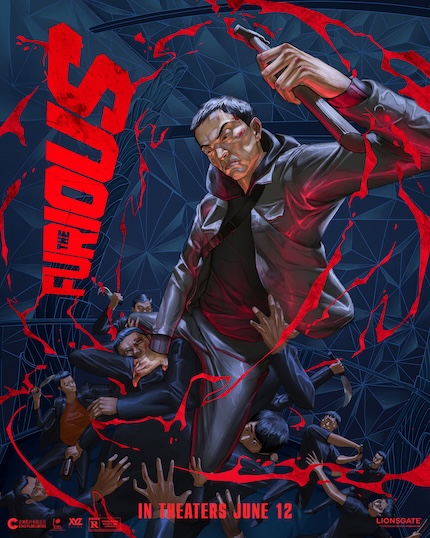
Few action films have been as eagerly anticipated as The Furious. Since its premiere at the 2025 Toronto International Film Festival, word of mouth has been building about the film's over-the-top stunts, driven by intense choreography and relentless editing.
Directed by Kenji Tanigaki (action choreographer on Twilight of the Warriors), with action choreography by Kensuke Sonomura (director of Ghost Warrior), it stars Xie Miao (My Father Is a Hero), Joe Taslim (The Raid), Brian Le, Yahan Ruhian, Jeeja Yanin, and Joey Iwanaga. Among its producers: the veteran Bill Kong, who has worked with Ang Lee, Zhang Yimou, and developed the Monster Hunt franchise.
The film opens around the world this weekend. We first talked with director Kenji Tanigaki, who explained his work on The Furious.
Screen Anarchy: You've had a remarkable career in action movies, from working with Donnie Yen to choreographing TWILIGHT OF THE WARRIORS. I feel you are developing a new kind of action.
Kenji Tanigaki: My approach to Twilight of the Warriors was totally different. This movie is more grounded, it's like "unplugged" music. Back to basic and down low.
On day one, our producer Bill Kong told me about this good Japanese film, Hydra, directed by Kensuke Sonomura. I joked that you can hire him, you don't need me. But I called Sonomura right away because I needed his help.
We worked together before; we share the same stunt team. We're from the same school, but with different styles. That made it a good collaboration.
HK films actors are farther apart. Here your fighters are closer together, on the ground, grappling more, using legs more. It's a different kind of action.
Hong Kong action is a different style in a different time. But do you remember the movie SPL? [2005, starring Donnie Yen and Sammo Hung] That's when we started using the "ground fight." At the time, many people complained that there weren't enough jumps or kicks. Twenty years later, more and more action movies are using this kind of "ground fighting," mixed in with cross combat. That's where you get the "human pyramid."
I'll tell you a story. Sonomura said that when he was working on low-budget movies, they didn't have many props or even production design. He would want to work with a ladder, or a stairway, but the budget couldn't afford them. So he would use people as the stairs.
But it looks good, right? It's more primitive and a lot of people like that.
You say primitive, which is true. But it's also messy, not perfect. Things don't work the right way.
I don't need perfection. If you want that, maybe you can use AI. For example, people love to watch sports, because the action is more primitive. It has more life.
When Donnie Yen and Jackie Chan were doing their moves, everything worked. The routines were all precise. In this movie, punches and kicks might go nowhere.
Messy, a little bit messy. On SPL, our slogan was "choreograph the unchoreographed." Like Bruce Lee said, "Stage the unstaged." People look at our work and maybe misunderstand, think it's a real fight. That's our style.
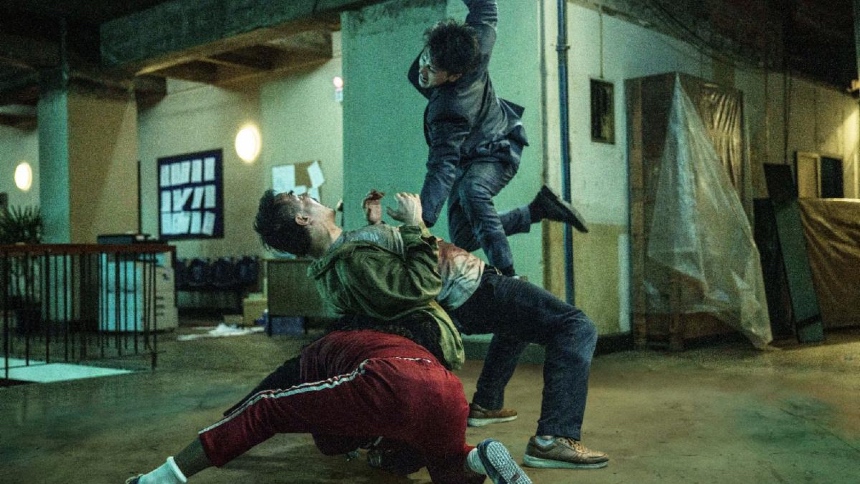
In the MMA club, Wang Wei [Xie Miao] and Navin [Joe Taslim] are fighting in an office. Wang flips Navin over, and as he tries to stand, Navin's shoes keep slipping out from under him.
People can see that and understand what's going on. They can see how slippery and painful the fight is, how much of a struggle. I love those kinds of mistakes.
Your fights are unpredictable.
Yes, that's why we have our first action scene, where Jeeja [Yanin] is trying to save the kidnapped child. In most movies she might die, but the kid will be saved. We went more for a Korean film style. It's like we're saying to the audience, "Hey, are you ready?"
Your fights have their own individual narratives.
Because Wang Wei is mute, our choreography must provide a narrative for him. If you watch closely, you can see that Wang Wei and Navin employ different martial arts styles. When they first fight, Navin tries to grab him, and Wang Wei tries to cut him down. In the middle of the fight Wang Wei takes off his jacket so Navin can't grab him.
By the last scene, when Wang Wei is fighting the chief villain, he's not using Chinese wu xia, he's using a judo style that he learned from Navin.
That's our story arc. At the same time, our action choreography arc. The first time they fight they learn about each other. By the end, you can say that Navin through his teaching saved Wang Wei's life.
I don't think a lot of the audience will be aware of these themes, but if some get it, I will be so happy.
The final fight is a five-way brawl with unbelievably complicated moves and stunts.
I have to give credit to Sonomura and his stunt team for that. We started rehearsing for the choreography in Tokyo three months before shooting. I told the team that some fights might be cancelled, but the five-guy fight is essential.
It's very complicated. We spent 18 days for that set piece. It's like one guy beats another, then the third beats him, but there are two more fighters to deal with. I've seen a lot of movies, but never one in which five guys fight on three different sides.
The veteran producer Bill Kong has worked with some of the finest talent in Asia, from directors Ang Lee and Zhang Yimou to stars Tony Leung Chiu-wai and Jet Li. Crouching Tiger, Hidden Dragon (2000) won four Academy Awards while introducing wu xia to an international audience.
An expert in producing action films like House of Flying Daggers (2004) and Fearless (2006), Kong is equally at home with other genres. Under the Hawthorne Tree (2010) helped launch Zhou Dongyu's international stardom. The Monster Hunt franchise broke box-office records in China. Office (2015) was Johnnie To's first 3D musical.
The Furious marks Kong's return to the gritty martial arts genre.
Did you plan THE FURIOUS For an international audience?
It was always aimed for international. I wanted to make a film for the world. The way we put the story together, we designed it like an action roller-coaster. That meant we needed to set up a story to get viewers as emotionally involved with the characters as possible.
Did you develop the project?
Yes, we developed the script with Kenji [Tanigaki], Frank [Hui], and the other writers. I was involved from the start, because I wanted to make a film with the best action actors in the world. We weren't looking for actors, we needed action stars because we didn't want to use doubles. And Kenji wanted to shoot long sequences using a wide lens.
Action films today, it's jump, jump, jump, you know? That's why we sought out Xie Miao, a martial arts master, and Joe Taslim, a National Judo Champion in Indonesia. It was Kenji's choice to work with [action choreographer Kensuke] Sonamura.
You decided to shoot in Thailand?
Yes, we shot it entirely in Thailand, although the setting of the film is not specifically Thailand. It's a great place to work, the people are fantastic. We had a very good crew, the best you can find.
You had some amazing locations, like a tenement building called the Snake Pit. Was that on a backlot?
No, it's in the city. Actually, right in the middle of the city.
We wanted to capture something raw, the rawness of an urban environment. We wanted to shoot this to feel real, with real, raw people, real rage, you know, furious. Bangkok was the ideal place to shoot because it's not prefabricated.
THE FURIOUS is set on a much smaller scale than something like MONSTER HUNT.
This is a different kind of project, a different script and background. I've worked on big studio films, but I'm going to continue doing this kind of movie. Monster Hunt was for the Chinese market, but The Furious is for the world. And I think the world needs more action movies.
This is a truly international film. I live in Hong Kong, and Kenji spent 30 years there working with the masters. We have Sonomura-san, we have Thai stuntmen, a Chinese star, an Indonesian star. The best people at the prime of their careers.
Was it a difficult shoot?
I don't remember the actual shooting days, 60 or maybe 69, in that range. But it was not difficult at all. In fact, my role was easy because I was lucky enough to assemble the right people. Everybody loved Kenji, everybody loved Sonomura-san. I was very lazy. I didn't even have to be in Bangkok because everyone was so happy.
And one more thing, in the entire shoot, with all this hard work and people being beaten up and killed, not one person was hurt.
Why did you choose Lionsgate to distribute in North America?
Lionsgate has a huge following of action fans around the world. It was an easy decision.
How are you going to build on this project?
Look, I'm not young, but I think my life was built to make movies. I think this is the beginning of me coming back to do more action films. I want to work more with Kenji and Sonomura-san. We've become a family. Of course, it's whether they want to work with me, it's not entirely my choice.