HAMLET Review: Thrillingly Cinematic Internal Journey Into Personal Hell
Riz Ahmed, Morfydd Clark, and Joe Alwyn star in director Aneil Karia's modern-day adaptation.

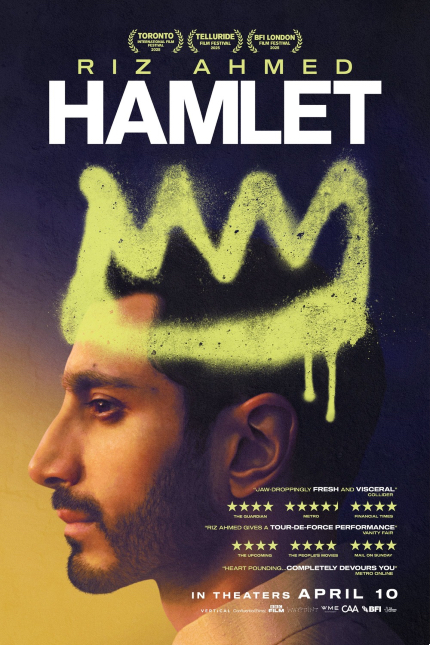
Following on the massive success of last year's Hamnet, Chloe Zhao's Hamlet origin story, it's safe to say that William Shakespeare's most enduring tragedy is certainly having a moment.
Director Aneil Karia's eponymous version of the play, starring Riz Ahmed, is just now releasing in North American theatres, probably a wise move to separate them in audience's minds. The two films are, of course, completely different in intent, but they originally premiered at roughly the same time in 2025, and their source is similar enough. Yet, the fundamental intent in each case couldn't be more different.
Karia's modern adaptation of the anguished prince's descent into madness eschews all the trappings of previous movie versions. There's no theatricality here (as in Kenneth Branagh's 1996 version, for example); there's a frenetic energy that drives the film, making it thrillingly cinematic. It's a version that more clearly embodies Hamlet's internal journey into personal hell. Karia more deliberately details Hamlet's already fragile emotional state as it collapses ever downward.
Set in an elite South Asian community in London, Prince Hamlet (Riz Ahmed in a riveting performance) returns home from university for his father's funeral. His grief is palpable as he performs a Hindu ritual for the occasion. He soon discovers that his mother, Gertrude (Sheeba Chaddha), is already engaged to marry his uncle Claudius (Art Malik), the former King Hamlet's brother.
This marriage will make him the new leader. In a subsequent drug-fueled anguished rampage through London's darkest, most remote streets, Hamlet encounters an apparition, his father's ghost (Avijit Dutt). The dead king tells his son that he was in fact murdered by his brother and demands that the young man avenge his death.
Michael Lesslie's script, based on Shakespeare's original, is lean and muscular. Whole plotlines are erased, along with a host of subordinate characters. This allows room not only for Karia to instill a distinct vision for the film but also for Ahmed to flex his commanding acting skills.
Lesslie is responsible for the compelling final script for Justin Kurzel's 2015 Macbeth, starring Michael Fassbender. His screenplays in both cases provide a fertile bed for each film's brash stylistics. It's also important to note that Lesslie is no stranger to this particular play, having written Prince of Denmark, a Hamlet prequel, which premiered in 2011.
These ousted secondary characters and plotlines did originally provide a necessary context for the action along with elaborating the inner workings of the court. They also functioned as a way to put Hamlet's increasingly disturbing state into relief. Other characters in this adaptation have their dialogue, their singular presence, stripped back. They all now exist as spectres in the orbit within Hamlet's experiences and perceptions.
Ophelia (Morfydd Clark) is but a shell of her previous underwritten character (they weren't known for writing well developed female characters in those days to begin with). Hamlet breaks her heart in the play, but we don't get the full impact in the film. Her father, Polonius, who had a more critical role in the plot and even provided the play's well known comic relief, is merely an irritating, spineless weasel here (although Timothy Spall tries his best to make that interesting). Besides, there's just no room for humour in this version.
The problem with erasing so much is that sometimes these small elements that appear random, or even superfluous, like extra nails in a structure, are actually crucial for the integrity of the whole. Removing them can mess up the mechanics and although that isn't a major problem here, it often clogs up the gears. At times, some of the interactions get a bit confusing, especially if you don't know the original, and do not have the same emotional impact.
But Karia makes the basic dynamics of the story work in a unique way. This production is particularly effective because it represents Hamlet's version. The action is now filtered through the lens of the character's distinct perception and ego.
Stripped so bare, this narrative proves much more suited to a cinematic interpretation. In this vision, this story immediately privileges Hamlet's internal world. Watching from his point of view, the viewer is given a fresh perspective on the entire enterprise, with no disrespect intended to the original author.
Our clues to the action often come from the cinematography. DOP Stuart Bentley gives this vision its brutally stark look. He creates an inspired contrast where the film's visuals are dull at times (the castle is a site of muted hues and the streets are densely murky in their dark tones), with sudden shifts to the neon lights piercing the noirish streets.
Add to that the breathtaking vibrant colours of the rituals of the funeral and later the wedding, there's a startling raw power. These accents are a necessary support system to Ahmed's performance as his character descends into madness.
Karia's visual strategy is a vital part of the film's success. What's key is the director's decision to keep the focus narrow. He relies on close-ups of Ahmed's face as he either speaks or watches the effects of his words on others. The camera loves him and he does not disappoint. His performance is exquisite in its acute intensity.
The key to Shakespeare's play is Hamlet's state of mind: the beauty of it is that it lends itself to opposing interpretations. There are productions that portray a cunning young man who feigns madness in order to catch people out, while others depict an agonizing descent into madness. In this film, it's the latter approach that drives the action, as Ahmed mingles an intense fury with heartbreaking vulnerability.
Together, Karia and Ahmed have created an audaciously cinematic adaptation of one of Shakespeare's greatest tragedies - if you're going to translate this play to the screen, this is certainly a fantastic way to do it.
The film opens Friday, April 10, 2026, only in movie theaters, via Vertical Entertainment.