Venice 2025 Review: THE STRANGER Proves the Third Adaptation Is the Charm
François Ozon’s take on the Albert Camus classic may well be the most definitive.

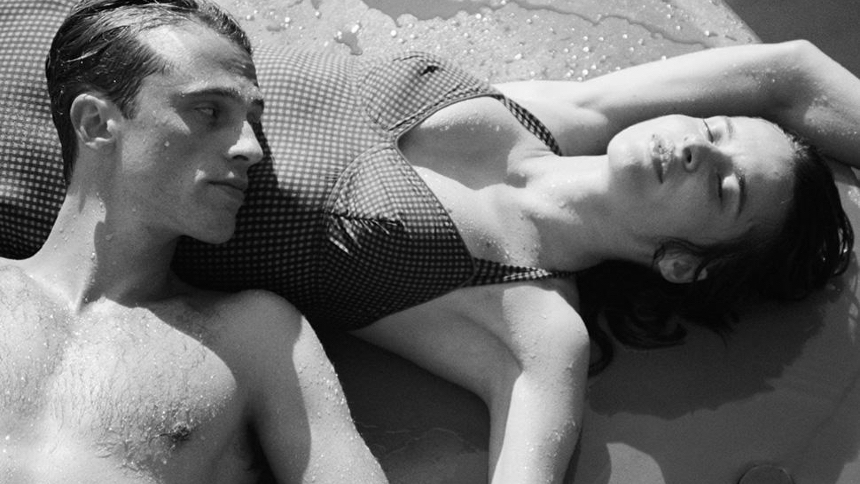
Albert Camus' 1942 classic The Stranger has spawned three film adaptations.
The first, by Luchino Visconti in 1967 and starring Marcello Mastroianni, should probably have rendered all future attempts extraneous. But word is that Camus' widow, Francine Faure, hated Visconti's rendition and withheld it from the public eye after its initial release. While the pairing of Visconti and Mastroianni is hard to top, their film does register as rather dated under Bruno Nicolai's musical direction. François Ozon was able to persuade Camus' daughter Catherine to give her blessing for a new version, which premiered at the Venice Film Festival.
Ozon places the action in 1838 French-occupied Algeria, which is, by scholars' estimations, years earlier than Camus' setting. Meursault (Benjamin Voisin) is thrown in prison for murdering an Arab. Rewind to earlier, when he requests a couple of days off at his office job to attend the funeral of his mother held at a countryside home for older adults. He smokes, takes his coffee with milk (a no-no) and dozes off during the wake, exhibiting no signs of grief. Meursault declines when the caretaker (Jean-Claude Bolle-Reddat) offers to remove the coffin lid so he can see his mother once more.
Upon his return, he runs into former colleague Marie (Rebecca Marder), and they spend the day at the beach and go to watch the Fernandel flick Le schpountz (i.e. a comedy) afterward. He also hangs out with his unscrupulous neighbor Raymond (Pierre Lottin), who is allegedly a pimp, and assists him by composing a letter in a plot to lure Raymond's lover, Djemila (Hajar Bouzaouit), over for a beating.
Raymond invites Meursault and Marie along to his pal's beach cabin, and apparently they are tailed by Djemila's brother Moussa (Abderrahmane Dehkani) -- in a nod to Kamel Daoud's The Meursault Investigation -- and another Arab. A fight ensues, and Moussa pulls a knife and slashes Raymond. Later, upon seeing Moussa brandishing the blade again, Meursault shoots him four times with Raymond's revolver.
Visconti's and Ozon's treatments are nearly verbatim. What truly separates them is the mood. Visconti placed heavy emphasis on the oppressiveness of the sweltering heat, an element absent in Ozon's version. The latter seems less literal. It has that cool aloofness that has come to define Ozon's oeuvre, which includes Under the Sand, Time to Leave and Young & Beautiful. His work may not be everyone's cup of tea, but he and Camus are absolutely simpatico. The sense of detachment even manifests visually in Manu Dacosse's monochromatic photography.
Unlike Visconti, Ozon eschews voiceover narration, making Meursault even more of an enigma. Meursault is supposedly in his 30s. Mastroianni was a decade older when he took the part. With all due respect to Federico Fellini's favorite leading man, the late-20-ish Voisin is more convincing as the directionless and impressionable Meursault. The character's undoing is his lack of pretense, his obliviousness to the optics of his actions, which are perceived by others as antisocial. Mastroianni instead projected maturity and world-weariness.
Ozon alludes to seduction and gay panic as motives in the pivotal shooting. That's entirely plausible, though it's hardly an improvement on the way Visconti presented it. Neither staging of the scene is really convincing, and perhaps that's purposeful since you can't really defend the indefensible.
Ozon's adaptation of The Stranger should now serve as the CliffsNotes alternative for students who haven't done their required reading. As for cinephiles, perhaps the new film will prompt the Camus estate to finally permit the release of the Visconti on physical media for the first time.
The Stranger
Director(s)
- Alexandr Khromhartov
Writer(s)
- Alexandr Khromhartov
- Elizaveta Suslikova
Cast
- Daryana Gallavich
- Elizaveta Ignatova
- Nazira Shamkhalova