Toronto 2025 Review: MĀRAMA, Bloody Gothic Revenge Comes to the Colonizer

The gothic has long been associated with isolated homes or castles, opulent yet neglected, dark family secrets that often mean a ghost or two, usually a woman with some connection to the paranormal, and the return of the repressed. But it also became popular during a time of colonialism, the rise of capitalism and flourished in the beginning of the industrial age. So much of the gothic is tied to fear of the Other, that it often takes the story of those who were most feared (i.e. the Other), to show the truth of what often happened in these dark places.
Mārama takes on the gothic to tell the story of a people who lay in the path of colonialism and the horrors they endured at the hands of their colonizers. This debut feature by Taratoa Stappard aims to show some of the real life-horrors of the Gothic era that often gets sidelined in favour of personal stories. Mārama combines the personal and political, not always as strongly as it could, but with beautiful and harrowing imagery.
Mary (Ariāna Osborne), a Māori woman who was adopted into a white family, receives a letter from a man in England, offering to tell her what happened to her birth parents, and sending money for the voyage from New Zealand. When she arrives, however, she discovers the man has died. She is taken in by his employer, Nathaniel Cole (Toby Stephens), who offers her a job as governess to his granddaughter Anne. Now trapped on an isolated estate, Mary is plagued by visions of another Māori woman who turns out to be her twin sister, who lived with Nathaniel. But what happened to her, and why, is a mystery that Mary must uncover.
Given the North Yorkshire setting, it’s hard to escape the spectre of the Brontës, but this works in the film’s favour, with the wild countryside, imposing ocean, and Mary’s need to discover who or what is hidden in the proverbial attic adding the necessary gothic flavour. The isolation of the location is palpable, as a carriage driver refuses to take Mary all the way to her destination, there’s only one other servant in the household, and while neighbours come to a party, there’s no sense of the distance travelled. It’s almost as if the Cole estate exists in some different dimension that Mary has crossed over.
And given the nature of what she finds, perhaps that explanation makes the most sense. Mary is confronted with a man who is obsessed with Māori culture, in that way that colonizers are, when everything becomes fetishized. As with Patricia Rozema’s adaptation of Mansfield Park which confronted how so of the wealth of the Georgian and Victorian era came from slavery, Stappard examines how so much of the Gothic symbolism comes from that wealth, those secrets, that proverbial strip-mining of cultures who were bulldozed by colonizing nations such as England. Animal bones, masks, artwork: at first the house seems to be a shrine to her culture. But Mary quickly realizes that it’s not a shrine, it’s an obsessive’s perverse graveyard.
At times it does feel as if the film is just aiming to hot all the various gothic tropes, such as hidden rooms, ghosts haunting the hallways, secret documents and photographs as clues to the truth. We’re often not given time to absorb the strangeness of the place, to feel as if we are there with Mary encountering this odd world and learning why she has become trapped in it. This is key to a gothic horror narrative, and often it feels as if the motions are gone through to make sure we understand they are Gothic, rather than let it surround us so that we feel the fear and rage as Mary does. We’re told at the top of the film that the story aims to confront the horror of colonization, so we are waiting for something quite horrific to be revealed.
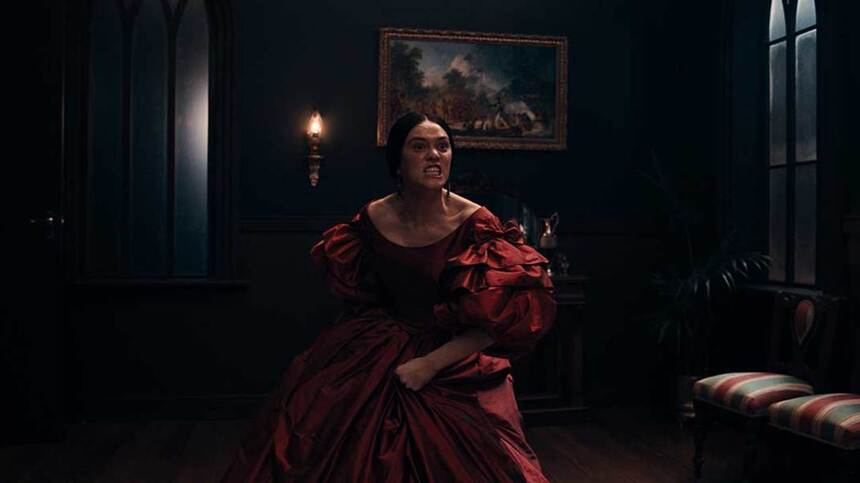
But, at least in Mārama, we’re seeing these in a somewhat different way, through the eyes of an outsider who is the object of that kind of worshiping-scorn of the colonizer: in one scene, Nathaniel throws a party in which everyone ‘dresses up’ as the ‘savage’, mocking the traditional Māori Haka dance. Mary, in a ravishing red dress, responds by performing the Haka as it is meant, tearing these guests apart, though of course they have no understanding of what is happening.
Osborne is terrific as Mary; she plays her as atypical of the young Gothic governess, in that her nightmares might frighten her, but she knows they are related to her past and her determination and fearlessness is pursuing the truth make her a force of nature. She knows her connection to the supernatural is part of her being and her ancestral line, and that energy is to be harnessed to save her and avenge those who came before.
Rich in its visual composition and lead performance, Mārama might be a little rushed, but it works the gothic tropes effectively enough to tell its story of colonial violence and that violence’s revenging angel, meeting it with the equal violence it has earned.
Marama
Director(s)
- Taratoa Stappard
Writer(s)
- Taratoa Stappard
Cast
- Ariana Osborne
- Toby Stephens
- Umi Myers