RED SONJA Interview: Director M.J. Bassett and Star Matilda Lutz Talk Fantasy and Humanity

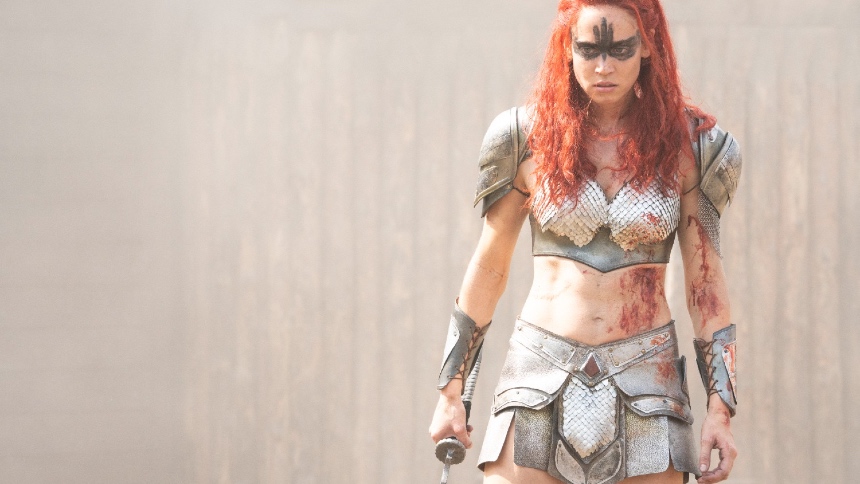
In my review of the new Red Sonja, I wrote about how the film's low budget holds back this "unabashedly earnest adventure movie" that engages in some very timely commentary on the disregard, if not outright destruction, of our environment in the name of progress.
So when I had the chance to speak with director M.J. Bassett and star Matilda Lutz, it was no shock to learn that when Bassett came aboard, she was told that she wouldn't have much of a budget for the film. Nor was it a surprise to hear Lutz emphasize how the humanity of the script, originally written by Tasha Huo and significantly re-written by Bassett, made the project feel special.
But there were still some surprises in our conversation, particularly about how Lutz was offered the role and the specifics of Bassett's changes to Huo's script. More than anything, though, talking with them made clear how the film manages the "surprisingly cozy tone" I mention in my review; it's because the two women at the center of the project care so much about this character and using her to tell a story about being good to one another.
You can read our conversation in full below.
[The interview has been edited for length and clarity.]
ScreenAnarchy: So the movie has had a very long gestation period. What was it like to come onto something that had been gestating for 17 years and how do you make a project like that your own?
M.J. Bassett: I'm a fantasy fan and I have been my whole life so I knew about Sonja. I'd seen the movie obviously as a teenager. But I'm also a fan of Robert E. Howard's original writings and I'd made a movie called Solomon Kane, which was one of his characters. And I was obviously also a fan of Conan and Bran Mak Morn and all the other ones.
So I knew Sonja from the short story where he first created her, and the comic book version, and Bridget Nielsen and Arnold's version. And I also knew that this thing had been in development for 17 years and I'd tracked it as a filmmaker cause this is my genre.
So you go, "Oh, Sonja's around, who's gonna make it?" And originally Robert Rodriguez was the big announcement, and Rose McGowan was gonna do that. And that would have been a very, very different movie than Bryan Singer's, and then I think Simon West and then Joey Soloway and a bunch of other people.
When I met the studio about various things over these years, I always said, "Hey, what's happening with Sonja?" And they'd always be like, "Well, we've got a writer and we've got a director." And I'm like, "Ah, damn, it's not me."
And I was just kind of stalking this project for years until one day they said, "Yeah, we think we're gonna make a change, probably gonna look for a new director." And I just went, "It's me! Give it to me, I know what to do with her. I love this character, I have an idea, let me do it."
And they were like, "Well, it's not gonna be a very big budget now and it's gotta be done in this amount of time." And I'm like, "I don't care how much, I don't care when. I promise you, I will get this across the line. Just let me get a great Sonja and then we can make a great movie."
What was it like for you, Matilda?
Matilda Lutz: I got an email with a script and an opportunity for a self-tape for Red Sonja. And from the start, when I read the script, I loved it. I loved the fact that there were a lot of stunts and possibilities to have fun with the action and the physical part of it, with the horseback riding and climbing and archery. And I got to lay down and sleep with a horse in the middle of the forest.
Like all of that was magical, but also the fact that there's so much humanity to the script. And I love how it talks about two stories, not to spoil it too much, but two stories that start from the same point and then because of situations you can go two ways. It's not about good and evil, but it's about what you do with the situation you live in. So I loved the human aspect of the script.
And then after my first self-tape, I got to meet M.J. on a Zoom call. And the passion that she transmitted to me by talking about Red Sonja and the script. And everything she just said now that she really pursued the film and she wanted to direct it. And the directions she had for me for just a simple self-tape, I knew that it was gonna be something that was gonna be fun. And also on a human level, was gonna be enriching because you learn so much from her, like in every aspect of life. So I was just happy to be on board.
That casting process was very long because I got to do like three, four self-tapes and then M.J. wanted to test the [other] few girls on the [finalist] list. And I was shooting a show [in Italy] so couldn't go to LA and I was so upset about it.
Then she came to Bulgaria for location scouting and I got to go to Bulgaria and test for it. And then I got the like role from a FaceTime call from M.J., which you never get because you always get the news from your agents or your managers. Usually it's like, "Hey, everybody's on the phone," like on the same call, your managers, your lawyer. And you're like, "Oh, okay, something's happening here."
But M.J. called on a Sunday, like it was the day after [I'd tested in Bulgaria]. And I was with my son and I didn't have the courage to pick up the phone. I was so nervous. I was like, "Why is she calling me?" And then she texted me "Hey I just need to ask you a last question before I make my decision."
So I called her, I was like, "Hey, M.J., what's up?" She's like, "Do you want to be the next Red Sonja?" And to me, it was the best way to know that I got the part. I remember crying because I was so grateful and happy. So, I mean, I'm just so happy about this experience.
Yeah, it's an important question to ask your next Red Sonja, if she wants to do it.
[Laughter]
M.J. Bassett: Exactly. "Do you want to do this?" I think I told her it was going to be really hard, really physical. You know, there are lots of challenges, but there was not a moment she didn't come at it full heart, full on from an emotional point of view and from a physical point of view.
As a director, you cannot possibly ask for more than that from your collaborator, because it's not just like, "Oh, this is an actor." This is somebody who you're working alongside in every aspect of trying to make this story come alive. You know, without a good Sonja, there's nothing. I can't work with anything. It was amazing to have her.
M.J. I've seen [your earlier film] ROGUE [which is in part about poachers] and loved it, and I know that you did some rewriting of Tasha Huo's original script. And conservation is clearly something you're very interested in and it is there in RED SONJA, like "Leave animals alone. Let's conserve their living spaces. Let's let them be wild creatures. Let's not kidnap them and make them perform in arenas." Was that there already and you embellished it, or was that something that you brought to it?
M.J. Bassett: I think it was something I brought to it. I can't beat around the bush on that. That's my agenda, right? So the script that I was given was a great script, a great foundation, lots of interesting characters, lots of places we could take them. But that script sort of leant into sexual politics a lot more. You know, men versus women and what it is to be a woman in the world. And I didn't want the movie to be about that. I wanted the movie to be about a person in the world, right?
The fact that Sonja is a woman, to me, was not important. I think it's the humanity that's important. Whether [villain] Draygan's a man, it's not a male versus female story. It's an ideological story. And it's also an empowerment story for a person, the fact that Sonja's a woman is never mentioned in the movie. There's no "Oh my god, it's a woman!" It's like, "No, it's a person."
So I wanted to make it so that she embodies something about how I feel about protecting the planet. And that Draygan, played by Robert Sheehan who's amazing in the film, [shows] there's also something to be said for "Technology will save us," but only if it's used correctly. You know, the tech bros have the ability to save the planet, but they're not going to because they're greedy and they're misguided. That's kind of where I wanted to be, and that wasn't in the script per se and I wanted to explore it.
So that's one of the things I wanted to do, but also to ultimately have the movie turn on the concept of humanity and understanding your enemy. As Matilda mentioned, it's two characters who start from the same point, go on very different journeys, and then meet at the end and have to find compassion for each other. And I found that a really valuable journey and something I wanted to explore.
One of my other questions was about having your villain yell "progress" feels very, very parallel to many of our current tech bros.
M.J. Bassett: Really? I wonder how. [laughter] But he's not wrong. The point is he's not wrong. He's just completely wrong! Two things can be true.
Yeah, I kept on thinking about these AI data centers causing droughts across the U.S.
M.J. Bassett: It's insane.
Yeah. I do want to ask you about the humanity of the film, 'cause my favorite aspect of it was the sense of camaraderie between the Damnati and the fun, flirty chemistry between you, Matilda, and Luca Pasqualino as Osin. So as director, M.J., how do you facilitate that? And then for you, Matilda, as an actor, how do you develop those relationships?
M.J. Bassett: From a directorial point of view, it's two things. One is casting is everything, right? So if you have an incredibly strong foundation, like I have Matilda, you've got to build people around her. And as you mentioned, Luca is just charming and wonderful, right? So you can't not fall in love with Luca. But also the movie doesn't have this big love story, it has a kind of chaste romance. So it's just building that out.
And then just hanging out and spending time and trying to build a safe space for actors to feel comfortable in and to be as real as possible. We weren't in blue screen stages. We were in built environments. We went out into the cold, out into the forest. We set fire to things and crashed things and got wet and cold and dirty and muddy. And it always feels to me that if you can do that and then you can build up a trust with the cast, you can allow them to be who they want to be.
Matilda Lutz: On my side, I will say, I think the director does it all.
[Laughter]
Matilda Lutz: Yeah, I mean, the director is usually the one who picks the people that are going to be on that set for several months. And M.J., I could tell from the start that she was super talented and she knew what she wanted and her vision.
But what I loved about her was the humanity she had and the care she had. And she brought on this set amazing people to work with. And I have to say, sometimes you have to fake it. I didn't have to fake the chemistry between the characters because they were wonderful actors to work with. We spent time when I had time off, because I didn't have a lot of time off. [laughter]
M.J. Bassett: You didn't have time off. [laughter]
Matilda Lutz: Yeah, I feel like everybody got to spend a lot of time together and I was like "I gotta train, I gotta horseback ride." But I really enjoyed spending time with them and the script was there. And then it was just about bringing these characters to life.
M.J., you already talked about SOLOMON KANE. What was it like for you to return to a Howard world? And Matilda, I know you've already talked about a lot of the work you put in, but was this being a "period piece" something that made you interested in it? Because I know most of your work has been in contemporary settings.
Matilda Lutz: Well, every experience for me is a completely different experience. So I try to pick projects based on the script and the character and the people that I work with. So getting into this world was amazing because [while] I had done similar physical work, there were fantastical creatures that were not [physically] there [in Red Sonja].
And what I really loved, that I hadn't experienced before, was that I got to be a kid again. You know, imagine something that's not there and I go play and make it real and imagine it and play with it. I have a 6-year-old son and that's what I started doing when he was born, like not immediately [laughter], but it just gets you back to your true nature and I loved that and I hope I get to do more.
M.J. Bassett: For me fantasy is the genre that made me want to be a filmmaker. I love the comics, I like reading the books. I grew up in the 80s, 90s and I devoured the pulp fantasy from the 70s. Michael Moorcock is one of my favorite writers.
It's just this thing where you go, "I get to worldbuild, I get to have real human stories in the midst of these fantastical worlds where I get to make up the rules." And that to me is the pinnacle of sort of cinematic storytelling.
Sci-fi is one genre, but for me, fantasy is where it's at. So if I had to spend the rest of my life making movies, I'd make fantasy movies.
Red Sonja will arrive August 29 on various Video On Demand platforms via Samuel Goldwyn Films.