
Ôshima on UK BluRay: IN THE REALM OF THE SENSES (1976) review

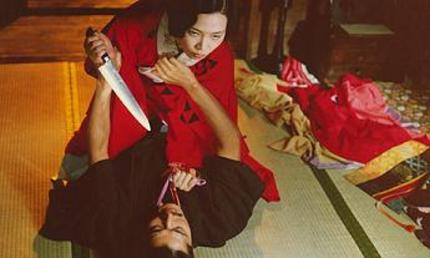
For anyone who hasn't yet checked Wikipedia the story takes place in the 1930s, in a rapidly industrialising Japan. Sada Abe (Eiko Matsuda) is a young woman who's just landed a position as a maid in the household of Kichizo Ishida (Tatsuya Fuji) a wealthy member of the upper classes. Despite her lowly status, Abe's clearly not about to let anyone push her around - most significantly, her history and personality mean she's determined to control her sexuality, and quick to fury if anyone slights her because of it. Ishida's instantly captivated by Abe's headstrong femininity, and with the attitude of a man used to getting what he wants, makes a move on her almost immediately. She's briefly resistant, but soon reciprocates, and the couple have soon moved from quickies in the master bedroom to lengthy bouts of lovemaking in a secluded hideaway downtown. The servants who wait on them seem increasingly appalled by their unbridled hedonism, but Abe insists this is merely her expression of how much she loves Ishida, so why should she be ashamed? Regardless of their motives, though, Abe's infatuation with her partner clearly can't accommodate the thought of anyone ever possessing him the way she does, suggesting there's only one way this can end.
First things first; whatever reading you want to make of the film, there's no avoiding there's a great deal of sex in it, and much of that is explicit enough the initial frisson of 'Oh, hey, they're actually doing it' never completely goes away. After all, the film clearly intends to portray the pleasure the couple take in each other, so to see the actors getting pleasure out of it themselves is enough of a rarity in 'proper' films, even today, that it can't help but startle to some extent. Again, though, Oshima's single greatest achievement here is that his two leads manage to portray the emotional side of a sexual relationship so well; intercourse as a dialogue between two people with needs and wants, with actual feelings and views on the relationship reflected in how they treat each other - how they touch as much as what they say. It was unquestionably a brave step at the time (the finished film had to be developed overseas, as Japanese laws would never have permitted it to be completed) and it still stands out as something remarkable. Matsuda and Fuji display a frank, unrestrained chemistry, she almost literally consumed by passion, he wryly letting himself be carried away, that goes way beyond merely being happy to be filmed sleeping together.
But there really is virtually nothing to the film beyond that. The film's reputation is widespread enough it's difficult to spoil it as such, but talking about it further requires giving away the ending, so look away if that bothers you! There's been plenty written about why Abe Sada became such a bizarre cause celebre for murdering her lover, and while it may well have been to deflect national attention from what the government was doing at the time a significant part of her fame certainly does go beyond salacious journalism. By all accounts the couple were genuinely devoted to each other in their way, and while you could - being coldly pedantic - call Abe mentally unsound (guilty of murder, remember), she was still a woman choosing for herself in a society that stifled female voices almost from birth. Yet you'd have to stretch mightily to claim any of this was in the script, explicitly or otherwise. Ishida's status is only discussed in the broadest terms, there's hardly any exploration of the couple's backgrounds and the film simply ends once Abe's taken the final step, with nothing beyond a brief postscript explaining what happened to her afterwards.
It feels like such a waste, particularly when other writers have explored the same territory far more effectively in the decades since. Josephine Hart's Damage (the novel, at least, rather than the film) evokes a similar atmosphere of fevered intimacy but fleshes out its central couple in far more detail, and gives their mutual dependency much more dramatic weight. Shinya Tsukamoto's masterpiece A Snake of June largely focuses on one woman, but while his protagonist similarly discovers herself through sexual expression what sounds like a porn narrative in theory proves anything but in practice - where Oshima's film feels largely the opposite. You can only assume the scholars and academics who defend In the Realm of the Senses have immersed themselves so deeply in the background details they can't separate them from the film, because going in without prior knowledge the social and historical context flatly is not there - is barely even alluded to. This is the work of a master, but it's not a very good or at least not a particularly satisfying film: beyond the craft and the movie's place in history there's nothing to warrant giving In the Realm of the Senses more than a very cautious recommendation.
THE DISC:
Available to buy now, the UK edition of In the Realm of the Senses from Studio Canal UK - previously known as Optimum Films - has been released as one of three Oshima films available on BluRay in the UK for the first time. In the Realm of the Senses is also released fully uncut for the first time in the UK. The film gets a very good HD presentation - not perfect, but in excellent condition with some substantial extras (though admittedly they are mostly dedicated to affirming its status as a classic). The disc boots straight from the distributor's logo into the main menu over a single static image from the film. The different sections take a little practice to navigate, but it's nothing too difficult. The film has been divided into eight chapter stops.
The disc carries the original mono 2.0 soundtrack, which is perfectly clear and generally clean, if very slightly raspy and distorted during passages with more treble. Removable subtitles are large, easy to read and seemingly free from grammatical errors.
The picture is very good. It still carries a little of the softness of the original film stock, and there is a fair amount of grain and flicker, particularly in large background areas of shadow, but overall the image is generally sharp and distinct . Paler colours are perhaps a touch washed out, but the costume design and interior sets seem fantastically vivid. This isn't quite demo material, but still a quality transfer that carries a substantial amount of detail.
Some of the extras will be more of interest to people who agree with the generally accepted reading of the film, to put it tactfully. All the same, there's definitely a good deal of weighty material here, and most cinephiles should find something in it to interest them. Once Upon a Time is an episode of a French TV series dealing with the cinema: 50 minutes devoted to In the Realm of the Senses. While a little staid and formal - it opens with a breakdown of the plot that seems unintentionally funny - it manages an impressively comprehensive primer on Oshima's work as a background to the film as well as grounding it alongside other early examples of sex and sexuality in mainstream cinema. The program goes into enough detail it even includes brief clips of the real Abe Sada interviewed for a Japanese documentary, as well as drafting in an impressive array of talking heads, from cast members to (French) critics and directors voicing their admiration.
Recalling the Film is a further forty-minute retrospective looking back at the production - while it covers some of the same territory it speaks to different people with a slightly different approach (less emphasis on historical context and more on the state , for example). It has markedly lower production values than Once Upon a Time, feels somewhat structureless on occasion and skews towards a definite reading of the film, though some of the interviewees express doubt or ambiguity regarding certain points. There's still enough trivia and different viewpoints it proves a worthy companion piece to the first feature.
Panel Discussion at Birkbeck College is the most problematic of the extras - three film scholars and a moderator chat for nearly an hour on the film: their first experiences of it, their readings of it, their thoughts on obscenity in the cinema and censorship, Oshima's career and so on. Frustratingly, though, they devote a great deal of time to very abstract details (the interpretation of the different titles for the film, say) that are arguably of very little relevance to a practical evaluation of the work and clearly take the view that merely including a visual reference to something in the film constitutes a learned treaty on it, which they are all too happy to comment on at length. While they clearly speak from very knowledgeable positions on most of these subjects, if you agree with the gist of this review many of their responses will more than likely drive you up the wall. Also, it bears noting that unlike the others this extra does not carry English subtitles.
Finally there are roughly twelve minutes of Deleted Scenes, most of which are simply slightly longer versions of the final takes or ones that elaborate on an existing setup and were obviously cut for time or pacing. None suggest they should have been left in. Some of these flip from black-and-white to colour, though all are presented in HD and come with English subtitles.
There's certainly much more to In the Realm of the Senses than its reputation as shameless censor-bait would suggest, and any cinephile who doesn't mind the graphic content should definitely see it at least once. Finding out about the cultural background to the original story and to the genesis of the film itself makes for fascinating viewing, and Studio Canal UK's BluRay is almost worth it just for that, with some excellent supplementary material as well as a great presentation. But you cannot ignore that virtually none of this back story actually appears in the film, and what does passes by without explanation; that the people holding the movie up as an unassailable masterpiece seem to have confused the history with the finished product. Few people have depicted sex as frankly yet as maturely as Oshima does with In the Realm of the Senses, but few films are thought of so highly for having done next to nothing else.
(Thanks go to Optimum Films/Studio Canal UK and EM Foundation PR for facilitating this review.)

Do you feel this content is inappropriate or infringes upon your rights? Click here to report it, or see our DMCA policy.


