Blu-Ray Review: BEATS, RHYMES, & LIFE: THE TRAVELS OF A TRIBE CALLED QUEST

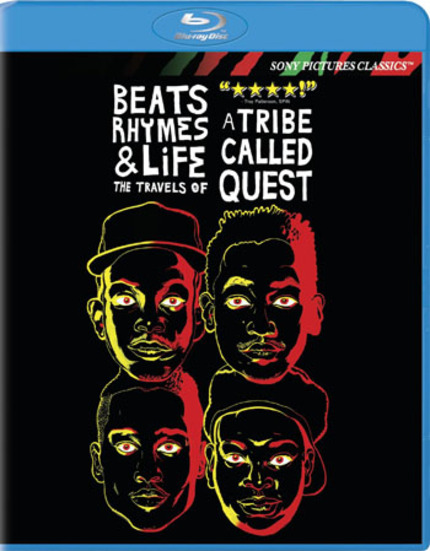
I've had to tear down and restart this review several times now because I want so very much for you to see Michael Rapaport's Beats, Rhymes, and Life, but I don't want to oversell it, while still adequately explaining the impact it had on me. My impulse is to say that in charting the rise and dissolution of the 90's hip hop sometimes-quartet A Tribe Called Quest, Rapaport has made a vital and important movie--not just because Quest was such a great group (which they were) but because there's no real sense of history with hip-hop, because for the most part, there is no idea of "classic rap," and articulating where the music's been is as essential as the history of rock, country, jazz, and the blues. And with style, with passion (the dude's obviously a big fan), and insight, Rapaport doesn't just take a snapshot of a moment, he shows that, for a little while there, we had a movement where hip-hop allowed itself to get weird, conscious, and brilliant all at the same time.
I said that the doc is about the four members of A Tribe Called Quest: Q-Tip (Kamaal Ibn John Fareed, formerly Jonathan Davis), Pfife Dawg (Malik Taylor), Ali Shaheed Muhammad, and Jarobi White, but it's more accurate to say that Q-Tip and Pfife are the heart and soul of BRL and the group itself. Childhood friends from Queens, the duo met up with Muhammad and White in high school, and started making their own raps over other DJs' beats. Before too long, they were choosing their own cuts, and by 1990, with the support of the popular New York DJ, Red Alert, they released their first album, the esoterically-titled People's Instinctive Travels and the Paths of Rhythm.
Listeners started taking notice thanks to expertly-chosen R&B and soul samples that was a complete 180 from some of the hard tracks coming out of the West Coast. They were socially-conscious, but in a way that emphasized the positivity of being young, black, and free. I would never dismiss the brilliance of work by acts like Public Enemy or KRS-One who shine a spotlight on the inequalities and struggles of being black in America, but sometimes you just want to hear that black is beautiful and that you are loved. And one effect the doc had was making me regret that as a kid I wasn't more aware of A Tribe Called Quest, that it took me until my 20's to really seek them out (and by then, they were effectively disbanded).
Rapaport documents the rise of the all-too-brief run of Native Tongues, which was essentially a rap collective involving Tribe, De La Soul, Jungle Brothers, Queen Latifah, and Monie Love, and just as Tribe is becoming bigger and better, the real fissures in the group start to appear. Pfife, kind of a reluctant member of the group to begin with, struggles with his health with the onset of juvenile diabetes and a stubborn unwillingness to give up sugar, while Q-Tip becomes the outspoken, public face of the group. You get the feeling that for all his intellect, for all his charm, it has to be exhausting being Q-Tip (not to mention being around him).Rapaport jumps between a recent, bruising series of reunion concerts put on, in part, to help with Pfife's mounting medical bills, and the history of the group with a lot of loving, passionate talking heads.
And this last bit might be where the movie could have verged on hagiography, or the "Everyone Loves A Tribe Called Quest" story. Thankfully, Rapaport found people interested in speaking candidly about the group, and about the personalities and people behind it. I think one of the painful moments comes late in the doc where we see a backstage altercation between Q-Tip and Pfife and later reactions from other rappers who grew up alongside them or with their music, and for all of them--even for me as a viewer--it's like that awkwardness of seeing some of your favorite people fight and feeling helpless that you can't stop them from being cruel to one another.
More than anything else, though, this is a beautiful documentary, filled with passionate voices, with snippets of wonderful, still vital music, with visual panache and flair thanks to the artfully-constructed animations and vignettes which bring the group's album covers to life. That's it, I'm all out of words. It's a beautiful, excellent documentary, and it is essential if you give a damn about hip hop, and hell, it's essential if you give a damn about music.