
STONE review

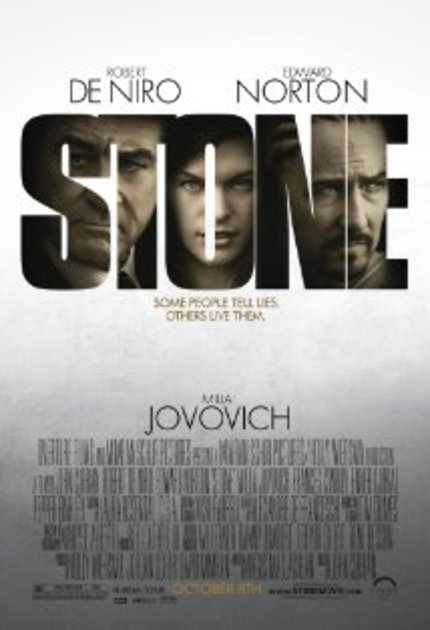
The story is one of the human need for redemption as actualized through the thick and constant metaphor of incarceration (among other things). De Niro is Jack, a world-weary parole officer on the brink of retirement. Edward Norton, sporting already-notorious cornrows and a forced dialect that most closely resembles Marlon Brando by way of white-rapper ebonics, is the beaten down street-rough inmate of the title, Stone. Stone wants to be free. Free of his past, free from prison, free from his guilt. (You get the idea.) But in order to obtain this elusive freedom, he must go through Jack. Jack has been in a loveless marriage for more years than many people I know have been alive, and as we're shown in the ham-fisted flashback prologue, he himself has been guilty of being one abusive jerk. For this, Jack has some sort of wandering, unfocused guilt. He listens incessantly to Christian talk radio, but shows no signs of living the life promoted therein. In the spirit of the heavy-handed metaphors this film lives to serve up, (bees caught in window screens, fire, overly pointed lines of dialogue, etc.) Jack, like Stone, has spent much of his life in prison - simply on the other side of the desk.
Stone in some way picks up on Jacks inner condition, and opts to take advantage of it by secretly assigning his ever-vampy and mega-sexy wife Lucetta (Milla Jovovich) to meddle with Jack. And meddle she does, as only a brazen nymphomaniac could. The fact that Stone himself is either generally oblivious or completely checked out from the fact that Lucetta is seducing Jack and liking it is a perplexing one, and one that the movie deals with in an almost equally perplexing yet unsatisfying way. The set-up is pure classic film noir; the outcome is the worst kind of forced wannabe art house pretention.
Jovovich is a classic film noir femme fatale in a movie that is classic noir at its core, but is ultimately afraid to leave any cards off the table. The depiction of the downward spiral of an everyman (De Niro) echos numerous better, classic films of yore, including "Scarlet Street" and "Double Indemnity". Morality tales those may be, but they never felt the need to be so on the nose as to include religious quotes and Christian banter. People (like myself, incidentally) who are interested in spiritual things in movies tend to harbor a love of classic film noir precisely because it deals with mankind's dark tendencies in a very stylized and palpable way. In this film, noir's trademark stylized quality has been replaced with the static camera of "reality", and gussied up with Edward Norton's cornrows and Milla Jovovich's bare breasts. Perhaps contrasting raw, lewd language and unflinching sex scenes with the plight of a spiritually broken individual will appeal to those in the permissive "hipster Christianity" camp, but I can't imagine more traditional believers warming up to the ultimate vagaries of this film. For non-believers, it has virtually nothing to offer, as the entire film for such as viewer would surely be seen as one long exercise in clumsy metaphor usage.
"Stone" has the rare and awkward distinction of being at once frustratingly vague but also overtly preachy. How can a film do both at the same time? Prior to this, I would've wondered that myself. As it turns out, the answer is, not very well. "Stone" wants to be profoundly subtle as the hard-bitten characters struggle and shift, but at the very same time, the film beats you with a sledgehammer of spiritual themes.
On one hand, "Stone", in the future as more people find it, will quite likely have a life beyond the cinema as a discussion point for those who love to dig into movies that aren't afraid to grapple with morality and spiritual things in a very up-front way. But on the other hand, the manner in which "Stone" deals with those things is so over-bearing, clumsy, and needlessly weighty, that it could be a legitimate candidate for worst movie of the year.
At best, "Stone" is a curious mess. It comes off as a film that was initially conceived by artists who had something definite to say, but were too afraid to come right out and say it. So they opted to dial their message's clarity waaaaaaaaay back, hiding behind the seemingly respectable high falutan storytelling veneer of the unsaid, the unresolved. To add insult to injury, the terminal shrug of non-clarity that plagues the ending is the probable result of creative meddling - so common as more and more powerful people get involved in the early phase of a film project. Finally, we are left with an unsettled blend of spiritual advocating and misplaced nihilism.
De Niro and (yes) Jovovich do impressively well with the material they are given. The ordinarily acclaimed Norton, however, runs hot and cold in this role, as sincere as he is distracting. Director John Curran ("The Painted Veil") deserves some kudos for his commitment to facing down big themes in an unflinching way, but in the end, "Stone" sinks in the muck of its own murky thematic swamp, imprisoned by it's own over-ambition and unfocused moralizing.
- Jim Tudor

Do you feel this content is inappropriate or infringes upon your rights? Click here to report it, or see our DMCA policy.


