
OSHIMA'S OUTLAW SIXTIES DVD Box Set Review

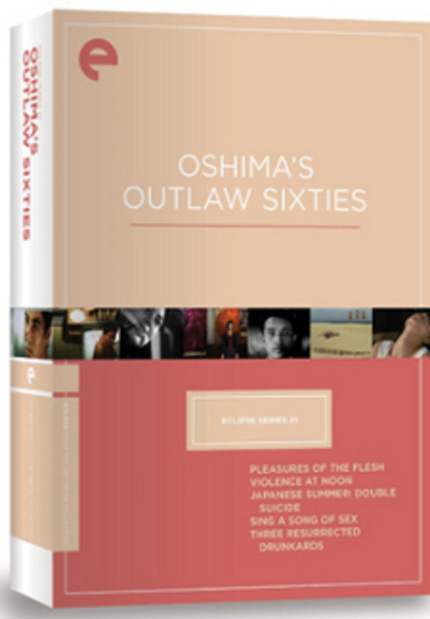
Eclipse's Oshima's Outlaw Sixties DVD box set is the first serious attempt to represent Nagisa Oshima's 1960s filmography on North American home video. The marketing of this box tends to make Oshima seem like a Eastern Jean Luc-Godard, but like other members of the so-called Japanese New Wave, Oshima worked in a completely different aesthetic, cultural and political space.
Nagisa Oshima's feature film career can be roughly divided into three periods: Shochiko (1959-1960), Sozosha (1965-1972), and Euro-Japanese co-productions (1976-1986). The Eclipse box set presents five films from the beginning of the Sozosha period, including Pleasures of the Flesh (1965/B&W), Violence at Noon (1966/B&W), Sing a Song of Sex (1967/Color), Japanese Summer: Double Suicide (1967/B&W), and Three Resurrected Drunkards (1968/Color). These films make use key themes that Oshima would return to throughout his career like criminality, sexual deviance, the Japanese left, militarism, and Japanese-Korean relations. However, instead of the formal elegance of his later works, these films are often deliberately absurd, bizarre, and fragmented. His approaches didn't always work. However, when everything locked together, Nagisa Oshima was on fire.
Pleasures of the Flesh (Etsuraku) tells the story of Atsushi Wakizaka (Katsuo Nakamura), a man who falls in love with school girl named Shoko (Mairko Kaga). The possibilities for consummating his love are limited so he admires Shoko from afar. After Shoko is molested, he kills the perp at the behest of the girl's parents. The murder is kept secret but a witness soon emerges. The crooked witness approaches Atsushi with a proposition: keep a suitcase full of embezzled money until I get out of jail or I will turn you in. Atsushi concedes out of concern for Shoko. He plays along for a while, but after Shoko gets married, he goes on a debauched spending spree. Pleasures of the Flesh, which was adapted from Yamada Futaro's novel Pleasures Inside the Coffin, is straightforward when compared to the four other films in the box. The subject matter (murder, jealousy, lust over young girls) was standard cinematic fare in Japan as was the story's ironic, fateful twists. The story's moral ambiguities fits nicely with Oshima's sensibilities and his direction is typically icy and detached.
In the darkly humorous Japanese Summer: Double Suicide (Muri-Shinju: Nihon no natsu), a horny teenage girl (Keiko Skurai) and a suicidal man (Kei Sato) cross the paths of Yakuza digging up a cache of guns on the beach. The pair are forced to go a hideout where the gangsters are preparing for a war. They are locked up over night with various other interlopers, including a gun obsessed student revolutionary, and a knife wielding bandit. Inside the building, the motley crew plot and scheme against each other as gang wars brew outside and a gaijin sniper moves ever closer to their location. Japanese Summer: Double Suicide boasts a dry morbid wit that reflects an awareness that the events being presented are improbable. In spite of the absurdity, the film conveys a genuine sense of unease and tension. The third act, which invokes the assassination of John F. Kennedy, is mad genius.
Pleasures of the Flesh (Etsuraku) tells the story of Atsushi Wakizaka (Katsuo Nakamura), a man who falls in love with school girl named Shoko (Mairko Kaga). The possibilities for consummating his love are limited so he admires Shoko from afar. After Shoko is molested, he kills the perp at the behest of the girl's parents. The murder is kept secret but a witness soon emerges. The crooked witness approaches Atsushi with a proposition: keep a suitcase full of embezzled money until I get out of jail or I will turn you in. Atsushi concedes out of concern for Shoko. He plays along for a while, but after Shoko gets married, he goes on a debauched spending spree. Pleasures of the Flesh, which was adapted from Yamada Futaro's novel Pleasures Inside the Coffin, is straightforward when compared to the four other films in the box. The subject matter (murder, jealousy, lust over young girls) was standard cinematic fare in Japan as was the story's ironic, fateful twists. The story's moral ambiguities fits nicely with Oshima's sensibilities and his direction is typically icy and detached.
Violence at Noon (Hakuchu no torima) tells the story of a serial killer (Kei Saito) who enters people's homes under false pretenses, chokes his female victims, and assaults them. Two women help hide the killer's identity: his wife (Akiko Koyama, who was married to Oshima at the time) and a victim named Shino Shinozaki (Sae Kawaguchi). The film is based on Takeda's Taijun's novel The Daylight Demon (the film's alternative name), which details the real life sex maniac who went on a rampage during 1957 and 1958. In the film, the killer emerges as a sympathetic figure; Oshima said that the character is a demon posssed by forces he cannot control. The film punctuates its unorthodox moral stance with non-standard technique. The rapid cutting (over 2000 cuts), short shot length, off-kilter compositions and flashbacks combine to create a visually disorienting work.
Sing a Song of Sex (Nihon shunka-ko) is an uneven effort that examines attitudes of Japanese youth in the 60s. A group of listless horny high school students (led by pop singer Araki Ichiro) are preparing for college entrance exams. The boys display with little interest in anything but exams and sex. In contrast, the world around them is filled with activism and protest about the Vietnam War and National Foundation Day. The boys go to dinner with some female classmates and their professor (Juzo Itami). While slamming drinks, the professor teaches the students a drinking song about having one's way with school girls. The boys become obsessed with the song, which serves as a theme for their evolution from curious teens into dangerous deviants ("I feel lascivious"). Sing a Song of Sex, which is also known as A Study of Japanese Bawdy Songs, was shot without a formal script, giving some scenes a loose, improvisational feel. The setup is quite strong. What follows is a mixed bag. One of the film's central themes is the use of songs in Japanese culture to express social or political concerns. As such, the bawdy song is used as a motif throughout most of the film. This becomes really tedious especially when it is linked with some of the film's more leaden political metaphors (e.g., Araki Ichiro singing the song while a folk band at a Vietnam war protest plays "We Shall Overcome").
In the darkly humorous Japanese Summer: Double Suicide (Muri-Shinju: Nihon no natsu), a horny teenage girl (Keiko Skurai) and a suicidal man (Kei Sato) cross the paths of Yakuza digging up a cache of guns on the beach. The pair are forced to go a hideout where the gangsters are preparing for a war. They are locked up over night with various other interlopers, including a gun obsessed student revolutionary, and a knife wielding bandit. Inside the building, the motley crew plot and scheme against each other as gang wars brew outside and a gaijin sniper moves ever closer to their location. Japanese Summer: Double Suicide boasts a dry morbid wit that reflects an awareness that the events being presented are improbable. In spite of the absurdity, the film conveys a genuine sense of unease and tension. The third act, which invokes the assassination of John F. Kennedy, is mad genius.
Three Resurrected Drunkards (Katte kita yopparai) is a circular commentary on the Vietnam war and Japan's relationship with Korea that comes across as Oshima's idea of a zany pop film. The film begins with three members of the folk-pop group Folk Crusaders (erroneously identified in the notes as the Parody Folk Gang) hanging out on a beach. The Folk Crusader's hit Japanese single Kaette kita yopparai plays in the background. While the band members swim in the ocean, an arm emerges from the sandy beach to swipe their clothes. Upon their return, the guys eventually find out that their clothes were stolen by two Korean soliders (one of whom is played by Kei Sato)escaping to Japan. The band members are mistaken for the illegal immigrants, which triggers a wacky adventure. The wackiest thing about this movie happens at around the 40 minute mark: Katte kita yopparai begins playing again and the whole movie starts over. The second half repeats many of the same beats, but changes things around in a way that serves as a commentary on the first half. Three Resurrected Drunkards suffers from some of the same problems as Sing a Song of Sex. Although the structure is interesting, the film tends to meander and hammer its political points a bit too hard.

Do you feel this content is inappropriate or infringes upon your rights? Click here to report it, or see our DMCA policy.


