NO PUEDO VIVIR SIN TI review

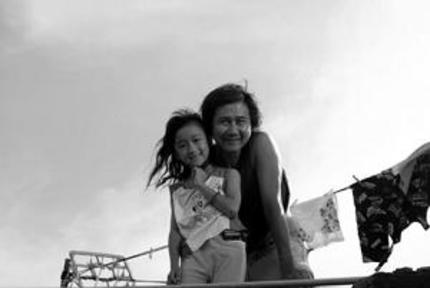
No Puedo Vivir Sin Ti (I Can't Live Without You) is an odd little film. Its one major weakness is it hardly seems to be about anything. While it tells the story of an itinerant Kaohsiung labourer who struggles to keep custody of his daughter in the face of bureaucratic indifference, it's not about one man against the world, and it neither paints its lead as underdog white knight nor its nominal villains as cruel or heartless.
At the same time, thanks in large part to this refusal to sully its dreamy, meditative ambience with any kind of reductive message - not to mention a stunning performance from Chen Wen-Pin and some truly wonderful cinematography - Taiwanese director Leon Dai's second film (after 20-Something Taipei) proves one of the best films out of the country in years.
It opens with a news report detailing how a nameless man has climbed out over a bridge above a busy underpass and now threatens to jump into the oncoming traffic with the young girl who's clinging to his back. While the police and television cameras swarm around him and onlookers debate the possibility he'll follow through, the film leaps back to several months before.
We join the same man, Li Wu-Hsiung (Chen), living rough in an abandoned warehouse by the edge of Kaohsiung harbour. Though desperately poor, lacking any formal education with which to better himself, he takes care of his daughter Mei (Chao Yo-Hsuan) the best he can with odd jobs around the bay.
Things take a turn for the worse when the police turn up to investigate. They inform Li he needs to register Mei in order to send her to school, or face hefty fines he can't possibly afford. Yet when Li attempts to do this he's informed that his ex-wife and her current husband are the ones registered as Mei's legal guardians, given they were in fact actually married when Li and she were living together.
Li's increasingly frantic attempts to find some way to reverse this ruling drive the narrative back to his earlier meltdown. Yet Leon Dai never once resorts to any easy option in playing out his lead's decline. His script - which he and Chen co-wrote - remains beautifully even-handed throughout.
No Puedo Vivir... is almost entirely non-judgemental, yet never detached. Coming up against the unrelenting administrative ennui that greets Li's efforts to do the right thing is evidently a profoundly soul-destroying experience, but at the same time the film is gently scornful of Li's naivete when it's revealed his relationship with his ex-wife was really adultery.
We see enough officials who offer to help resolve Li's case then just conveniently forget about him, but at the same time these people are never presented as monstrous or criminally negligent - their only crime being, perhaps, that lacking Li's perspective they trust too readily that the system will just work the way it's supposed to.
This hands-off approach, however grounded, does sometimes leave No Puedo Vivir... feeling somewhat directionless, even a little dry. There are moments when it comes across more as a record of events (the film was in fact loosely based on a true story) than a narrative feature.
These are minor nitpicks, however. Chen Wen-Pin's performance alone goes a long way towards making up for any flaws in the scripting or pacing. If the film is about anything, it would have to be a father's love for his daughter, biological or otherwise (Li pointedly refuses to take a paternity test to establish this). There are no syrupy montages to reinforce the idea, but any number of beautifully subtle, often wordless moments between the two - and one major sequence to introduce the ending which Chen turns into a emotional hammer blow, a devastating counterpoint to the earlier scene on the bridge.
Chang Yu-Hsiang and Chou Yi-Wen's cinematography is also a major highlight, repeated motifs underpinning the bond between father and daughter; the handheld black-and-white camerawork has a gorgeous, smoky aura to it, every other shot something that could be framed and hung on a wall.
Ultimately the elegant, minimalist aesthetic is far more strength than weakness. It may fall a mark or two short of being an outright masterpiece but No Puedo Vivir Sin Ti is still a tremendous achievement that comes highly recommended to any prospective viewer. For all its apparent lack of substance it still proves surprisingly memorable, captivating and hugely, powerfully emotive. If the best ideas are those which can be expressed the most succinctly, Leon Dai's second feature must be some way up any list of them.