DVD Review: Steven Soderbergh's CHE

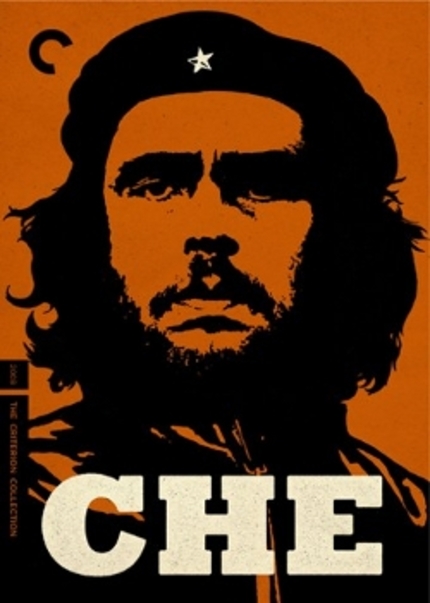
Steven Soderbergh's Che was met both praise and derision upon being unleashed in 2008. After a long wait, The Criterion Collection (in conjunction with IFC) has issued a three DVD box set and two disc Blu-Ray set of the film. The naysayers are entitled to their opinions, but as Criterion's exquisite home video release demonstrates, Che is a technically accomplished and intellectually rigorous film that stands as one of the more important works in Soderbergh's filmography.
Che is divided into two parts (135 and 136 minutes, respectively), which are included on two separate DVDs. The two films are different in style and tone, but combine to form an epic rise-and-fall story. The map sequences that open each part of Che serve as a guide to the film geographical and temporal structure and serves as indicator of its epic scope.
Part One (released as The Argentine in Europe) chronicles Ernesto Che Guevara's participation in the Cuban Revolution of 1958. This part is based on Guevera's Reminiscences of the Cuban Revolutionary War. The revolution has been portrayed in numerous films, but never with this level of detail or immersion. Part Two (released as The Guerilla in Europe) focuses on Guevara's activities after he resigned from the Cuban government. The film, which is based on Guevara's Bolivian diaries, is a decidedly grimmer work that chronicles his failed attempt attempt to topple the Bolivian government.
One can criticize Che for being overly long and laborious, but Soderbergh handling of this material is spot on. The film manages to coherently pack over a decade of events into four-and-a-half hours while sticking to historical facts and avoiding the romanticization of the film's larger-than-life subject. The screenplays (Peter Buchman wrote Part One and collaborated with Benjamin A. Van Der Veen on Part Two) eschew standard narrative devices in favor of a modular event-oriented structure that reflects the progress of history and Che Guevara's driven personality. This modularity creates a natural rhythm that flows from the events being portrayed. Reality is the guide.
This atypical approach would not have worked without Benicio Del Toro. His resemblance to the character as presented in photos and filmed footage is uncanny, but his physical appearance is just a substrate on which the performance is built. Del Toro really communicates the Guevara's intense, doctrinaire mindset while also capturing his self-image as a liberator and humanitarian.
Both parts of Che were shot in 4K resolution on the very first Red One Digital Camera prototypes. Soderbergh has used these lightweight, mobile cameras on numerous productions since the film was made. However the Che production showed that these cameras could actually work for feature films. Soderbergh used the cameras to create a fast, agile shooting style that gives each part the immersive quality of documentary filmmaking. The scenes in jungle and mountain terrain Part One was shot in a 2.39:1 aspect ratio, and is preserved in a letter box format on the Criterion release. Part Two was filmed in 1.78:1. The taller framing and darker color palette amplifies the grim tone of Guevara's failed attempt at toppling the Bolivian government. Black-and-white 16mm footage appears throughout both films. This adds a vintage look to some dramatic scenes, and gives a newsreel quality others.
The Criterion DVD release is packaged as a three-disc box set. The DVDs are contained in beautifully printed four-panel digipak that includes an essay by critic Amy Taubin and a small poster. The digipak, which is enclosed in a slipcase, folds into the equivalent of two DVD cases. As to image quality, the DVDs look amazing with clear, color-rich image and flawless (i.e., completely unnoticeable) compression. The Blu-Ray undoubtedly looks better (the film was shot in 4K resolution, and the home video release was derived from a 2K source), but the quality of the DVD transfer is as good as the medium could possibly deliver. Both parts have a single 5.1 surround Spanish language audio track; Part One has an option for hearing Benicio Del Toro's voice-overs in Spanish as opposed to English. Optional English are provided on both discs. Author Jon Lee Anderson, who served as a chief consultant on the film, provides audio commentaries for each part.
The third disc contains hours worth of extras. Making Che, a documentary about the film's production, featuring interviews with Soderbergh, producer Laura Bickford, actor-producer Benicio del Toro, and writers Peter Buchman and Ben van der Veen. A 1968 Granada Television documentary called End of a Revolution examines Guevara's death and its impact on the revolution he tried to foster in Bolivia. Interviews with conducted by producer Laura Bickford and Benicio Del Toro with Cuban historians as well as participants in the 1958 Cuban Revolution and 1967 Bolivian campaign are provided. A documentary called Che and the Digital Revolution! covers the use of the Red One cameras in the film's production. Deleted scenes from both films are included with commentary by Steve Soderbergh (he does not provide commentary for the features).