BEHIND THE PINK CURTAIN Retrospective: Masao Adachi's GUSHING PRAYER

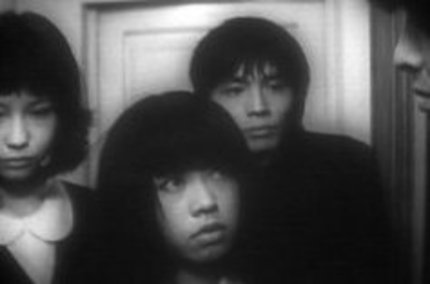
As with Blue Film Woman, Stance's new 35mm English subtitled print Masao Adachi's Gushing Prayer premiered at Fantastic Fest 2008. Unlike Blue Film Woman, Masao Adachi's film is best summed up in one word: obtuse. Gushing Prayer's indirect approach never really allows for the development of an emotional connection but the film nevertheless remains compelling.

Gushing Prayer presents a group of high-school students (two females and two males) who are engaged in a group relationship. Yasuko is the most precocious of the group, and her budding curiosity compels her to plow through a series of random encounters in search of ultimate sexual satisfaction. Along the way, Yasuko becomes pregnant. Will the pregnancy be terminated or will the baby be born? The answer to this question is interesting to say the least.
The film's black-and-white photography is mesmerizing, and footage of the foursome walking through fog has an almost iconic quality. As with many pink films of the time, scenes occasionally switch to full-color to highlight dramatic elements. The visual aspect of the film draws is compelling but the content seems intentionally designed to alienate the audience. The stone-faced actors, the didactic dialogue and matter-of-fact approach form a brick wall that many will not want to climb. For example, one of the supposed high-school students actually integrates a George Bataille quote into a conversation. These moments reveal the film's true face as a piece of abstract agit-prop. As Jasper Sharp explains, Gushing Prayer operates as an allegory for the political turmoil occurring in Japan during the time. Indeed, among the many street scenes are jeeps and tanks, which reflect the increased police presence in response to the left-wing terrorist activities. An allegorical reading of this film won't help most viewers get in to this movie, though. Those who do stay the course will find that Gushing Prayer is a complicated piece of work that shows there is more to pinku eiga than titillation.