
WICKER Review: Witty Modern Fairy Tale Hits the Spot
Olivia Colman, Alexander Skarsgård, Elizabeth Debicki, and Peter Dinklage star in prickly yet delightful film.

If you have seen a trailer for Wicker, you might think the subheading above is a double entendre. And you would be right, at least partially (because why the heck not). But it's also about how fairy tales still are ubiquitous in so many cultures is that are a means to discuss timeless themes in a form whose iconography and semantics are familiar enough that we can grasp the themes and ideas the story is playing with, which can also be timeless but also contemporary. But it can be tricky for a modern fairy tale, to handle both with the necessary skill and entertainment.
Luckily, Wicker handles this quite masterfully. The second feature of Eleanor Wilson and Alex Huston Fischer (Save Yourselves!), based on the short story "The Wicker Husband" by Ursula Wills, is a romantic comedy and a satire, a concave-mirror of much of our own world in relationships, love, sex, and the fight for meaning and fulfillment.
A village in an unnamed country has a fairly solid rules: if you're a man, you're called by your profession (tailor, butcher, baker); if you're a woman, you are that profession's daughter, or wife when the time comes. Your status in the community comes from how 'elevated' your profession is, and women had better be happy with being a mother. And while she might rule in the house, there is little to no other power or option available.
But then there is Fisherwoman (Olivia Colman); orphaned as a child, she's had to live her own existence on the fringes of the community. She's used to being the butt of jokes about her appearance; she sees what the women of the village have to put up with, in husbands who really have no idea how little they do to keep a marriage and household working, and she's fine. Really, she's fine, she tells herself. Except she's tired of being looked down on, and while it's hard for to her to admit, tired of being alone.
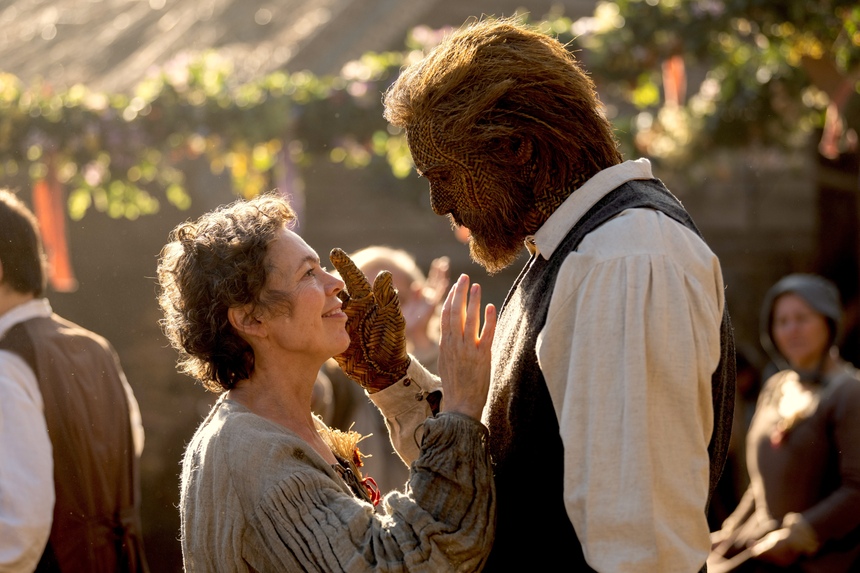
So she takes a journey to the local Basket-Weaver/witch (Peter Dinklage), and asks him to weave her a husband. He agrees, has an out-loud deliberation with himself as the unofficial narrator of this tale, and a month later, We hear what sounds like a large piece of wicker furniture going from door to door, asking for various items so he can be married in the morning. And thus there is Fisherwoman's Husband (Alexander Skarsgård), in all his strange and beautiful glory.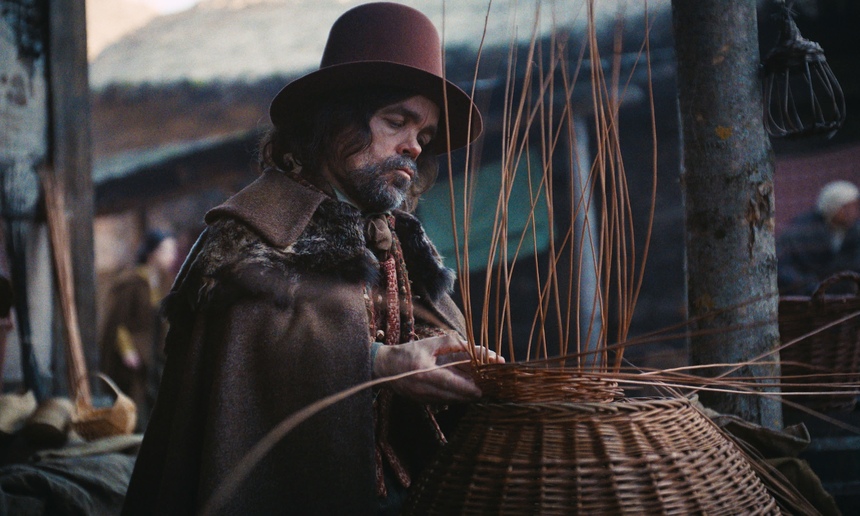 The new couple quickly form a strong, loving, and yes, very sexually active bond, which causes jealousy, longing, and irritation from the villagers, especially Tailor's Wife (Elizabeth Debicki), who is used to being at the top of the proverbial village heap, centre of attention and advice. When the other women look to Fisherwoman instead, and the men find their near-complete lack of effort in their marriage and parenting, painfully obvious, the knives come out for the happy pair.
It might seem a bit antiquated to set the story in a world where women are, in the long run, subordinate to men and expected to marry, but that world is neither that far behind us, and still somewhat adjacent. Women's sexual desire is also still too often considered subordinate, and they are too often still pitted against each other when a society places men's needs at the top. But this is not only what the film is about: it also shows how a patriarchal society hurts men as much as women, disallowing them any sensitivity or pursuit of any other interests, in life or love, that they might have.
Fisherwoman's outcast status leaves her both independent and capable in a society which does not allow women these qualities, but also vulnerable to the whims of that same society when it wants what she has, but can't admit it. Humans are social creatures, and while it doesn't have to be romantic love that sustains us, we do need love and support from the people around us. When that curdles and turns to hate, it spoils everything around it. But that love that Fisherwoman and her Wicker Husband share shines bright. Colman and Skarsgård are magically both on their own and together. The embodiment of their characters is so complete, you forget that that's a (absolutely brilliantly rendered by Weta) CGI suit Skarsgård wears, and we believe that Fisherwoman sees her husband as that. Love given and love returned, in all its lust and imperfections.
And it helps that the supporting cast are all excellent, Dinklage relishing his role as witch and orchestrator of love and errors, and Debicki getting to use her skill of a single look to wither and enrage; and we believe in the world they inhabit. Wilson and Huston Fischer give small details with character gestures and rituals to make us feel that this place is real and its ways so embedded, that it took an outcast to show its many errors. The film might not be brash, but it's not subtle, nor does it need to be. Wicker finds its prickly humour in the satire and its love in the characters. The village feels maybe a little uncomfortably familiar, and We can't help but gaze with wonder and longing at this strange couple that might have begun with an 'order, but still find its magic in that commitment to care and wonder.
Wicker opens in the USA and Canada on Friday, October 23rd.
Wicker
Writer(s)
- Alex Huston Fischer
- Ursula Wills
- Eleanor Wilson
Cast
- Alexander Skarsgård
- Olivia Colman
- Peter Dinklage


