
A TALENT FOR MURDER Review: Mirren and Ehrenreich Elevate an Otherwise Middling Psychological Thriller

Over five decades, Patricia Highsmith wrote 22 novels and numerous short stories.
Of those singular works, seven stand out in the popular imagination: the five Ripley-centered novels, Strangers on a Train (published in 1950 and adapted by Alfred Hitchcock in 1951 into a noir classic co-starring Farley Granger and Robert Walker), and The Price of Salt (aka Carol), written under a pseudonym and published in 1952.
Despite other work and additional successes, longtime Highsmith fans and, thus, publishers, hoped Ripley would return for a sixth, final novel. She never did. Highsmith passed away in 1995 after a lengthy battle with cancer and other chronic ailments.
While Highsmith’s history as a racist, antisemite, and all-around misanthrope has been well documented, she remains among the best-read 20th-century crime novelists. Her work continues to be closely read, dissected, and re-read by one generation after another from a variety of perspectives, including, but not limited to, sympathetic queer readings, not just of her overtly queer work like Carol, but practically her entire oeuvre as a novelist and short-story writer.
Like many artists, living, dead, or somewhere in between, Highsmith contained multitudes. Along with generational writing talent, Highsmith could be, by turns, charming, abrasive, and derogatory to anyone within earshot. That she shared her reactionary opinions freely certainly didn’t endear her to fellow writers or New York City’s literary community, leading to mid-60s self-exile in Europe and eventually, Switzerland.
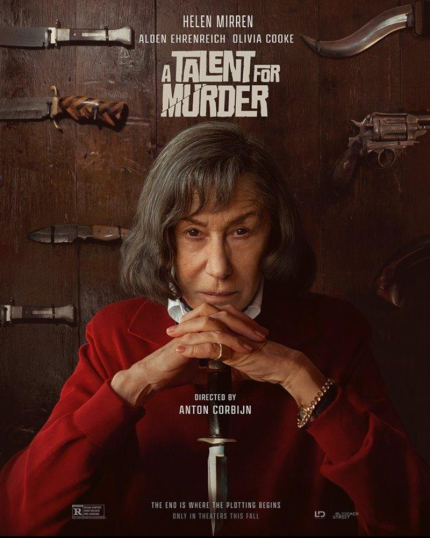
It’s in the early part of 1995 that director Anton Corbijn (A Most Wanted Man, The American, Control) finds the 74-year-old Highsmith (Dame Helen Mirren), in his latest film, A Talent for Murder. She's alone, isolated, and creatively blocked from writing anything else, living in a well-lit, well-appointed chalet in Switzerland. True to her real-world analog, Highsmith drinks and smokes incessantly, occasionally peering over to her neatly arranged writing desk, a blank piece of paper occupying a spotless typewriter.
If the typewriter could talk, it’d ask why it’s been left unused for so long. For Highsmith, that question would be tantamount to an accusation. Thus, she drinks and smokes, embracing her mortality with a brittle bitterness for all she failed to do or, presumably, the personal and professional relationships she left behind, irreparably broken.
The arrival of Edward Ridgeway (Aldren Ehrenreich), a junior editor sent by Highsmith’s NYC-based publisher to convince her to sign a contract for a new Ripley novel, disturbs her carefully calibrated equilibrium. Even as she expresses her distaste for Ridgeway’s unwanted presence in her chalet, she welcomes a verbal sparring partner. Except for Ridgeway’s predecessor, another junior book editor who left Highsmith’s chalet under mysterious circumstances, never to be heard from again, Highsmith doesn’t entertain visitors of any kind.
Initially obsequious to a fault, Ridgeway stumbles through his pitch; he gradually finds his footing, parrying Highsmith’s jibes with some of his own. Despite Corbijn’s best efforts, the long, dialogue-driven scenes double as evidence of A Talent for Murder’s origin as a 2014 stage play written by Australian playwright Joanna Murray-Smith. (Murray-Smith also wrote the screenplay.) Those scenes depend less on Corbijn’s technical abilities as a visually oriented director than on Mirren and Ehrenreich’s skills as actors, imbuing Murray-Smith’s heightened, non-naturalistic dialogue with lived-in plausibility.
As Ridgeway pushes for Highsmith’s signature on the contract, Highsmith pushes back, enlisting his assistance in an imagined Ripley story featuring a cash-poor heiress, Clementine Balfour (Olivia Cooke), her controlling aunt, Peggy (Juliet Stevenson), and, of course, a slick-haired, couture-wearing Ridgeway as the manipulative, sociopathic Ripley. When, however, they reach an impasse, Highsmith tasks Ridgeway-as-Ripley with devising an elegant murder for Aunt Peggy. Devise a solution to Highsmith’s satisfaction, and Ridgeway will leave Highsmith's chalet with a signed contract in hand and a bright future ahead.
Periodically shifting between different in-film realities — Highsmith and Ridgeway’s, along with in-film analogues for Clementine and Peggy, and Ridgeway-as-Ripley — should offer narrative and thematic dividends. That those dividends fail to materialize, or at best, only materialize partially, proves to be the film’s most glaring weakness and ultimately, its most pressing, irresolvable issue: The imagined resolution for Aunt Peggy’s removal runs contrary to Highsmith’s predilection for elegance, symmetry, and surprise. In short, it falls short of anything approaching the real Highsmith’s inventive, twist-heavy plotting, or elegant writing.
Despite their unquestionably best efforts, neither Ehrenreich’s dual performance as Ridgeway and/or Ripley, Mirren’s flawless performance as the bitter, cynical Highsmith, nor the supporting cast can save the film from the screenplay’s lack of an imaginative resolution for either the murder question Highsmith puts to Ridgeway as a condition for the book deal, collapsing in-film realities (a trope to some, a cliché to others), or the absence of dramatic or emotional payoffs in the film's final moments.
A Talent for Murder opens today, only in movie theaters, via Bleecker Street. Please check the official site for local showtimes.

Do you feel this content is inappropriate or infringes upon your rights? Click here to report it, or see our DMCA policy.


