
Karlovy Vary 2026 Review: 3 WEEKS AFTER Turns High-School Cruelty Into Social Horror

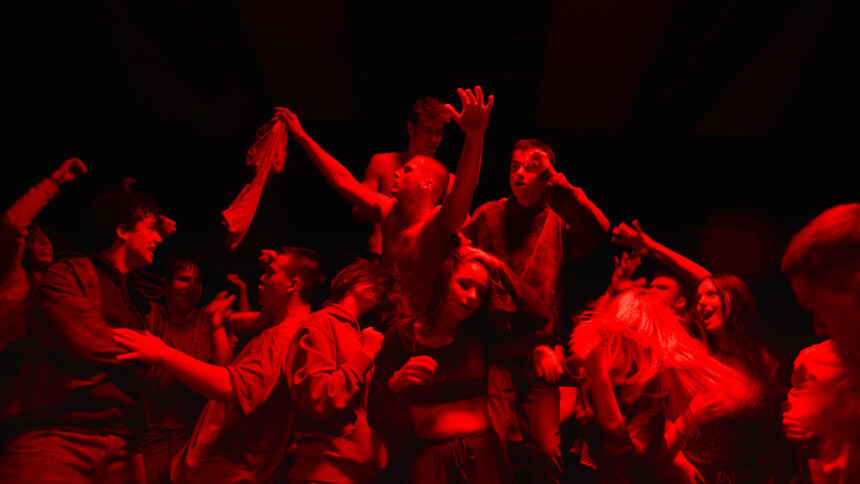
Serbian filmmaker Miroslav Terzić has examined social taboos in his previous works, and 3 Weeks After continues in that vein. In this case, however, he does so with hypnotic formal flair.
(The film won the Europa Cinemas Label at the Karlovy Vary International Film Festival, with the jury praising the authenticity of its ensemble, its attention to adolescent perspectives and the precision of its filmmaking.)
The opening shot of 3 Weeks After is a hypnotic and slightly surreal moment in which Tsotsa (Jovan Ginić) stares at an apartment engulfed in flames before continuing on his way, apparently unperturbed. A long tracking shot, with the fire crackling underneath, emphasizes an as-yet-invisible tension until Tsotsa meets a schoolmate who commends him on his decision to join them.
The conversation continues in an enigmatic manner until it is revealed that they are going on a school trip. Even the teacher, who initially stares at Tsotsa in surprise, says that he is happy he was able to join them.
-thumb-860x484-105770.jpg)
Terzić keeps the flow of information slow, with some of Tsotsa’s peers surprised to see him on board while others remain uninterested. Tsotsa himself appears rather apathetic as the teenagers’ shenanigans begin on the bus.
His presence clearly disrupts the mood of what should be a cheerful and enjoyable outing. Terzić gradually maps the group’s social order, and it becomes clear that Tsotsa is not merely a regular misfit within its dynamics.
The hierarchy is fairly stable: the popular girl, the bully Miloš (Andrija Marković) who dates her, and Daria (Anđela Alavirević), a fellow misfit and Tsotsa’s only ally. He is shunned by nearly the entire group. While some remain indifferent toward him, others react more violently to his presence.
The director, alongside his co-writers Vladimir Arsenijević and Bojan Vuletić, gradually untangles the mystery surrounding the class and explains why Tsotsa is at the center of the ordeal. Terzić takes the familiar topic of bullying and teenage psychological terror a step further through a hypnotic and carefully composed formal approach that exposes the darker recesses of adolescent psychology.
3 Weeks After goes beyond the usual freaks-and-geeks fare of teenage angst and turbulent high-school coming-of-age stories. Its meticulous compositions push the film beyond the conventions of austere social realism into the territory of Hanekenian social horror.
Terzić’s austere yet highly conscious and stylized framing, constructed through fixed tableaux and longer takes, gives Damjan Radovanović’s cinematography an observational quality. The psychological undercurrents, however, remain present in every shot.
By allowing the tension to rise gradually and placing the audience in the position of a bystander, 3 Weeks After offers an Östlundian take on teenage bullying. One of the early shots on the bus brings to mind a particularly prolonged moment of social discomfort from Ruben Östlund’s Involuntary, but Terzić takes that discomfort and reshapes it to darker effect.
-thumb-860x484-105773.jpg)
Terzić is not limited by the boundaries of naturalism. While he prolongs distressing scenes of escalating humiliation and psychological abuse to the point at which averting one’s gaze offers temporary respite, he also takes his mannerism beyond plain and austere observation.
Unafraid to employ almost psychedelic sequences bearing the unmistakable influence of Gaspar Noé, Terzić skews the realism into realism into the realm of psychological expressionism of a collective madness of Climax. This turns 3 Weeks After into a high-school, Gen Z Lord of the Flies, as Tsotsa’s class ends up stranded at a motel in the middle of nowhere. The school’s principal bully asserts his dominance, while the popular girl proves to have as little concern about the humiliating abuse as anyone who is not on its receiving end.
While Terzić takes a familiar topic and enhances it with an absorbing style, 3 Weeks After also offers a timely portrait of ritualized generational indifference, sadism and a shocking lack of empathy. Furthermore, the film touches on the social mechanisms of uncompromising oppression and coercive conformity in young generation while also saving a few discomforting rug pulls to for more memorable viewing experience and engagement.
3 Weeks After
Director(s)
- Miroslav Terzic
Writer(s)
- Vladimir Arsenijevic
- Miroslav Terzic
- Bojan Vuletic
Cast
- Andjela Alavirevic
- Jovan Ginic
- Karaulic Klara



