Karlovy Vary 2026 Interview: A HAPPY FAMILY Director Jan-Eric Mack and Star Anna Schinz on Poverty, Motherhood, Breaking the Rules of Social Drama

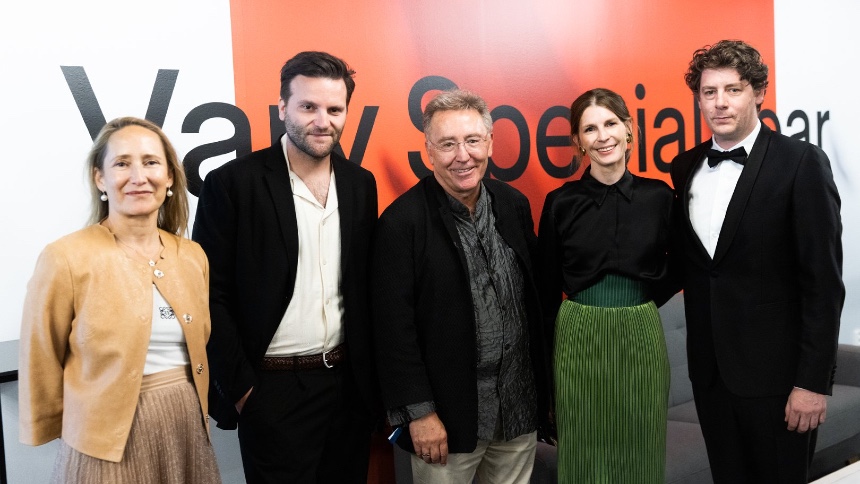
Swiss director and co-writer Jan-Eric Mack and lead actress and co-writer Anna Schinz presented A Happy Family in the Crystal Globe Competition at the 60th Karlovy Vary International Film Festival.
The family thriller follows a mother who loses temporary custody of her children and sets out to find them after they are placed in foster care. Anna Schinz received the Best Actress Award for her performance at the festival.
Screen Anarchy sat down with the pair to discuss the shame surrounding poverty in a wealthy country, their refusal to divide the film’s characters into heroes and villains, and the challenges, and unexpected freedom, of making a thriller with two young first-time actors.
Screen Anarchy: In previous interviews, you mentioned that Switzerland does not care about families, politically speaking.
Jan-Eric Mack: I wouldn’t say that Switzerland does not care, but its family policies are quite conservative. There is not a great deal of financial or social support. In that respect, Switzerland is one of the last countries in Europe, which I find quite surprising.
In Switzerland, having children is considered a very private matter. You are expected to be responsible for it yourself. The majority does not want the state to be involved in providing support.
You did a lot of research for the film, but I assume there was no single true story that inspired it. Did you combine elements from several different cases?
Anna Schinz: It is a fictional story, but we researched the subject extensively. We spoke to many different people, including people working for the authorities, single mothers and members of the working poor.
Gradually, the story developed in our minds, and we wrote it down. We created a kind of microcosm through which we could raise many questions connected to the subject.
When you say “working poor” in Switzerland, I find it difficult to imagine those two terms going together.
Anna Schinz: That was very important to us. Many people, even in Switzerland, hardly know that this exists.
At the moment, around 1.4 million people out of a population of nine million are either affected by poverty or at risk of becoming poor. That is a very high number.
We were surprised by that, and we felt we should talk about it. One particularly important aspect is shame. In such a wealthy country, people are ashamed to admit that they are struggling. You can see it in schools. There are children who do not have the things the other children have, like the T-shirts in the film, without revealing too much. It is a real problem, but nobody talks about it.
To what degree do you see the film as a political act, as opposed to a social one? Do you expect it to bring about any concrete change?
Anna Schinz: Our goal was to encourage people to start talking about the issue and to connect with it emotionally. We tried to approach it from a very humanistic point of view.
It would be a lot to expect one film to change politics, but I hope it can bring people together and at least make the subject part of the conversation. There are also some amazing organizations in Switzerland, such as Caritas, that are deeply engaged with this issue, and are doing everything they can to create change.
Jan-Eric Mack: Maybe the film can make its own small contribution.
Films that are explicitly intended to instigate social change often take a very different form. They may be hard-hitting social dramas, semi-documentaries or activist films. You chose to work more within genre cinema.
Jan-Eric Mack: At a certain point, we simply wanted to tell a story that we liked. It was also important to entertain, to let the audience engage with the characters and become part of their journey.
From a political perspective, it was important to us to reach people beyond our own political spectrum. People who might not initially share our point of view can still become involved through the kind of film we made. At least, that is our hope.
Did you have any particular genre references when you began developing the screenplay?
Jan-Eric Mack: Not really. The genre elements emerged quite naturally from the story. The protagonist changes her identity, and that immediately creates suspense because there is a criminal energy to what she is doing.
At the same time, you understand why she is doing it. We found it interesting to place this character in increasingly difficult situations. I had also directed two series before this film, including the spy thriller Davos 1917, so I had already developed an interest in directing genre material.
Anna Schinz: It was Jan-Eric’s first feature film, and, in a way, a first for all of us. What I remember most is how free the process felt. We were always trying to tell the story from the character’s point of view, and the mixture of genres emerged quite naturally from that.
Jan-Eric Mack: We wanted the freedom to do whatever felt right for the story. The film begins almost like a social drama, so the audience brings certain expectations from other films. We wanted them never to feel completely secure. At any moment, the story could move in another direction. It was risky, but we wanted to take that risk.
Your film has a more mainstream, almost Hollywood-like approach, which is why I keep asking about your influences.
Jan-Eric Mack: I cannot name one specific film. I love many different kinds of cinema.
The films that have probably influenced me most are older ones, particularly Italian neorealism. I love filmmakers such as Fellini, De Sica and Rossellini because they approached difficult subjects from a human perspective. Their films were about dignity. Even when the situation was hard, the films were not only about hardship. There was also hope. That was something I wanted to preserve in this film.
You mentioned neorealism, which seems interesting in term of your film.
Jan-Eric Mack: It is completely different, but of course we do use thriller and genre elements. Those mechanisms work in a particular way to create suspense, and I am interested in using them and understanding how they function. That is probably something we know particularly well from Hollywood cinema.
Directors often say that the most difficult things to work with are animals, children. How do you make a thriller with children? Did you organize a large casting process and extensive rehearsals?
Jan-Eric Mack: We had a huge casting process. We considered around 500 children. First there was an online casting, then live auditions, and finally we brought Anna into the process because it was very important to test the chemistry between her and the children. That is how we found the two young actors, and we were incredibly lucky.
Afterwards, we began a workshop process. Some of the scenes were emotionally difficult, so we needed to introduce the children to their characters gradually and give them time to engage with the subject.
Anna Schinz: One of the most important things was to be completely honest with them. They knew the whole story and understood what was happening. There was no manipulation. They knew that we were going to play these situations together.
The girl was nine and extremely clever. She read the screenplay herself. The boy was six, so his parents explained the story to him, and we also had a coach who prepared him before the shoot.
We had a really good time together. They are from Switzerland, and we are still in contact with them. They were at the premiere yesterday. We have many wonderful memories. That was very important to us because they gave the film so much. The movie is about them, and they are simply wonderful.
Were they professional actors?
Anna Schinz: No, it was the first film for both of them.
Jan-Eric Mack: For me, it was mainly about trust. They had to trust us, and particularly Anna. Once that trust was established, they could let go and simply play with her. Whatever situation they entered, they reacted to Anna. She had the responsibility of carrying them through those situations as both an actress and a character, and that helped enormously.
At the beginning, I tried to direct the girl in the way you sometimes direct children, simplifying things or explaining them differently. But she was too clever. She would always tell me, “I know what you want.” So I stopped doing that and began working with her as I would with a professional actor.
In some countries, strict laws regulate how long children can work. You also have several night scenes. Were the children present for night shoots?
Jan-Eric Mack: No, we shot those scenes during the day and created the night effect afterwards. We filmed in winter, which also helped. Under Swiss law, the children could not work for more than six hours a day. We shot with them for around 18 days, which was quite a lot, but we always had to remain within that six-hour limit.
Was that restrictive for you as a director?
Jan-Eric Mack: Of course it was limiting, but it was also important to protect their energy. It was a long production, and they needed to remain focused over an extended period. If you push children too hard, you are going to have problems anyway. I would not have wanted them to work longer.
Anna, how did you find working with them? Do you have any funny stories?
Anna Schinz: It was very inspiring. The work on this film was unusually intuitive for me. I had spent years writing the screenplay from a very analytical perspective. Then the shoot came closer, and I realized I had to let go of that analytical thinking. I needed to reconnect emotionally with the character and, in a sense, forget everything I knew. It became a process of returning to my intuition.
On the first day, I arrived with some small ideas about how I might react in certain moments. Then I came onto the set and met these children, and it became impossible to plan anything.
That was actually the best possible situation. You react. You listen.
Listening is also one of my main goals as an actor. Children constantly surprise you. As you said, with children and animals, you never know exactly what you are going to get. For me, it was liberating.
Did you rehearse the scenes precisely and then allow more improvisation on set?
Anna Schinz: We rehearsed, but in a playful way. It was important not to plan everything so precisely that the scenes would lose their freshness. The children did have written lines, so there was not a great deal of improvisation. But you never know whether a line will come in exactly the expected way. You simply react and live through the situation together.
Jan-Eric Mack: The boy also broke his leg one week before the shoot.
Really?
Anna Schinz: It was the worst-case scenario. Before that, there had been a skiing holiday. The girl went skiing, and of course she was completely entitled to do that, but we were thinking, “Oh my God, hopefully she doesn’t break her leg.” She returned and everything was fine.
Then, one week before shooting, Jan-Eric received a call saying that the boy had broken his leg.
Jan-Eric Mack: His character was supposed to play football and move around a great deal. At first, we rewrote the story to include a broken leg. Then we realized we might be able to hide it until the football scene.
The doctor told us that it might be possible, but we did not know for certain. In the end, everything went well. When you watch the film now, you would never imagine that he had recently had a broken leg.
Anna Schinz: He is such an energetic child.
The film never fully explains what happened to the protagonist before the story begins, why she is a single mother or how she got into debt. Was that omission intentional?
Jan-Eric Mack: Yes, it was a deliberate decision. You discover small details that may suggest what her story was, but the audience also creates its own version of what might have happened. Each person probably imagines something different, perhaps based on a cliché or a particular judgment.
We wanted to remain focused on the situation she is in and on the experience of poverty. We did not want the film to become a discussion about the absent man, the divorce or some other personal explanation.
Those explanations can quickly lead to ideological judgments. The same is true of addiction. If you say she was addicted, or that she became a mother too young, people can easily decide that she brought the situation upon herself.
We wanted to begin at a very advanced point, when she is already in serious trouble. We do not need to know every detail. The story starts just before the situation reaches boiling point.
You keep the character in a moral grey zone. It is never entirely clear whether the situation is her fault, whether she is a good mother or even how the audience should judge her. Why was that ambiguity important?
Anna Schinz: One of the questions we asked was: What is a good mother? And connected to that: What does somebody need in order to be a good mother? I am a mother myself. Care work is an enormous responsibility.
I am lucky because I have a partner who takes care of the children, but I have met many women who have to do everything alone. Who am I to judge them? Who are we to decide what they should or should not be able to manage?
The grey zone leaves space for every member of the audience to think about these questions. We did not want to moralize or judge. We wanted to open a space in which people could reflect.
Was that intention present from the beginning, or did you consider different versions of the protagonist?
Anna Schinz: The story and the subject both contain a great deal of complexity. They need that complexity. I do not think a black-and-white approach was ever a real possibility for us.
Jan-Eric Mack: The idea of an ambivalent character was there from the very beginning. It gave us the opportunity to present a fuller picture of the situation.
It was also important to show the perspective of the authorities. They find themselves in extremely complex situations and have to make very difficult decisions. During our research, we met many people who genuinely wanted to take care of the families and do what was best for them. But under the law, they are responsible for protecting the children. When a certain kind of situation arises, they have to make a decision, even though they understand how painful it will be for the whole family.
Visually, you also moved away from neorealism. The film has stylized, almost glossy cinematography, with strong colors, deep shadows and imagery reminiscent of action films. It does not look like a conventional social-realist drama.
Jan-Eric Mack: It is interesting that you describe it as glossy. Very early in the process, the cinematographer, Yunus Roy Imer, and I decided that we did not want to use the typical handheld, documentary-style camera associated with social drama. It felt to us as though that visual style could become an effect designed to make the story appear more emotional. We were not interested in that.
We decided to acknowledge that this is a film. It is a constructed story. We even use slow motion, which clearly tells the audience that they are watching a movie rather than a documentary.
Did the cinematographer work from any particular visual references?
Jan-Eric Mack: No, I do not think so.
You are making it sound as though none of you watch films.
Jan-Eric Mack: No, but genuinely, we did not begin with specific references. Roy is a very intuitive cinematographer. He usually develops and questions his images through the screenplay. My own professional background is in graphic design, so the image is extremely important to me. I talk about it a great deal, and I begin to form ideas about how something might look at a very early stage.
But Roy did not create a conventional mood board or carry out that kind of visual-reference research at the beginning, which surprised me. Instead, we found the locations and began making decisions based on the spaces themselves: Where we were, how we wanted to film each place and which images could tell the story in the way we wanted.
We did not look at other films dealing with similar subjects and decide that our film should resemble them. We really did not work that way.
Cover image courtesy of Karlovy Vary Film Festival Servis. Jan-Eric Mack on the right with Anna Schniz next to him.