THE DEATH OF ROBIN HOOD Review: Brutality and Sweetness Battle to Affirm the Importance of Stories
Hugh Jackman, Jodie Comer, Bill Skarsgård, Murray Bartlett, Noah Jupe star in writer/director Michael Sarnoski's new version of a classic character.

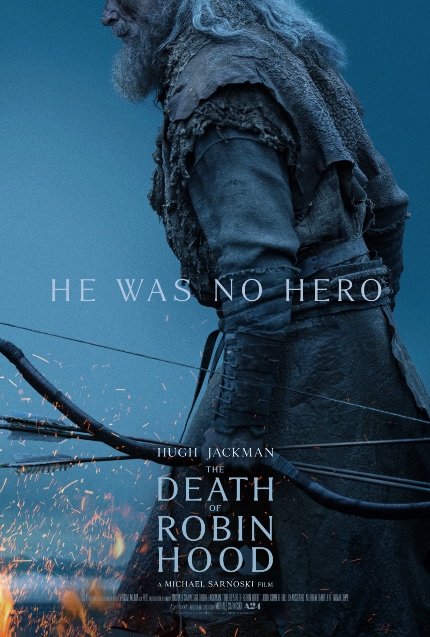
For the first half hour or so of Michael Sarnoski's The Death of Robin Hood, it seems that Sarnoski is doing his absolute best to ensure that the movie brings to mind the term "grimdark," in the most literal sense.
Within the first 15 minutes, two young people (one teen, one tween) and an innocent woman have been brutally murdered on screen, safely ensuring the "grim" portion. Throughout this section it's also often extremely difficult to see, whether it's the daytime doused in fog or the minimally lit night, there's a lot of squinting.
Even during the undeniably epic Lord of the Rings-esque wide shots of Robin Hood (Hugh Jackman) and Little John (Bill Skarsgård) walking the stunning mountains of Northern Ireland, scored fantastically with ominous bowed strings and cavernous drums by first time film scorer Jim Ghedi, it's hard to see through the dense gray fog.
Sometimes the darkness works well though, when cinematographer Pat Scola allows it to add dimension to the images rather than flatten them. An extended action sequence lit only by a burning farmhouse that turns the smoke hanging in the air orange is a highlight.
This scene also shows that Sarnoski can viscerally affect an audience without relying purely on shock. Unbroken shots reveal information through camera moves and pull the audience into the muck with Robin and his foes by placing us firmly within the desperation of the simple, often slow violence. It's nasty, impactful stuff that promises a film full of brutality.
But then the movie changes.
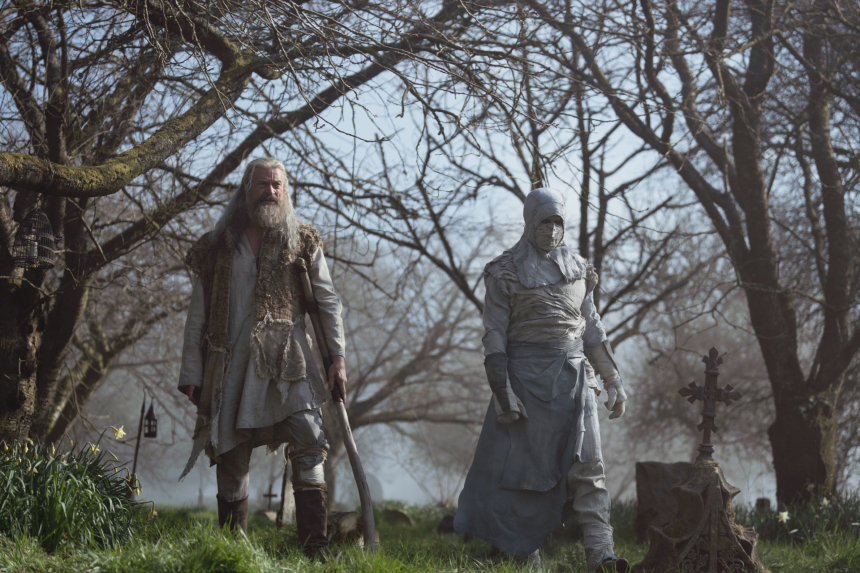
Robin is severely wounded in the battle and brought to a priory on a small island to recover. There he meets Sister Brigid (Jodie Comer) who informs him that this is a place of healing, open to all.
After some brief moments of recovery from the worst of his injuries, he walks out of his room into the gorgeously clear sunlit priory, soaking in the peace of the shimmering blue sea and bright green trees. It's a moment that justifies all the preceding darkness, offering the viewer a sense of relief and escape from the visual gloom and promising a tonal shift.
The tone doesn't just shift into a more melancholic register as Robin reflects on leaving his life of violence behind, though. There's also surprising humor in his masculine discomfort and initial refusal to harvest fruits rather than hunt game at the request of Sister Brigid and the leper (Murray Bartlett) she took in, who now assists her in the operation of the priory. An almost shocking sweetness joins the humor when Little Margaret (Faith Delaney), a young girl who knows Robin from his previous life, arrives at the refuge in the wake of violence.
Her trauma leads Margaret to refuse to eat or sleep, and we see Robin coax her into both by acting as protector and cheeky role model. A moment where Robin and Brigid eat in front of the girl, agreeing that the food is good, and Robin asks Margaret if she's not hungry, moving to take her portion to motivate her to claim it, is downright adorable.
From here the film stumbles. It seems unsure of how to progress, both narratively and thematically. Without spoiling things, suffice to say there appear to be two clear paths forward, and the movie opts for a third, arguably inevitable (it is very loosely based on the folk ballad/poem "Robin Hood's Death"), unexpected option.
Subverting expectations can, of course, serve films well. It serves The Death of Robin Hood well in its initial tonal shift, but the finale feels less like an interesting subversion and more like an abrupt adjustment to reach the required ending. It simultaneously underlines and undercuts the redemption arc by laying things on a bit too thick.
It similarly adds an exclamation point to the film's consideration of the power of stories, which somehow avoids feeling too on the nose, perhaps by virtue of cinema's long history of explicit interrogation of myths/tales/legends and so forth. In the first scene, Robin speaks with a teenager about his legend and immediately establishes that this ain't your daddy's Robin Hood; he says the tales are "lies upon lies" and that "people saw meaning where there was none."
When he speaks with Little John early in the film about a detail John can't remember from an experience decades ago, Robin says that they never lived it, they just picked up the story and made it their own. During a conversation with Brigid later on, he argues that stories have the power to make people do terrible things and that we cannot be trusted with them.
Of course, in its final moments, the film reaffirms that this power can and must be used for good, both for comfort and as motivation for the next generations to do better than the ones before. But the acknowledgment of their terrible power lends the film a layer that (while not wholly original) makes it more intriguing than most movies we see question their own importance as narratives.
The film opens Friday, June 19, only in movie theaters, via A24 Films.