Tribeca 2026 Review: In DEATH BOOM, Eli Roth Narrates a Brutally Honest, If Not Brutal, Exposé of the Funeral Industry
Director Jessica Chandler's documentary makes "viewers think seriously about a subject most would prefer to avoid."

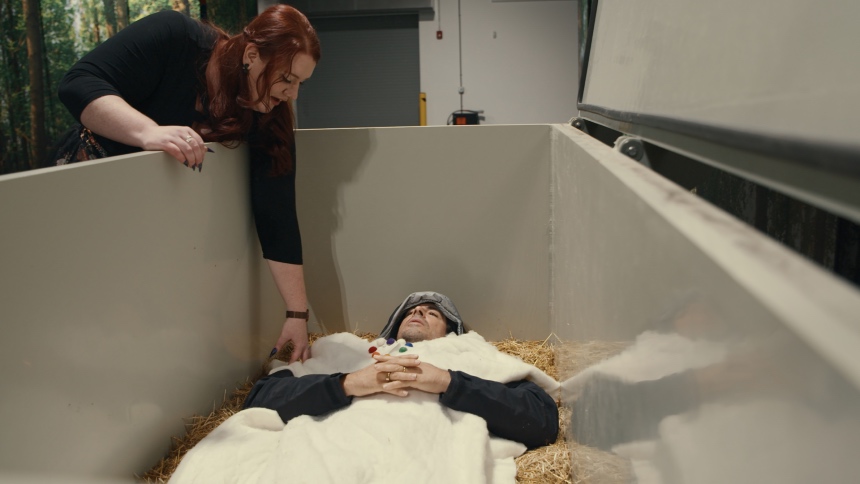
It's not every day that a documentary turns up in a film festival's genre sidebar, but Jessica Chandler's Death Boom earned its place in Tribeca Festival's midnight-adjacent Escape From Tribeca program.
Narrated and coproduced by Eli Roth, whose name has become synonymous with cinematic mutilation, the film is a thorough and frequently illuminating survey of the largely unregulated billion-dollar death-care industry, encompassing funerals, embalming, cremation, burials, and more. Chandler's camera lingers on corpses being prepared for open-casket viewings or left to decompose naturally, while Roth's narration is punctuated by montages of grisly scenes from horror movies, as if the nonfiction footage alone might not be unsettling enough.
The film's central argument is that neither of America's dominant methods of handling the dead is particularly sustainable. Embalming, which has become almost part and parcel of modern funeral arrangements, relies on chemicals such as formaldehyde that are flushed into the environment alongside bodily fluids extracted from the deceased--to the tune of hundreds of thousands of gallons annually.
Traditional burial poses practical challenges as well. Cemetery space is increasingly scarce, while burial plots can cost anywhere from $13,000 to $1 million, according to the film. Cremation, which now accounts for roughly 60 percent of dispositions, fares little better environmentally, generating air pollutants and burning enough fuel for a 609-mile drive.
Chandler also explores a range of lesser-known alternatives. Donating one's body for medical research or training emerges as perhaps the most practical option, not least because it is free. Other possibilities include green burial, conservation burial, natural decomposition, and newer technologies such as alkaline hydrolysis. Yet many of these methods remain unavailable in large portions of the country, as industry groups and religious organizations--including the Catholic Church--exert influence to preserve more established and profitable practices.
Death Boom is informative and often useful, particularly for viewers confronting decisions they would rather postpone indefinitely. Despite its Escape From Tribeca branding and Roth's involvement, the film is less a shocker than it is a consumer guide, a sober examination of an industry most people encounter only in moments of grief.
Roth, meanwhile, turns out to be the documentary's least sensational element. Best known for directing elaborate displays of cinematic carnage, he serves here as a measured and reassuring authority through an uncomfortable subject. If anything, the horror montages sometimes feel out of place, providing jolts of exploitation-movie energy in a documentary whose real strengths lie in reporting, interviews, and practical information.
That tension points to a larger uncertainty about what kind of film Chandler has made. Death Boom is at its most compelling when exposing the economics of death care and the environmental costs hidden beneath familiar funeral customs. It excels at revealing how many supposedly traditional practices are relatively recent inventions sustained by commercial interests. The notion that embalming, expensive caskets, and conventional burial represent the natural or respectful way to treat the dead begins to look less like timeless wisdom and more like a successful marketing campaign.
Yet there is a curious mismatch between the film's packaging and its actual interests. The titular death boom--the wave of aging baby boomers said to be straining funeral infrastructure--often feels like the documentary's hook rather than its actual subject. The demographic argument arrives with the awkwardness of a thesis added after the reporting was already complete.
Chandler keeps insisting that her film is about a looming population crisis, though its real fascination lies with the machinery that processes the dead. The result is a work that repeatedly discovers a more interesting story than the one it set out to tell.
The same narrowness limits the film's perspective. Chandler approaches death primarily as an American logistical problem: how to dispose of millions of bodies without exhausting available land, poisoning the environment, or bankrupting surviving family members. Yet funerary practices are expressions of culture and belief as much as efficiency.
The question is not simply what works, but what societies owe their dead and what rituals help the living make sense of loss. While the film briefly invokes Japan and India as examples of population pressure, it shows little curiosity about the traditions and systems those societies have developed in response.
The omission leaves Death Boom feeling oddly provincial. A documentary devoted to alternative ways of handling death spends surprisingly little time investigating whether some of the most instructive answers may already exist elsewhere in the world.
Even so, Chandler has produced a film that succeeds in making viewers think seriously about a subject most would prefer to avoid. If Death Boom ultimately falls short of its larger ambitions, it is because its most persuasive insights are practical rather than prophetic. The documentary warns of an impending demographic wave, but its lasting value lies in revealing how much of the funeral industry has been hidden in plain sight all along.
The film enjoyed it world premiere at the 2026 Tribeca Festival. Visit the film's page at the festival's official site for more information.